
Understanding suffixes Worksheets for Ages 3-6
4 filtered results
Difficulty Level
Grade
Age
-
From - To
Subject
Activity
Standards
Discover our engaging "Understanding Suffixes Worksheets for Ages 3-6" designed to enhance your child's vocabulary and reading skills! These thoughtfully crafted worksheets help young learners grasp the concept of suffixes through fun, colorful activities that make learning interactive. Each printable focuses on simple, commonly used suffixes, aiding in the development of word recognition and comprehension. Ideal for both preschool and kindergarten levels, these exercises foster early literacy by providing a solid foundation in word formation. Unlock your child's potential and boost their confidence with our effective, age-appropriate suffix worksheets!
Favorites
With answer key
Interactive
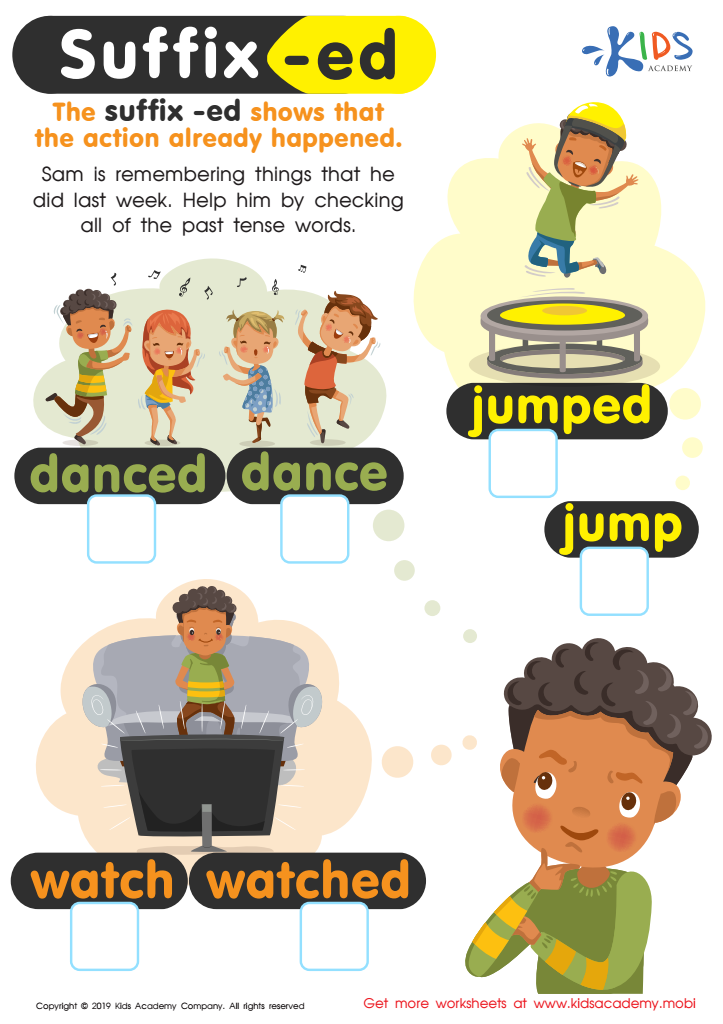
Suffix-ed Worksheet
Ask your kids if they know what suffixes are, and explain they are words added to the end of another word which changes the meaning. This worksheet focuses on the suffix -ed which shows something already happened. Help the kid in the picture find the past tense words.
 Assign to My Students
Suffix-ed Worksheet
Worksheet
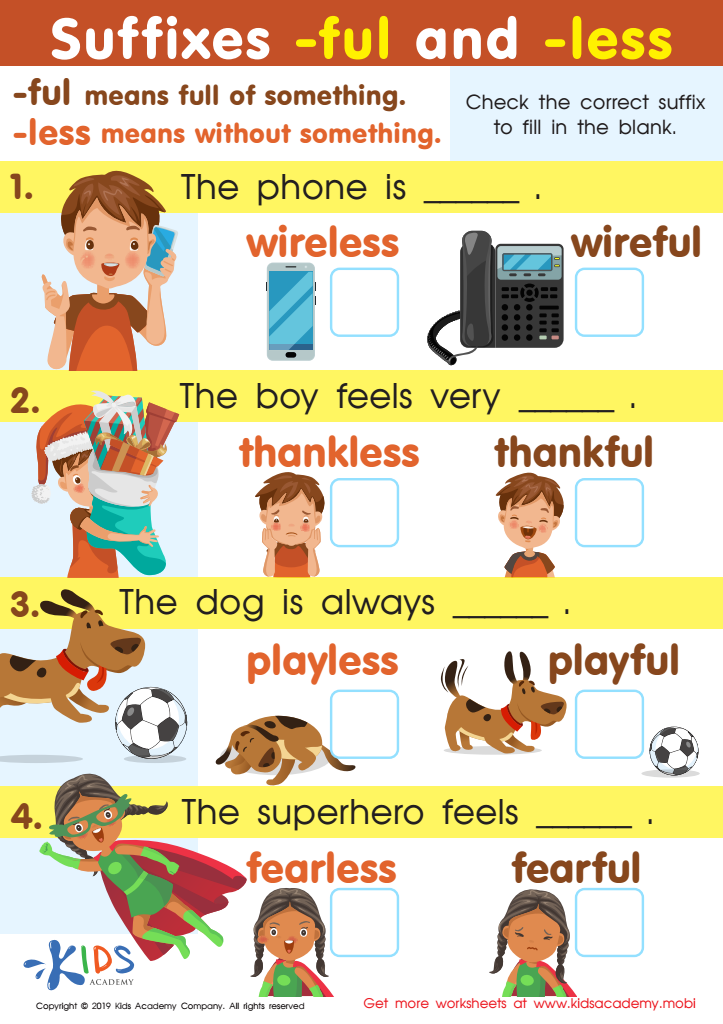
Suffixes –ful and –less Worksheet
Before you start this worksheet, make sure your kids know about suffixes. Explain that they're added to the end of words to change their meaning. In the worksheet, kids will learn about the suffixes –ful and –less. Look at the sentences in the picture with them, and help them to choose the right one for each blank.
Suffixes –ful and –less Worksheet
Worksheet
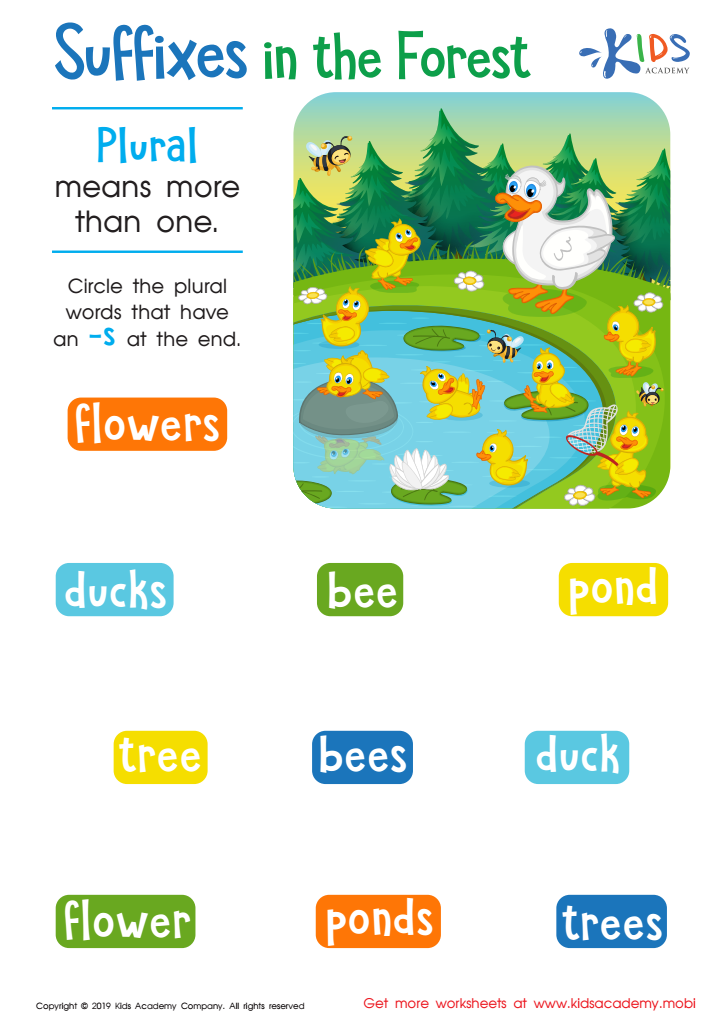
Suffixes in the Forest Worksheet
Suffixes are letters added to the end of words to form new words. These can be used to denote one who does something (e.g. reader) or more than one (e.g. adding -s). This worksheet helps kids practice pluralizing words they know by circling the plural words ending with -s.
Suffixes in the Forest Worksheet
Worksheet
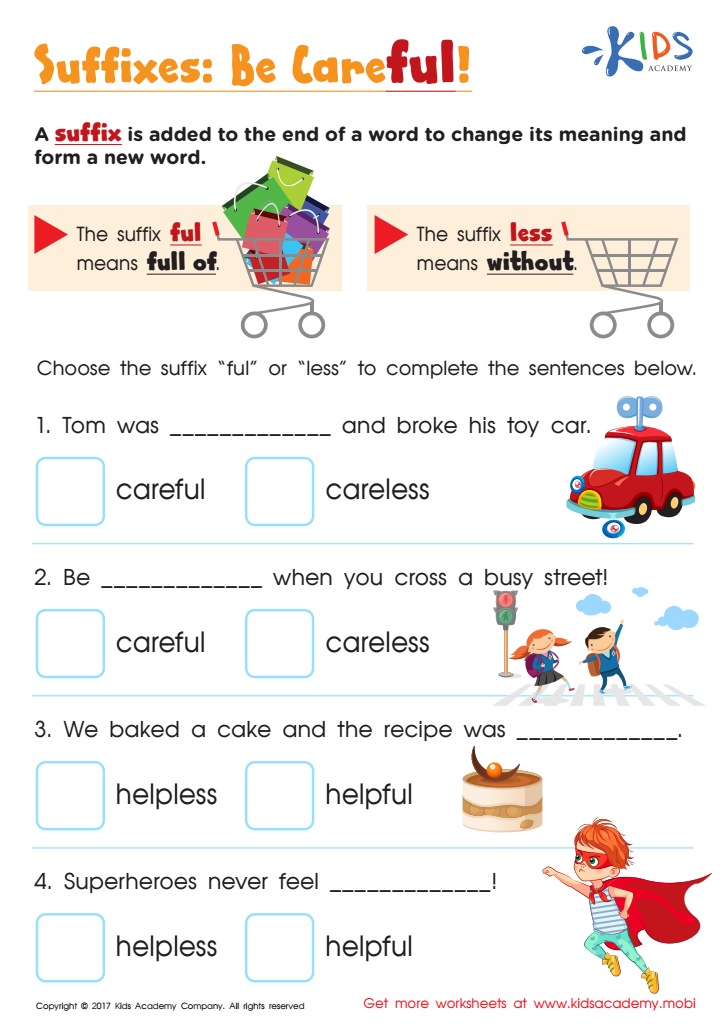
Suffixes Ful and Less Worksheet
Uh oh! Careful and careless might look similar, but have very different meanings. To avoid mix-ups, learn to spot and use the right suffixes. Use this suffixes ful and less worksheet to help your child master common suffixes!
Suffixes Ful and Less Worksheet
Worksheet
Join Kids Academy for Free
Who is primarily going to use this learning content?








Understanding suffixes is crucial for young learners aged 3-6 because it lays the foundation for their language and literacy development. Suffixes, the letters or groups of letters added to the end of words, can alter meanings, tenses, or parts of speech. For instance, adding “-ing” to “play” turns it into “playing,” changing the tense and implying an ongoing action.
For parents and teachers, teaching suffixes at an early age aids vocabulary expansion. Children begin to recognize patterns within words, which increases their ability to decode new words — a critical reading skill. Awareness of suffixes also supports spelling skills, helping children understand why words take certain forms, like why the “-ed” in "jumped" indicates past tense.
Moreover, suffixes help in comprehension and communication. Children who understand that adding “-er” to a verb like “teach” creates a noun like “teacher” can express more complex ideas and understand more detailed texts. This early grasp of suffix concepts fosters confidence in both written and spoken language.
In summary, teaching suffixes to young children enhances their linguistic abilities, promoting better reading, spelling, and comprehension skills, forming a vital part of early educational development.








