
Mathematical reasoning Addition Worksheets for Ages 3-6
6 filtered results
Difficulty Level
Grade
Age
-
From - To
Subject
Activity
Standards
Enhance your child's mathematical reasoning skills with our engaging Addition Worksheets designed for ages 3-6. These worksheets offer a fun and interactive approach to learning basic addition concepts, helping young learners build a solid foundation in math. Our carefully crafted activities encourage critical thinking, problem-solving, and number recognition while promoting early numeracy skills. Each worksheet features colorful graphics and age-appropriate challenges to keep children motivated and excited about learning. Ideal for both home and classroom use, these addition worksheets provide the perfect opportunity for parents and educators to foster a love for math in early childhood. Start making math fun today!
Favorites
With answer key
Interactive
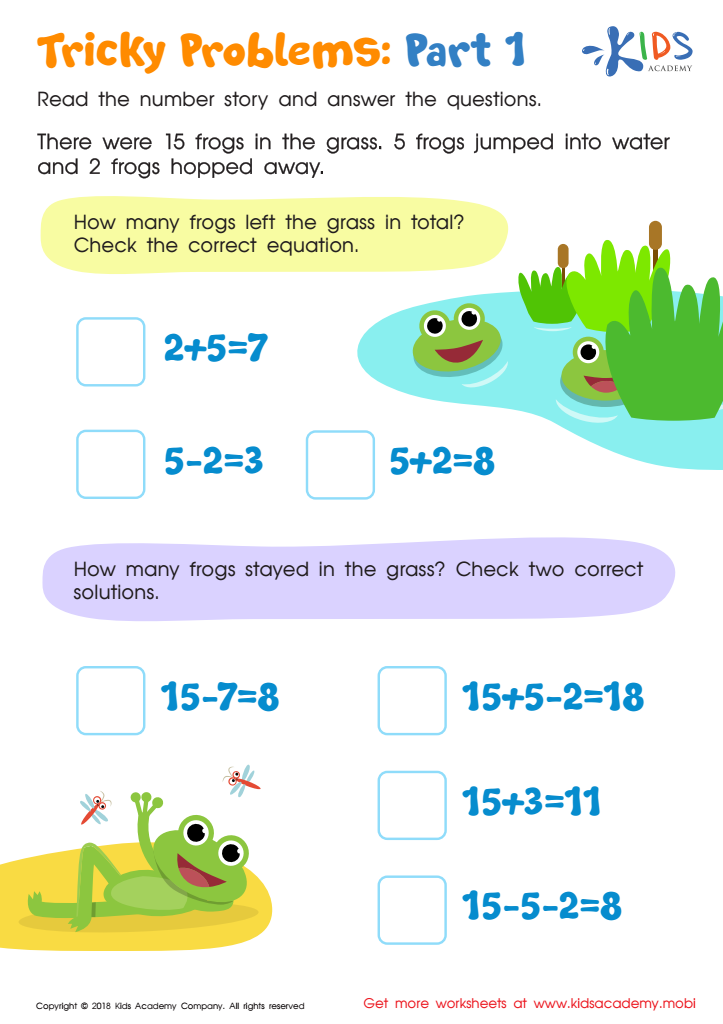
Tricky Problems Worksheet: Part 1
Visualizing word problems can help students solve them. This fun PDF worksheet encourages students to create mental images using math facts, then check boxes to match the equations for basic addition problems. It's a great way to build confidence in solving math.
 Assign to My Students
Tricky Problems Worksheet: Part 1
Worksheet
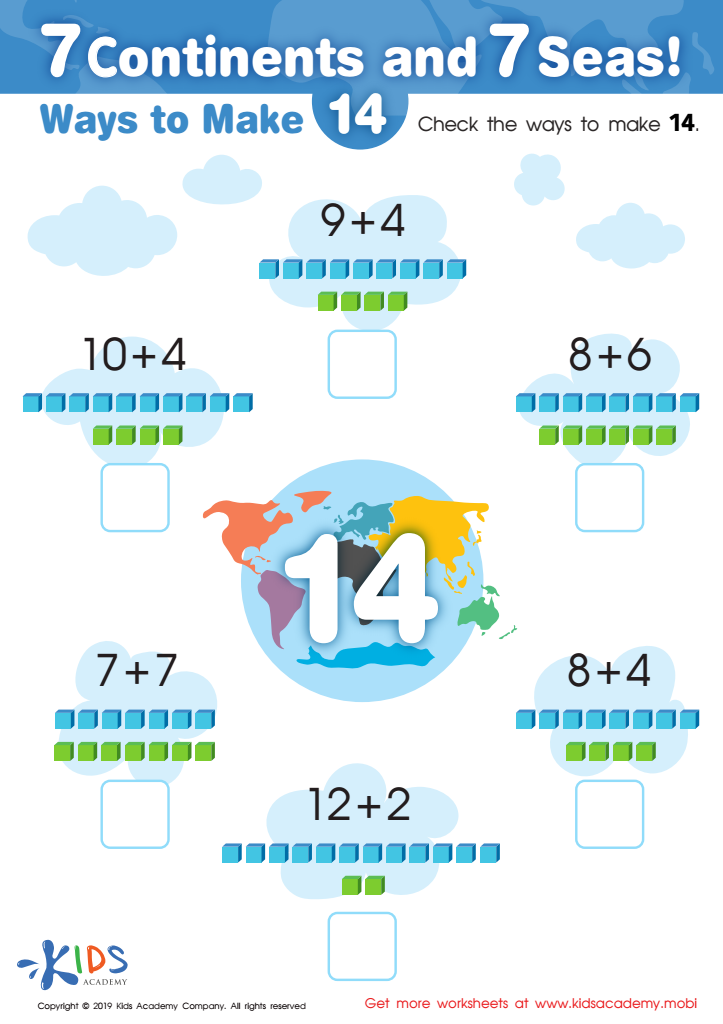
7 Continents and 7 Seas Worksheet
Remind kids of the continents and show them how different numbers can add up to the same figure. Give examples, like 2+2 =4, and 3+1 =4. Ask if they can provide other examples, then work through the simple additions in this worksheet with them. Ask them to circle all equations that make 14.
7 Continents and 7 Seas Worksheet
Worksheet
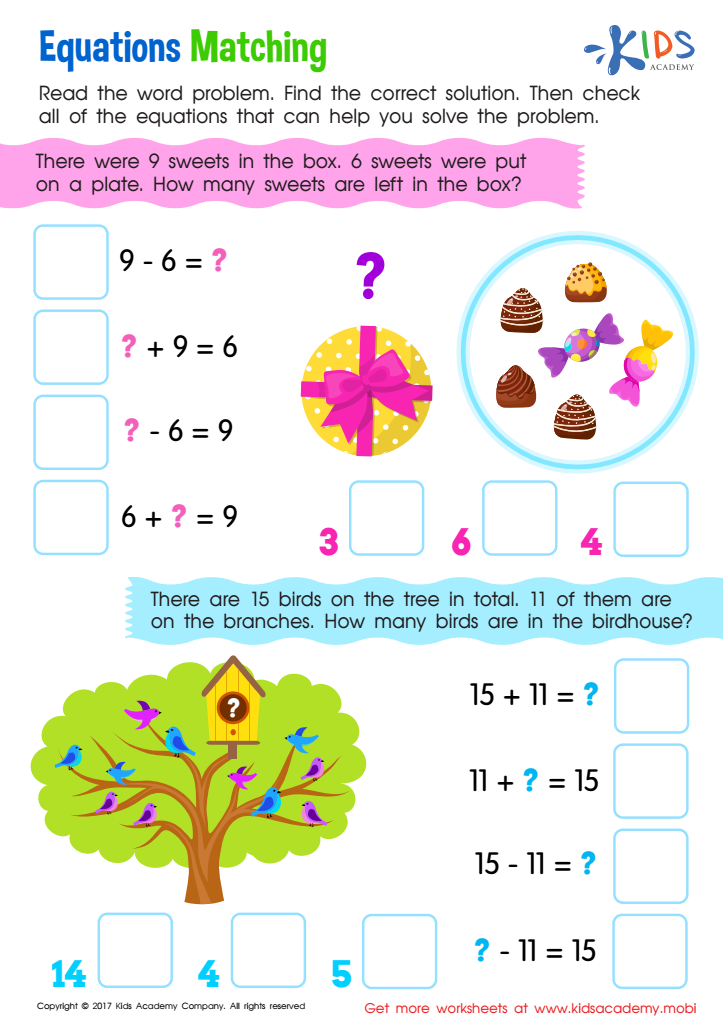
Equations Matching Word Problems Worksheet
Download this worksheet and give your young mathematician practice in solving equations using matching numbers and number family facts. They'll solve word problems, develop critical thinking and algebraic reasoning, and gain success with addition and subtraction.
Equations Matching Word Problems Worksheet
Worksheet
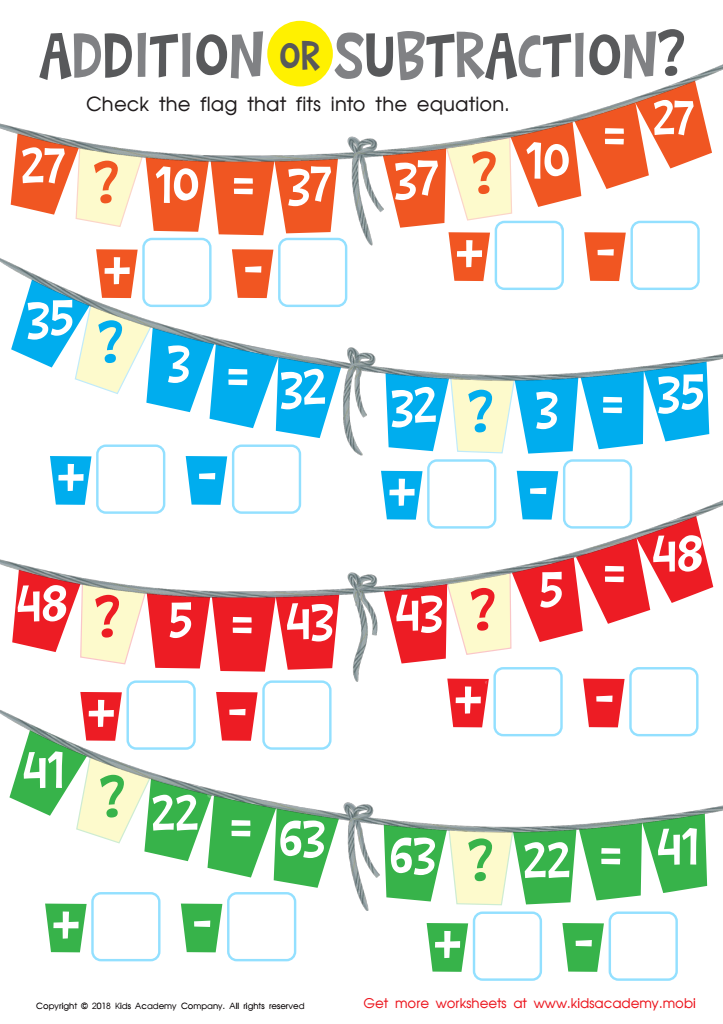
Addition or Subtraction? Worksheet
Help your math whiz's number skills advance with these colorful flag equations! With the free PDF, they'll learn to solve addition and subtraction facts by following the correct orders of operation. And the best part? They'll develop a deeper understanding of how the different operations work together within equations. Give it a try and watch their skills soar!
Addition or Subtraction? Worksheet
Worksheet
Join Kids Academy for Free
Who is primarily going to use this learning content?








Mathematical reasoning, particularly in addition, is crucial for children aged 3-6, laying the foundation for their future academic success. This early stage of development is characterized by rapid cognitive growth, where children begin to explore and comprehend numbers, quantities, and relationships. Understanding addition fosters critical thinking and problem-solving skills, enabling young learners to make connections between concepts.
When parents and teachers prioritize mathematical reasoning in addition, they provide children with practical strategies to develop number sense. Engaging in activities that promote addition—such as counting objects, playing number games, or using visual aids—helps children grasp the idea of combining quantities, setting the stage for more complex operations later on.
Moreover, early mathematical reasoning enhances confidence and encourages a positive attitude toward math, reducing anxiety around the subject as they progress in their education. It also promotes collaborative learning, as children often work in groups to solve problems or share strategies, fostering communication skills.
Ultimately, instilling strong mathematical reasoning in addition equips young learners with essential skills for everyday life and nurtures a lifelong love for learning. This foundational knowledge not only benefits academic achievement but also supports overall cognitive and emotional development.








