
Fine motor skills (tracing) Worksheets for Ages 3-8
3 filtered results
Difficulty Level
Grade
Age
-
From - To
Subject
Activity
Standards
Enhance your child's fine motor skills with our engaging tracing worksheets, specially designed for ages 3-8. These fun and interactive activities help young learners develop precision and control as they trace various shapes, letters, and images. Ideal for preschool and early elementary students, our worksheets not only promote hand-eye coordination but also foster confidence and creativity. Each worksheet aligns with early learning standards, making them perfect for at-home or classroom use. Download these printable resources today and watch your little ones thrive as they practice their tracing skills while enjoying their learning journey! Tailored for growth, these worksheets make learning enjoyable!
Favorites
With answer key
Interactive

The Night Sky: Leo Worksheet
Let your kids explore the wonders of the stars with this fun worksheet! They'll connect the dots to create the constellation Leo. Night gazing instruments, a telescope or this printout can help your kids learn about constellations and horoscopes. Download the worksheet and let the star watching begin!
 Assign to My Students
The Night Sky: Leo Worksheet
Worksheet
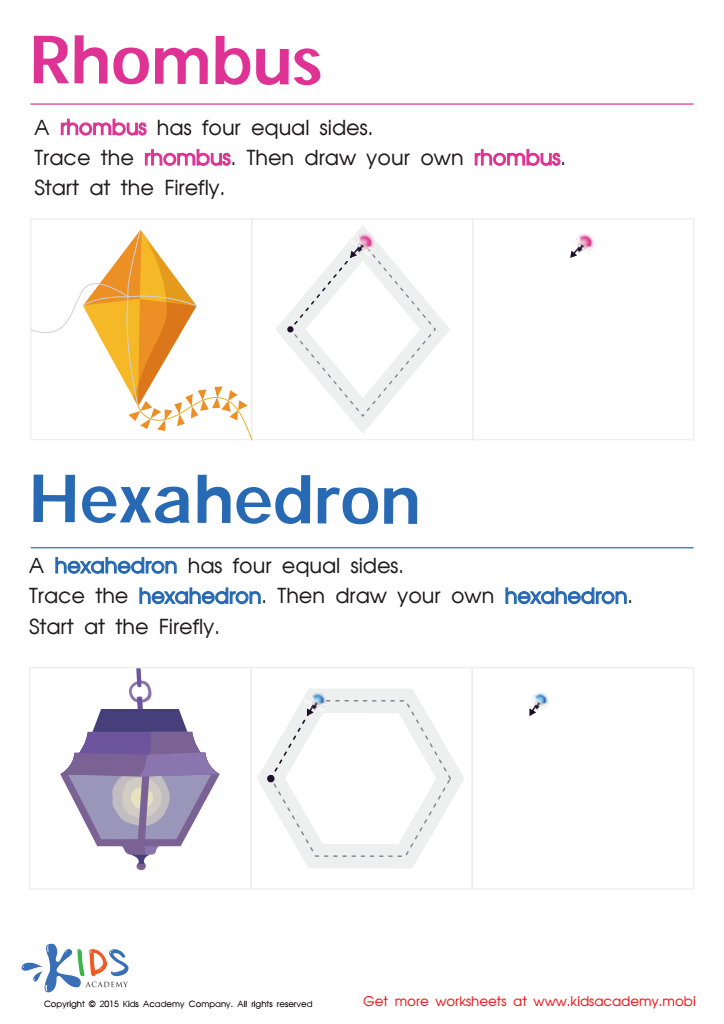
Draw a Rhombus And a Hexahedron Printable
Trace, draw and recognize shapes like rhombus, hexahedron and more! Start with the firefly to trace a rhombus, then use the yellow kite to remember the shape. Use the light to trace and draw a hexahedron. Learn with the best!
Draw a Rhombus And a Hexahedron Printable
Worksheet
Join Kids Academy for Free
Who is primarily going to use this learning content?








Fine motor skills are essential for children's overall development, particularly for ages 3-8, as they form the foundation for various academic and everyday tasks. Tracing activities, which involve precise control of hand movements, greatly enhance these skills. First, fine motor skills help children develop the hand-eye coordination necessary for writing, drawing, and eventually typing.
As kids engage in tracing, they improve their dexterity and strengthen the small muscles in their hands and fingers. This physical control is vital for tasks such as buttoning clothing, using utensils, and crafting—activities pivotal for independence and self-care.
Moreover, tracing helps with cognitive development. It encourages focus, patience, and problem-solving, as children learn to navigate shapes and letters. This activity primes them for future learning experiences in reading and writing. Furthermore, fine motor skills are often linked to academic achievement; children proficient in these skills generally find themselves more confident in school settings.
Finally, tracing offers an enjoyable way for parents and teachers to connect with children. Engaging in these activities fosters a supportive learning environment, making education a fun and collaborative journey, which is fundamental in nurturing a love for learning.








