
Prefix understanding Worksheets for Ages 3-8
3 filtered results
Difficulty Level
Grade
Age
-
From - To
Subject
Activity
Standards
Explore engaging "Prefix Understanding Worksheets" designed for ages 3-8 at Kids Academy. Our carefully crafted worksheets help young learners to grasp the fundamental concept of prefixes, enhancing their vocabulary and reading skills. With fun and interactive exercises, children can learn to identify and use common prefixes, laying a solid foundation for advanced language skills. Ideal for both classroom and home use, these worksheets make learning enjoyable and effective. Give your child a head start on their educational journey by downloading our free printable worksheets today. Nurture their curiosity and watch their love for words grow!
Favorites
With answer key
Interactive
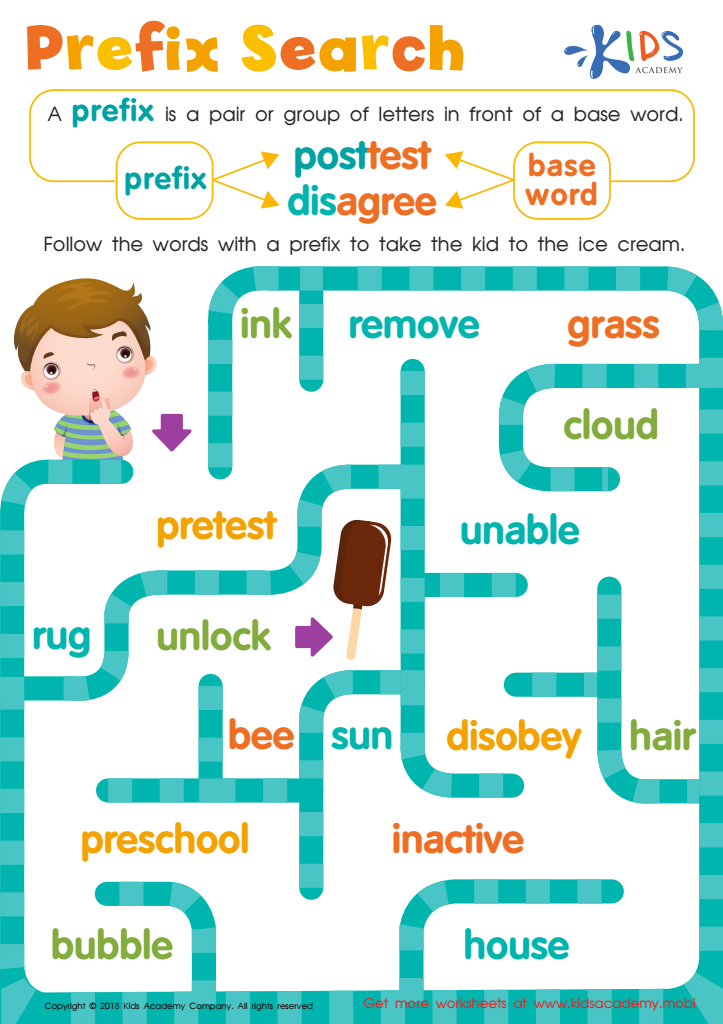
Reading: Prefix Search Worksheet
Maze your way through prefixes! This worksheet helps students practice reading new words with a prefix and figuring out the base word. An understanding of prefixes gives students the skills to comprehend new words. A fun and useful activity for the reading classroom!
 Assign to My Students
Reading: Prefix Search Worksheet
Worksheet
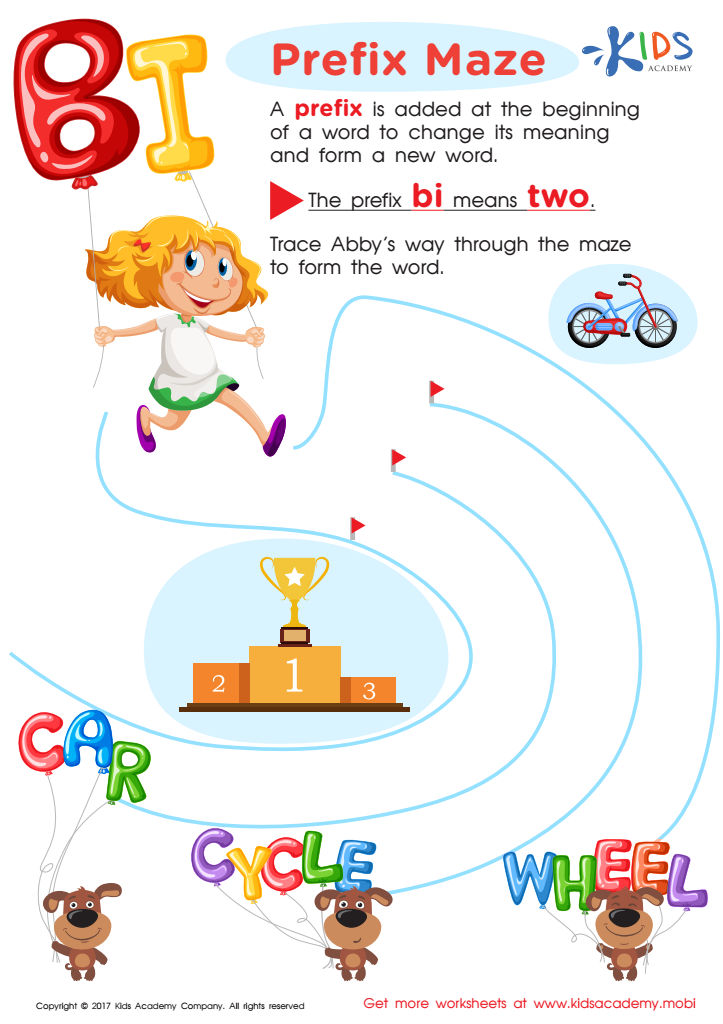
Prefix Bi Words Worksheet
Help "bi" find its root word in this fun and colorful prefix worksheet! Your child will learn how words are built while having a great time!
Prefix Bi Words Worksheet
Worksheet
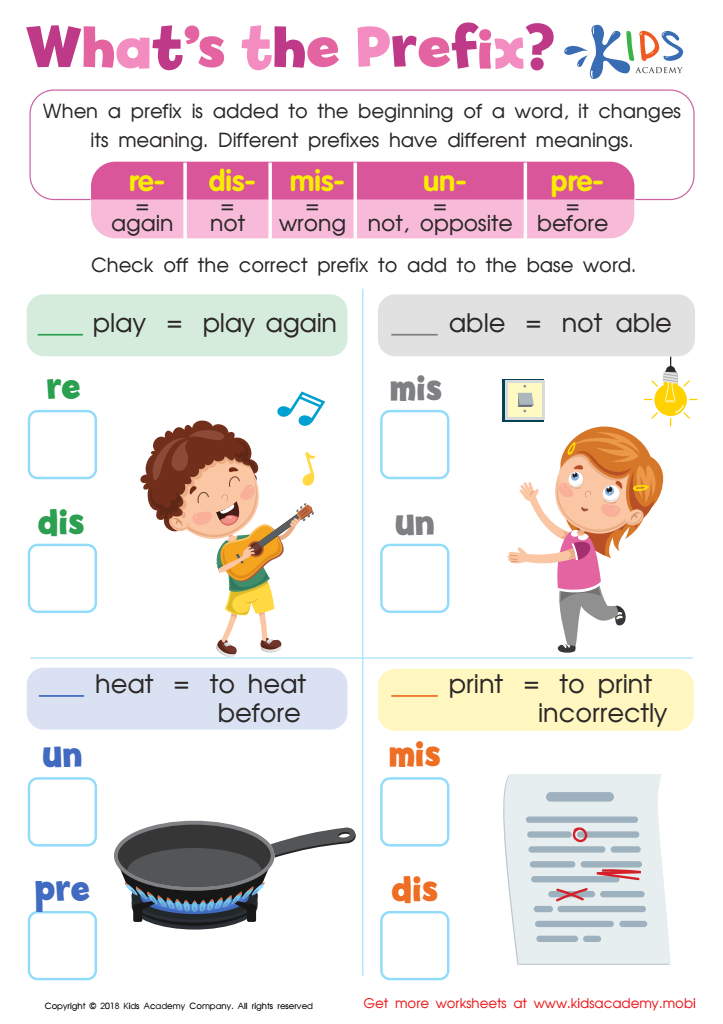
Reading: What Is the Prefix Worksheet
This worksheet helps children learn about prefixes by matching pictures and base words with the correct prefix. Learning these prefixes and their meanings is essential for reading and vocabulary comprehension. Use this free download to check your students' understanding.
Reading: What Is the Prefix Worksheet
Worksheet
Join Kids Academy for Free
Who is primarily going to use this learning content?






Understanding prefixes is crucial for children aged 3-8 because it lays a strong foundation for reading and language development. For young learners, vocabulary acquisition and comprehension are essential stepping stones to becoming proficient readers and effective communicators. Introduce prefixes at an early age to help children recognize patterns in words, making it easier for them to decode new terms and understand their meanings.
Prefixes, the building blocks attached to the beginning of root words, imbue students with the skill to discern word meanings without always seeking adult help, fostering independence. As children recognize familiar prefixes like "un-" meaning "not" or "re-" implying "again," they can extrapolate this knowledge to deciphering unfamiliar words, thereby boosting their confidence and curiosity.
Moreover, a solid grasp of prefixes aids in expanding a child's vocabulary and supports them in logic and critical thinking. For example, understanding that "pre-" means "before" helps them grasp that "preview" implies seeing something before others do. This foundational knowledge extends into other academic areas as well, such as math and science, where specific prefixes have particular meanings.
Fundamentally, parents and teachers nurturing an early mastery of prefixes empower young minds with invaluable tools for lifelong learning and literacy, contributing significantly to their academic success and overall cognitive development.








