Understanding Quantities Worksheets for Ages 3-8 - Page 3
53 filtered results
-
From - To
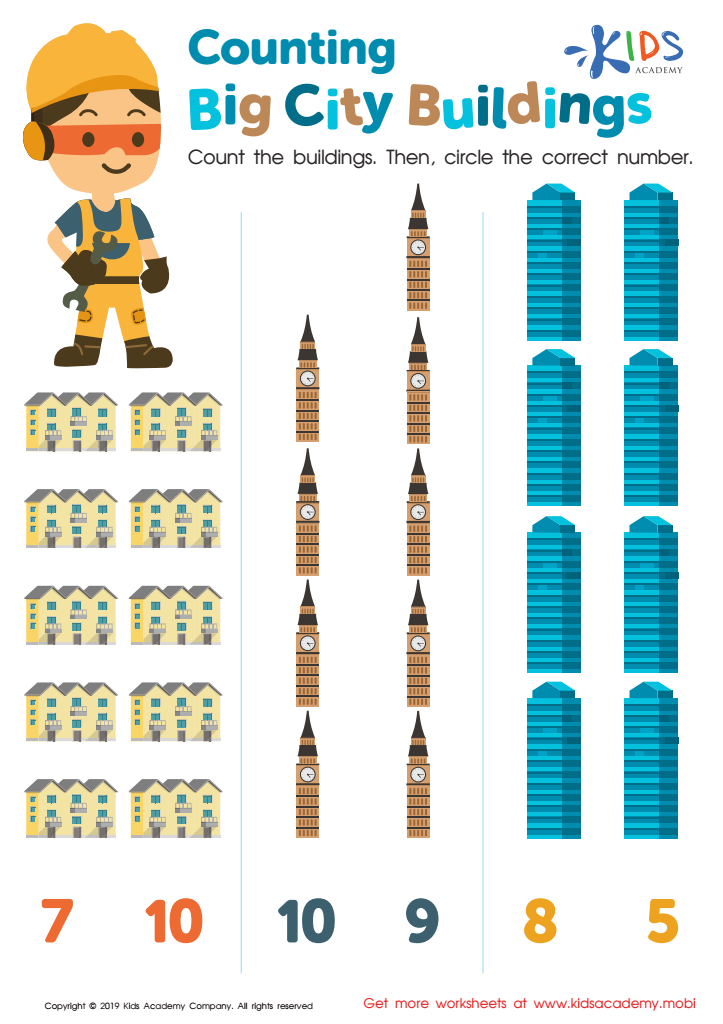
Counting Big City Buildings Worksheet
 Assign to My Students







Understanding quantities is a fundamental skill that supports a child's overall cognitive development and builds a strong foundation for more complex mathematical concepts. For children aged 3 to 8, developing a sense of quantity helps them grasp ideas of size, number, and measurement which are essential for problem-solving and logical reasoning.
Early exposure to quantity understanding fosters number sense—the ability to recognize, compare, and manipulate numbers. This paves the way for arithmetic skills like addition and subtraction. When children comprehend quantities, they make meaningful connections between numerals and actual amounts, which can make learning math more intuitive and less abstract. For example, recognizing that the numeral "3" corresponds to three objects helps bridge the gap between concrete and abstract thinking.
Moreover, a solid grasp of quantities extends beyond math. It encourages precision and careful observation, skills vital in science and daily life. Activities like counting steps, comparing toy sizes, or sharing snacks equally allow children to apply quantity concepts practically. Understanding quantities also contributes to language development, offering children vocabulary to describe the world around them (more, less, equal).
For parents and teachers, nurturing this early mathematical awareness can significantly impact a child's educational journey. It cultivates confidence, enthusiasm for learning, and an aptitude for tackling more complex subjects, ultimately contributing to well-rounded development.








