
Visual fraction representation Worksheets for Ages 3-8
3 filtered results
Difficulty Level
Grade
Age
-
From - To
Subject
Activity
Standards
Explore our engaging Visual Fraction Representation Worksheets designed for children ages 3-8! These worksheets help young learners grasp the concept of fractions through colorful visuals and interactive activities. By using shapes, icons, and real-life examples, kids can easily understand and visualize parts of a whole. Each worksheet is tailored to varying skill levels, ensuring a fun and educational experience for every child. Perfect for home or classroom use, our resources support early math development while making learning about fractions captivating and enjoyable. Start nurturing your child’s mathematical skills today with our comprehensive and creative fraction representation worksheets!
Favorites
With answer key
Interactive
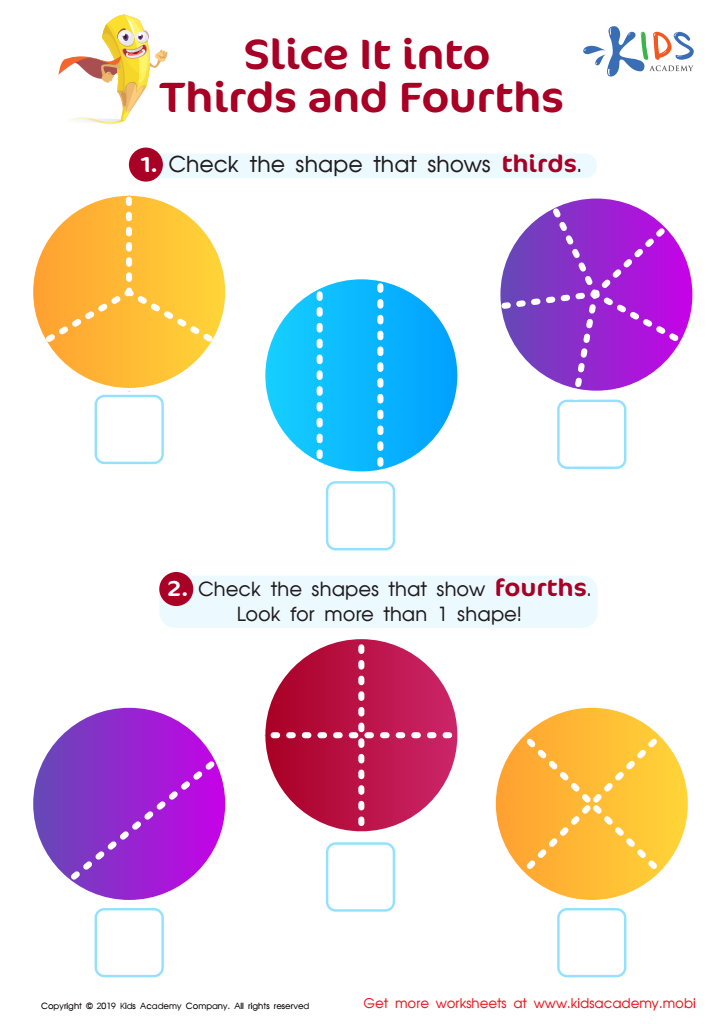
Slice in Thirds Fourths Worksheet
This worksheet helps kids learn fractions visually by dividing circles into thirds and fourths. They will learn that fractions must be equal parts, not just sets, by choosing the right colorful circles. It's an easy way to master fractions and have fun doing it!
 Assign to My Students
Slice in Thirds Fourths Worksheet
Worksheet
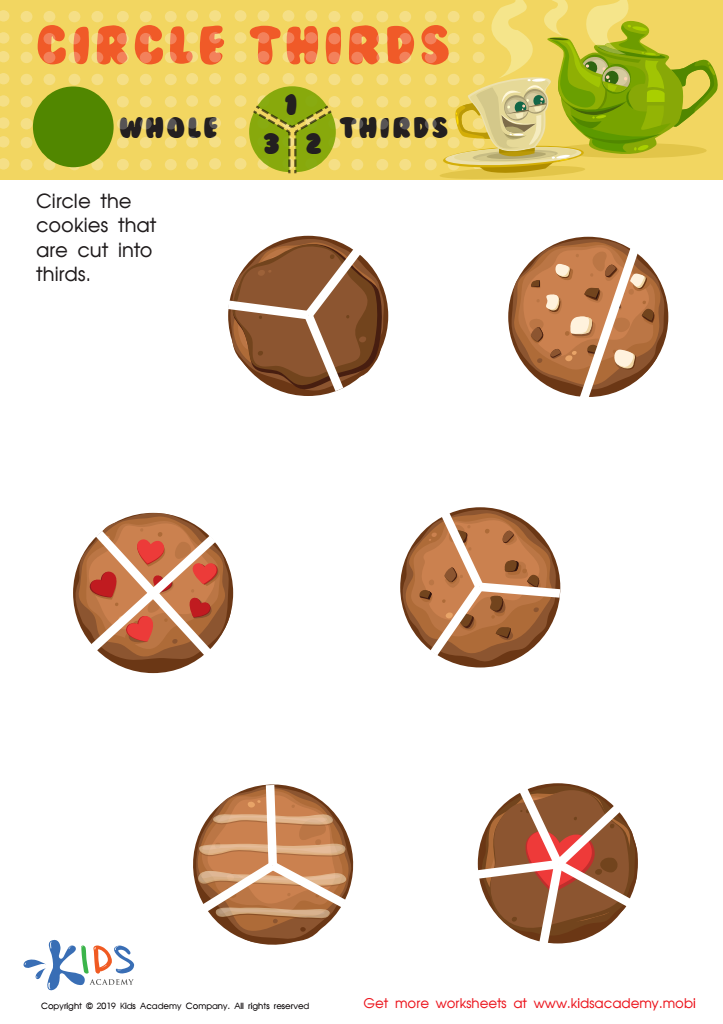
Circle Thirds Worksheet
Remind your kids of the different ways shapes can be divided: wholes, halves, thirds, and fourths. Now, look at the shapes in the worksheet and have them circle the cookies cut into thirds.
Circle Thirds Worksheet
Worksheet
Join Kids Academy for Free
Who is primarily going to use this learning content?








Visual fraction representation is crucial for young learners, aged 3 to 8, as it builds a foundational understanding of mathematical concepts. At this stage, children begin to explore basic fractions, and visual tools—such as pie charts, number lines, and manipulatives—play an essential role in making abstract ideas more concrete. Visual representations help children grasp the concept of part-to-whole relationships, enabling them to understand fractions not merely as numbers but as representations of quantities.
Furthermore, visual learning strategies cater to diverse learning styles and capabilities, fostering engagement and promoting retention. Children can easily relate to visuals, thus making learning fractions enjoyable and compelling, which can motivate them to explore more complex mathematics later.
Parents and teachers should care about visual fraction representation because it equips children with the skills they need for future math learning. A strong grasp of fractions is foundational for more advanced math concepts, such as ratios, proportions, and algebra. By prioritizing this visual approach early on, educators and caregivers can enhance students' confidence and competency in mathematics, setting them up for academic success in later years. Ultimately, understanding fractions is a vital skill that extends beyond the classroom, impacting daily life and future career opportunities.








