Addition Practice Adding up to 1000 with Regrouping Worksheets for Ages 3-8
3 filtered results
-
From - To
Our "Addition Practice Adding up to 1000 with Regrouping Worksheets" for ages 3-8 offer engaging and educational exercises to enhance your child's math skills. Designed to make learning fun, these printable worksheets help young learners practice addition with regrouping, ensuring they understand the concepts thoroughly. Each worksheet provides age-appropriate challenges, assisting in building confidence and competence in solving larger addition problems. Perfect for home or classroom use, these resources support your child in mastering essential math skills, laying a solid foundation for future learning. Foster a love for math with these interactive and exciting worksheets!
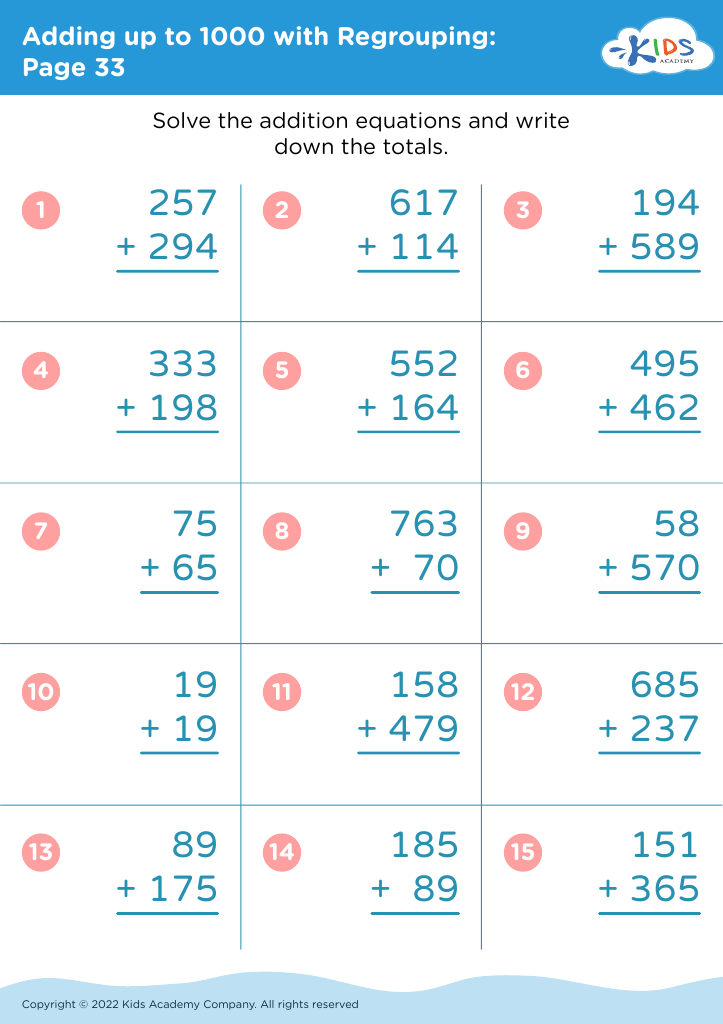
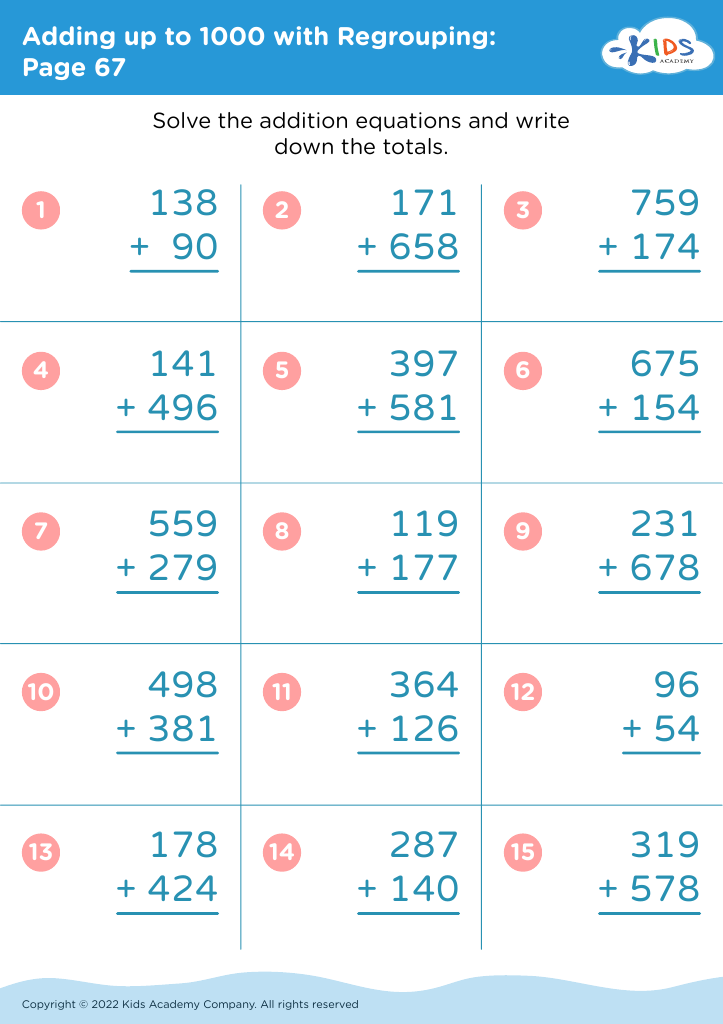
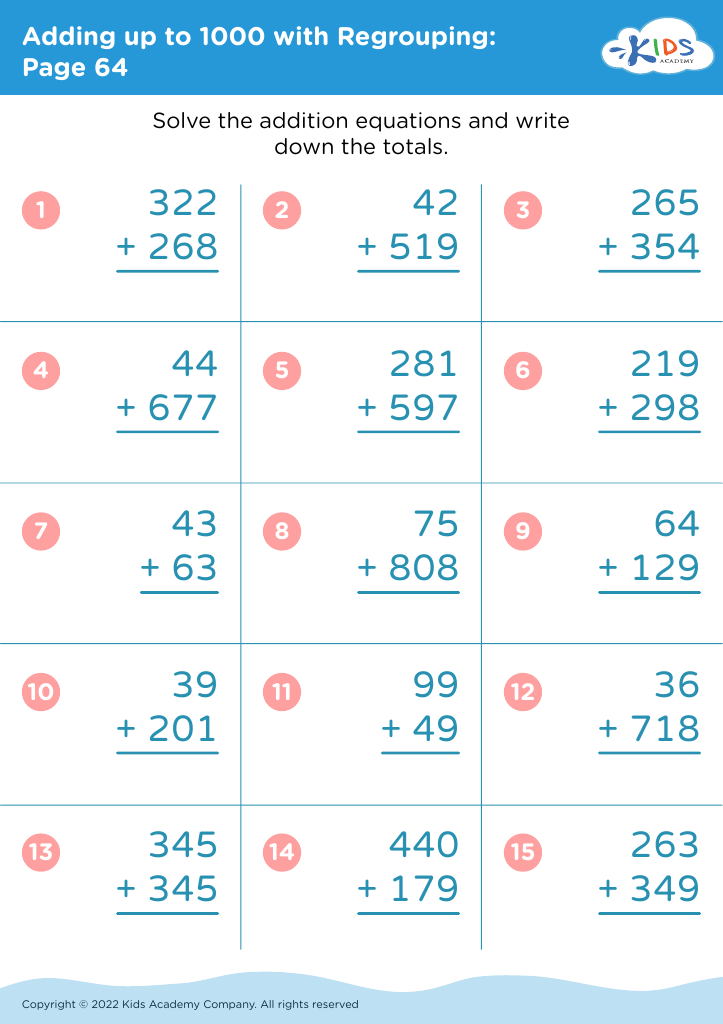


Parents and teachers should prioritize addition practice with regrouping up to 1000 for children aged 3-8 because foundational math skills are crucial for a child's academic and cognitive development. During these formative years, children are developing their numerical understanding and computational fluency. Mastery of addition with regrouping helps them handle more complex arithmetic in the future.
Firstly, addition with regrouping is an essential concept that introduces the idea of carrying over numbers, aiding their understanding of the base-10 number system. Understanding this system is fundamental in mathematics as it is a building block for other arithmetic operations, such as multiplication and division.
Moreover, regular addition practice builds problem-solving skills and enhances children's attention to detail. When students learn to tackle and solve addition problems accurately, they boost their confidence in math, fostering a positive attitude towards learning.
Interacting with numbers and engaging in regular practice also develops memory and cognitive abilities. For instance, recognizing number patterns and predicting outcomes strengthens their logical thinking and reasoning skills.
Overall, consistent addition practice up to 1000 with regrouping for young learners ensures they have a strong mathematical foundation, making future learning experiences smoother and more enjoyable. This prepares them not just for academic success, but for practical everyday arithmetic tasks as well.