Simplifying Fractions Adding up to 1000 with Regrouping Worksheets for Ages 3-8
3 filtered results
-
From - To
Discover dynamic worksheets designed for ages 3-8, focused on simplifying fractions and adding up to 1000 with regrouping. Kids Academy's expertly crafted activities make learning engaging and efficient, laying a strong mathematical foundation. Children explore fractions in interactive ways while mastering regrouping for addition, ensuring they grasp essential skills early. Perfect for homeschooling or supplemental practice, these worksheets cater to individual learning speeds and styles, fostering confidence with each exercise. Watch your child progress and enjoy math with vibrant, educational resources tailored just for them. Unlock their potential with these enjoyable, age-appropriate worksheets!
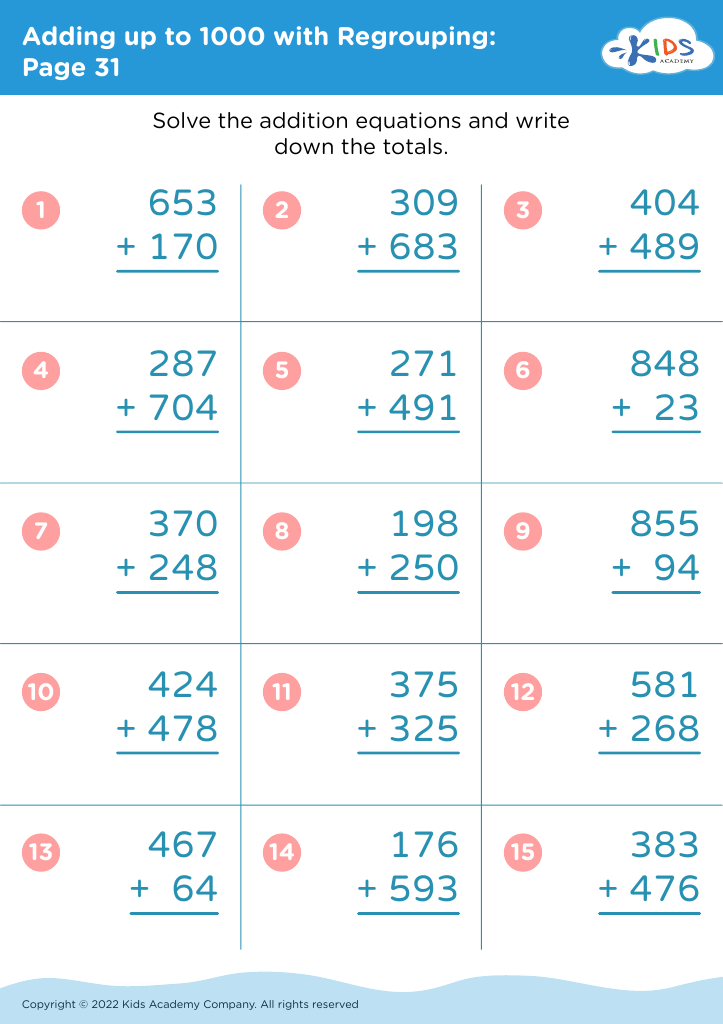
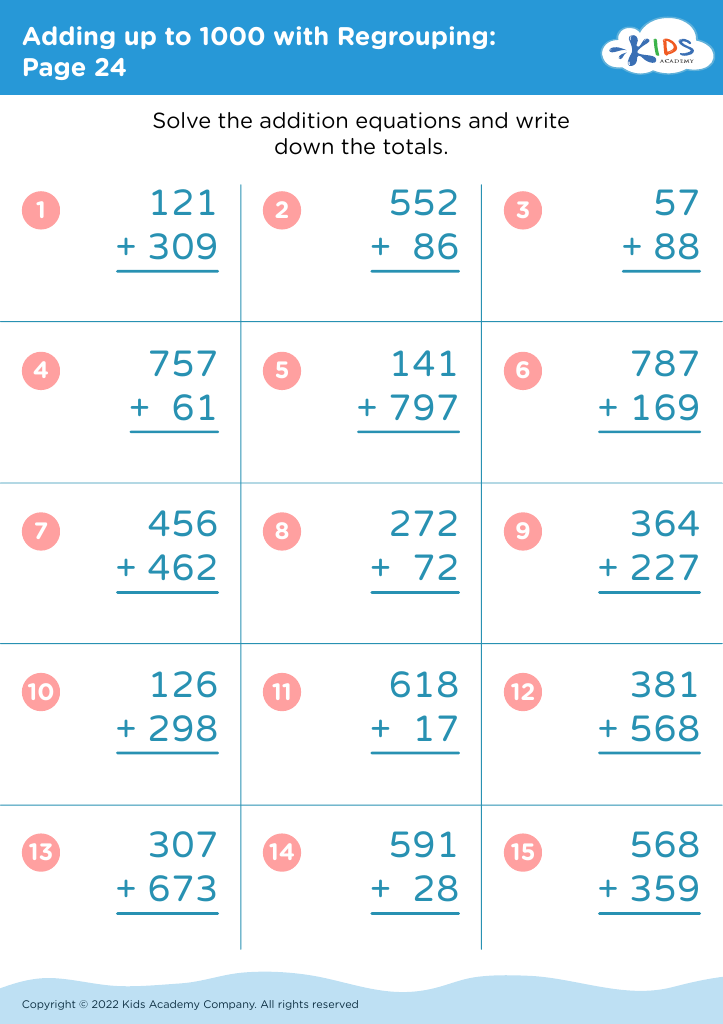
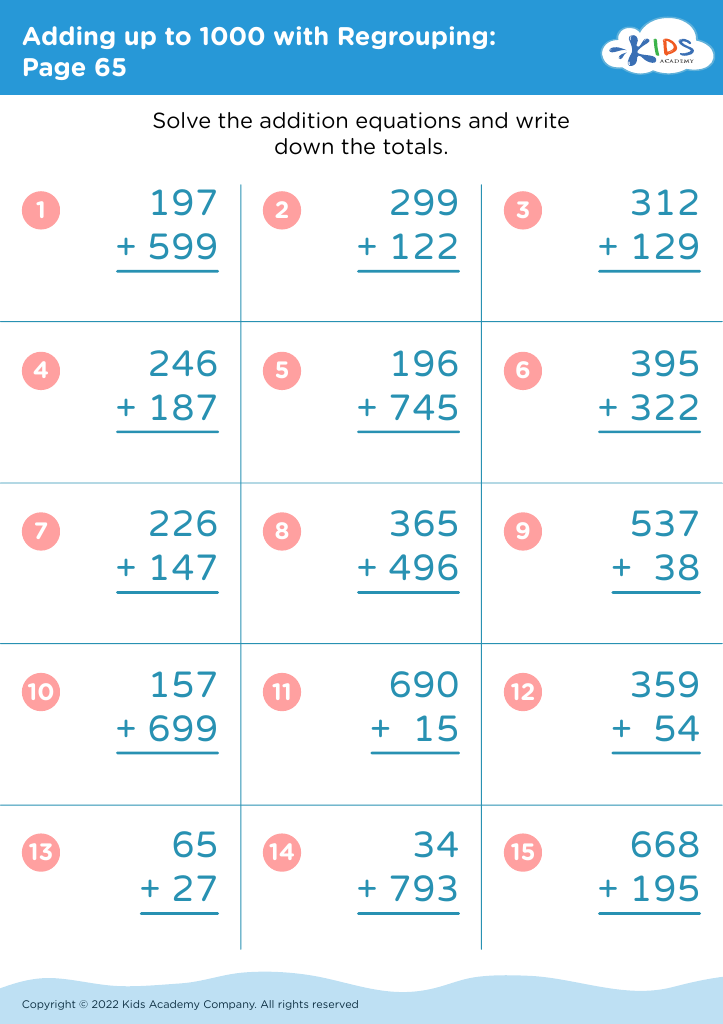


Simplifying fractions and performing addition up to 1000 with regrouping are foundational math skills that support a child's overall mathematical development and critical thinking. For ages 3-8, mastering these skills early paves the way for more complex concepts in later grades, such as algebra and calculus.
Fractions are a key part of understanding numbers and their relationships. Simplifying fractions helps children develop a sense of equivalence and proportionality, crucial for more advanced math skills. When children understand how to break down fractions into simpler terms, they build confidence in their mathematical abilities and improve their problem-solving skills.
Adding up to 1000 with regrouping involves carrying over numbers to the next column. It introduces children to multi-digit arithmetic, a critical thinking process where they learn to manage larger numbers systematically. It teaches them the principles of place value, ensuring that they accurately perform arithmetic operations. This process underlines the importance of precision and logical thinking, which are valuable across various subjects and real-life situations.
Encouraging proficiency in these areas fosters a positive attitude toward math, reducing anxiety and building a strong foundation. Both parents and teachers play a critical role in nurturing these skills, setting children on a path to academic success and developing lifelong mathematical understanding.