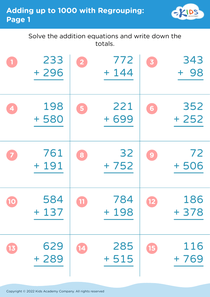
Basic Math Skills Adding up to 1000 Without Regrouping Worksheets for Ages 3-8
3 filtered results
-
From - To
Introduce your young learners to essential math skills with our "Basic Math Skills Adding Up to 1000 Without Regrouping" worksheets, specially designed for ages 3-8. These interactive worksheets provide a fun and engaging way for children to practice addition without the complexities of regrouping. By emphasizing simple addition concepts, children will build their confidence and improve their problem-solving abilities. Our user-friendly format supports early mathematical development, ensuring a solid foundation in arithmetic. Perfect for home or classroom use, these worksheets make learning math enjoyable and accessible for young minds. Download them now to boost your child’s math skills!
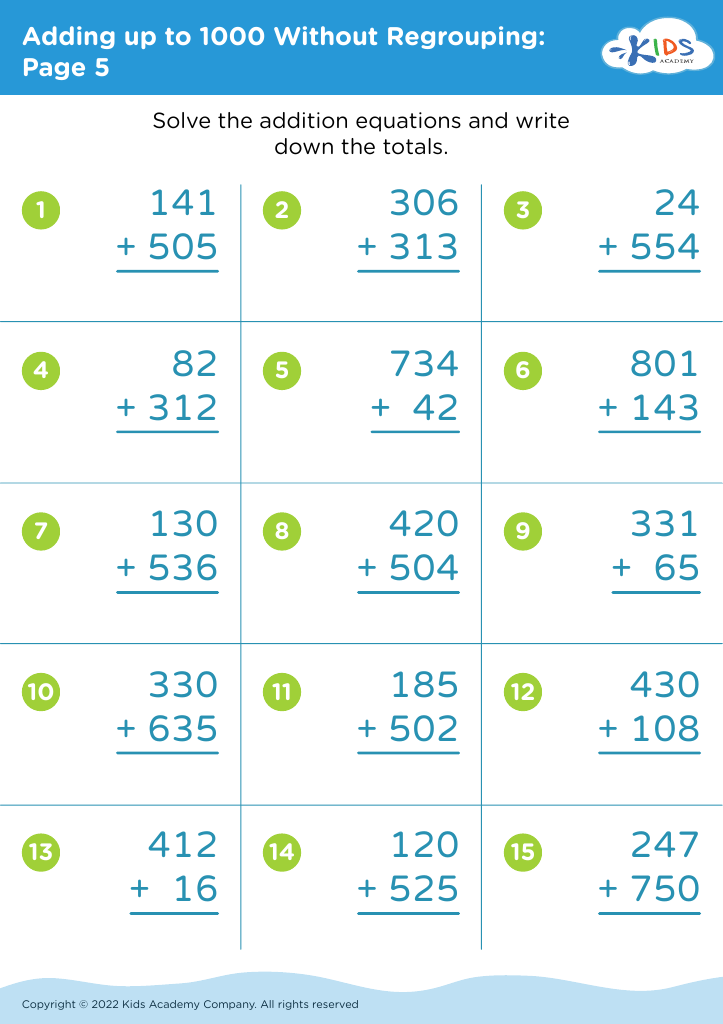
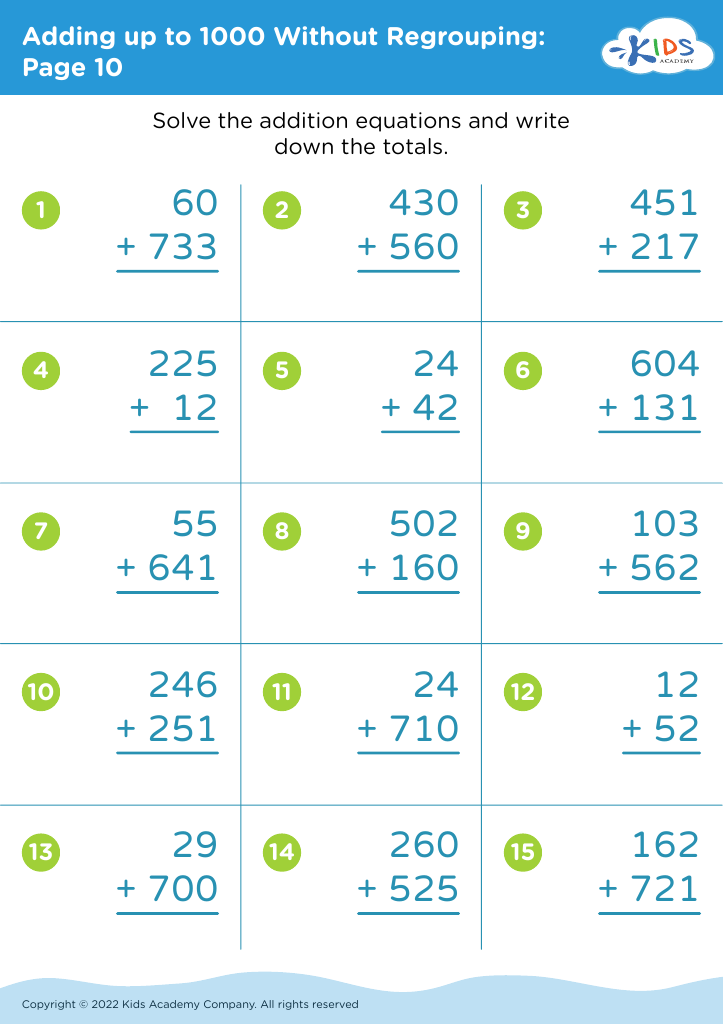
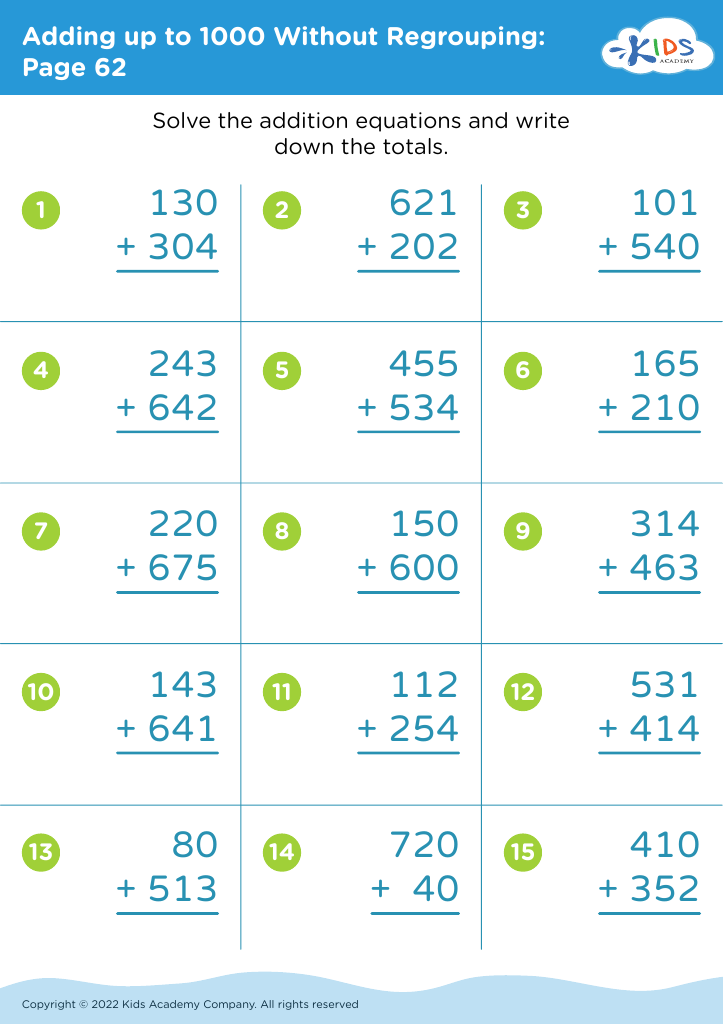


Parents and teachers play a crucial role in a child's early mathematical development, especially when it comes to basic math skills like adding up to 1000 without regrouping. These skills form the foundation of more advanced math concepts and are essential for problem-solving in everyday situations. For children aged 3-8, mastering simple addition provides a sense of accomplishment and boosts confidence in their mathematical abilities.
Understanding addition helps young learners develop critical thinking and logical reasoning skills. When children can add numbers effectively, they are better equipped to handle tasks such as measuring, estimating, and budgeting as they grow older. Additionally, basic math skills are linked to success in other academic areas, fostering a well-rounded educational experience.
By focusing on adding up to 1000 without regrouping, parents and teachers can create engaging and meaningful learning experiences that make math enjoyable. Games, hands-on activities, and practical applications encourage curiosity and a love for learning. Ultimately, emphasizing these basic math skills sets children on a path to academic success and lifelong learning, making it an important focus for parents and educators alike.