Improving counting skills Adding up to 1000 Worksheets for Ages 3-8
4 filtered results
-
From - To
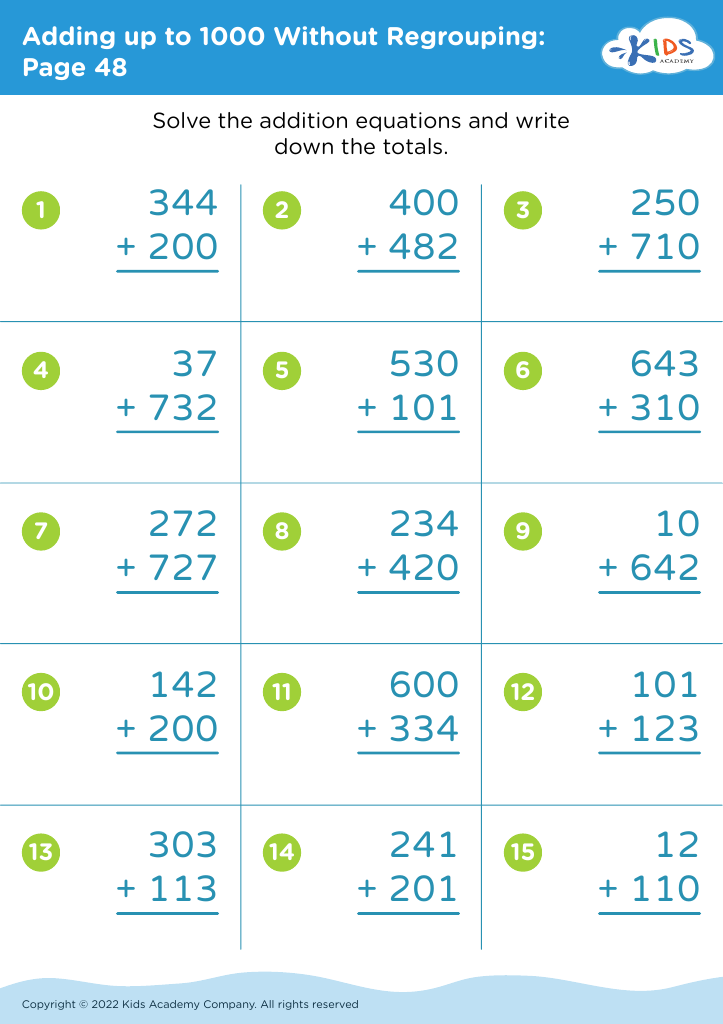
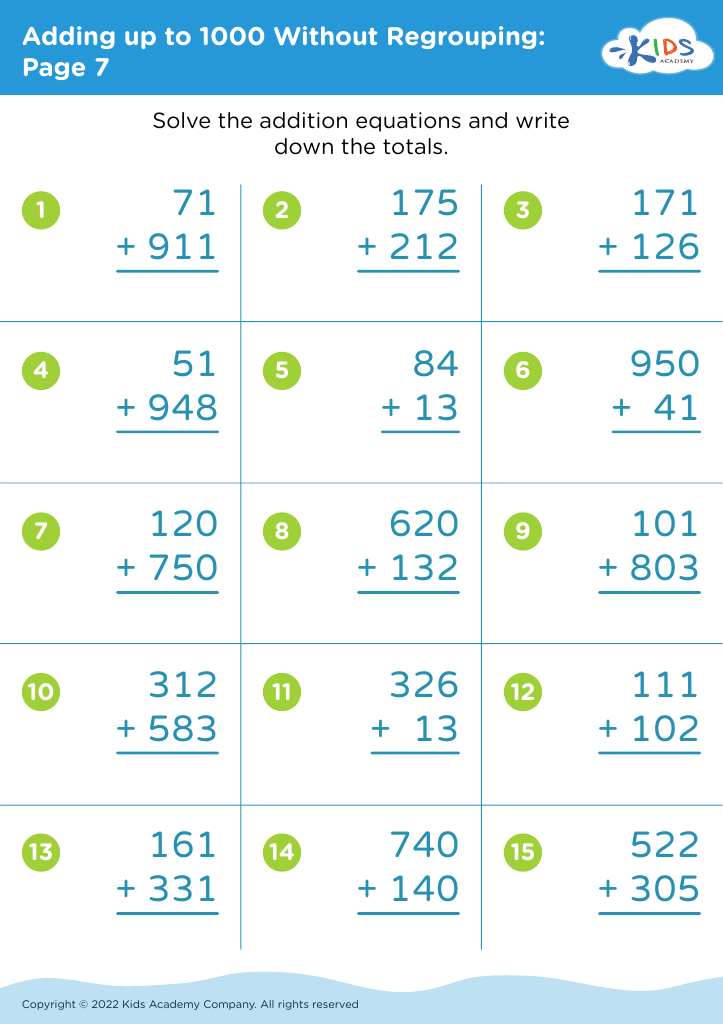
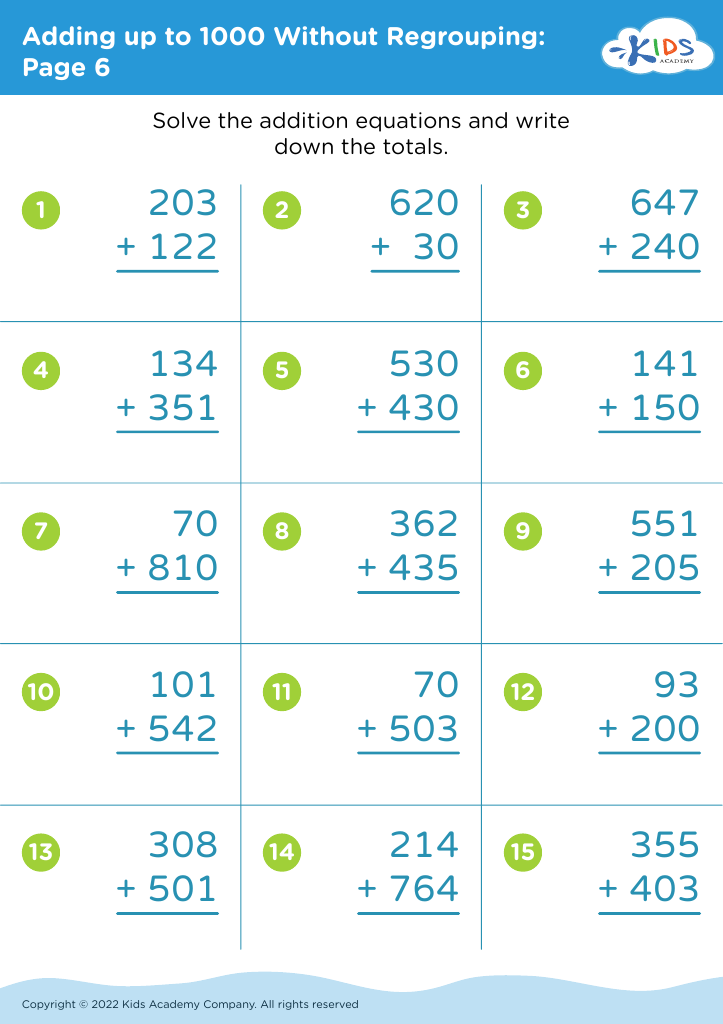
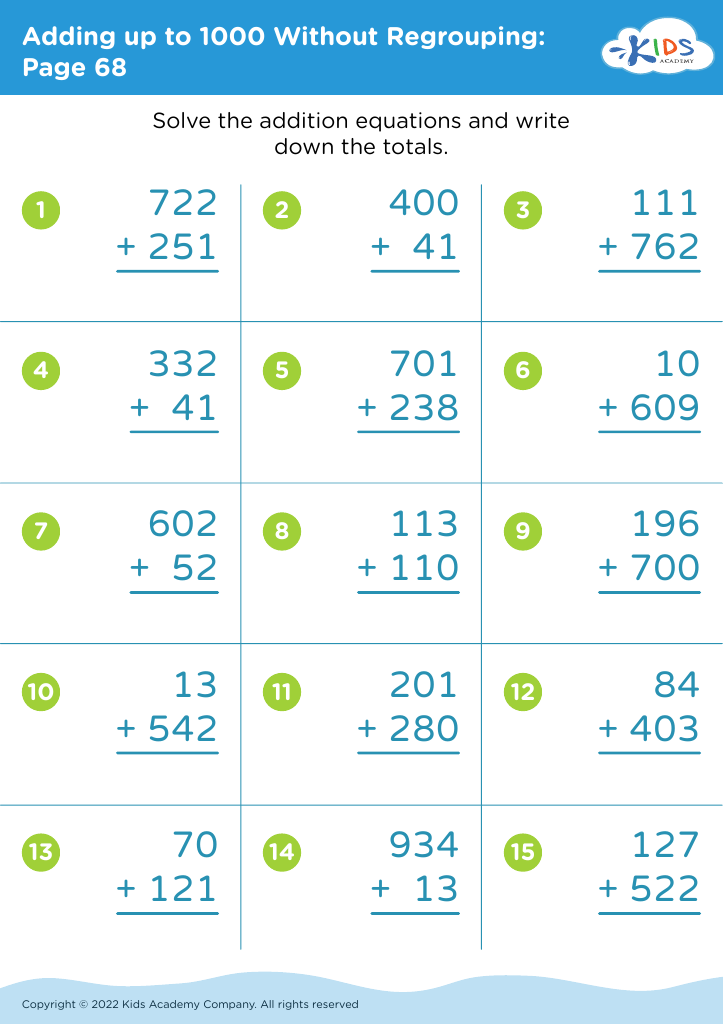
Enhance your child's counting skills with our "Adding Up to 1000" worksheets designed specifically for ages 3-8. These engaging and interactive printables provide an excellent opportunity for young learners to practice and master essential counting techniques. Through fun activities, children will develop their numeric confidence and understanding of addition as they work towards the goal of reaching 1000. Our worksheets offer diverse exercises, from simple counting to more complex addition problems, all tailored to support various learning levels. Perfect for home or classroom use, these resources make math enjoyable while laying a solid foundation for future mathematical success.



Improving counting skills, particularly the ability to add up to 1000, is crucial for children aged 3-8 as it lays the foundation for their entire mathematical education. First and foremost, counting is one of the most fundamental skills in numeracy that young learners must master to succeed in math. As children develop counting skills, they also enhance their understanding of number sense, which fosters problem-solving competencies that can be applied in real-life situations.
Building strong counting skills supports critical thinking and cognitive development as children learn to analyze and organize information, recognize patterns, and make connections. Additionally, mastering counting up to 1000 helps children develop mental math abilities, setting them up for success in more complex concepts such as addition, subtraction, and beyond.
Moreover, counting skills foster self-confidence and independence. When children feel secure in their ability to count and understand numbers, they engage more actively in learning experiences, feel motivated, and develop a positive attitude towards mathematics. In a world that increasingly relies on data and technology, a solid grasp of counting and numerical skills prepares them for future academic endeavors and everyday life. Therefore, enhancing children’s counting skills is critical for their overall developmental progression and future success.








