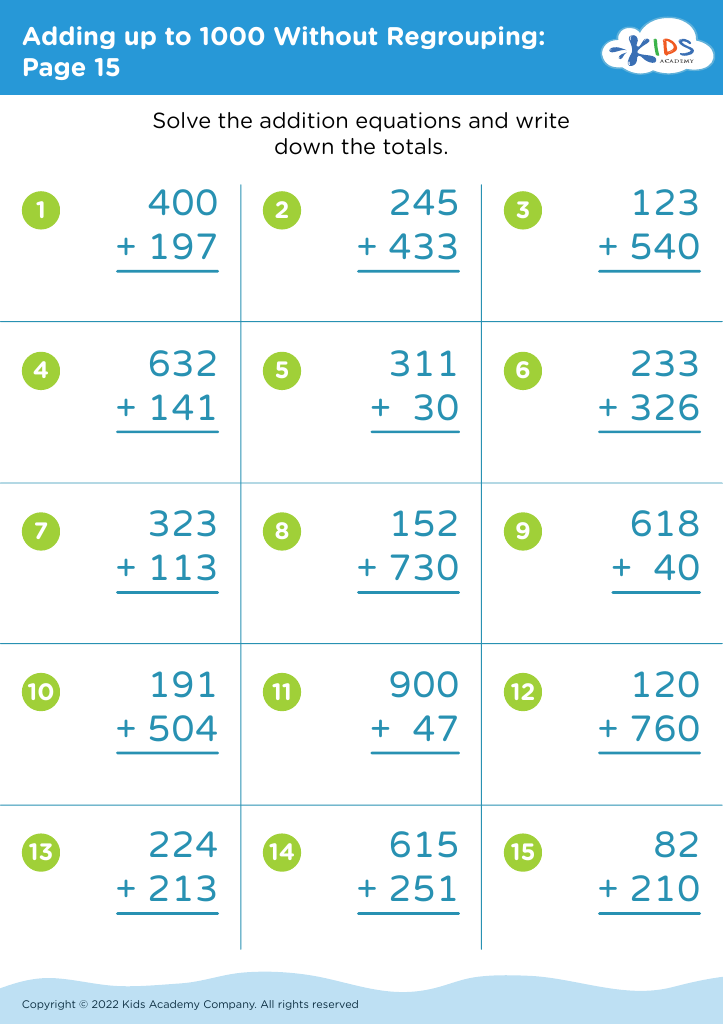




Problem-solving skills, particularly in the context of math problems involving adding up to 1000, are crucial for the cognitive development of children ages 3-8. These exercises go beyond developing basic arithmetic skills; they cultivate critical thinking, perseverance, and adaptability—traits that are vital for lifelong learning and success.
First, engaging in problem-solving helps children understand numbers conceptually. Instead of memorizing facts, they learn to strategize, breaking down complex problems into manageable steps. For instance, figuring out how to sum multiple numbers totaling up to 1000 encourages a deeper comprehension of addition and place value.
Second, these activities enhance focus and attention to detail. Children learn to detect patterns, errors, and efficient pathways to solutions, fostering meticulous work habits.
Third, problem-solving builds confidence. Successfully solving a complex problem provides a sense of accomplishment that can motivate children to tackle more challenging tasks, both academically and in everyday situations.
Moreover, early exposure to math-related problem-solving prepares children for the heightened academic demands they'll face in later grades. When parents and teachers nurture these skills, they are laying a solid foundation for academic achievement and instilling a growth mindset, where children view challenges as opportunities for learning rather than obstacles.








