Understand patterns Adding up to 1000 Worksheets for Ages 3-8
3 filtered results
-
From - To
Enhance your child's math skills with our "Understand Patterns Adding up to 1000 Worksheets for Ages 3-8"! These engaging worksheets are designed to make learning fun and effective, helping young learners recognize and predict number patterns while mastering addition up to 1000. Ideal for home or classroom use, these activities support developmental learning, sharpen problem-solving abilities, and build a strong mathematical foundation. Perfect for ages 3-8, our worksheets align with early education standards, ensuring your child receives a coherent and comprehensive learning experience. Let your child's confidence and proficiency in math flourish with our expertly crafted worksheets!
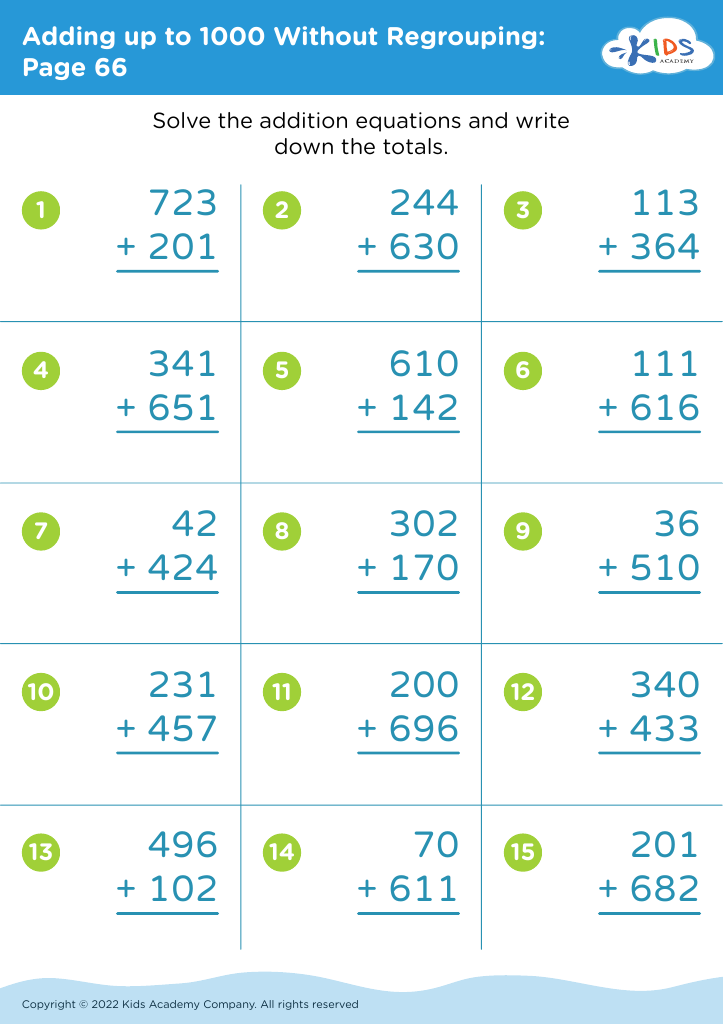
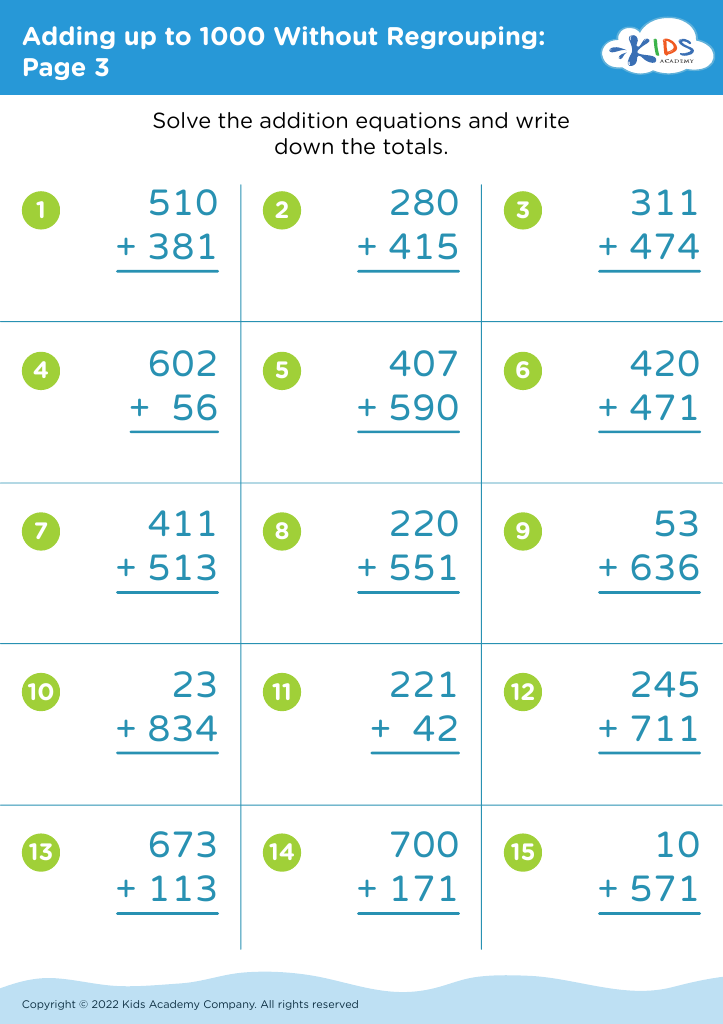
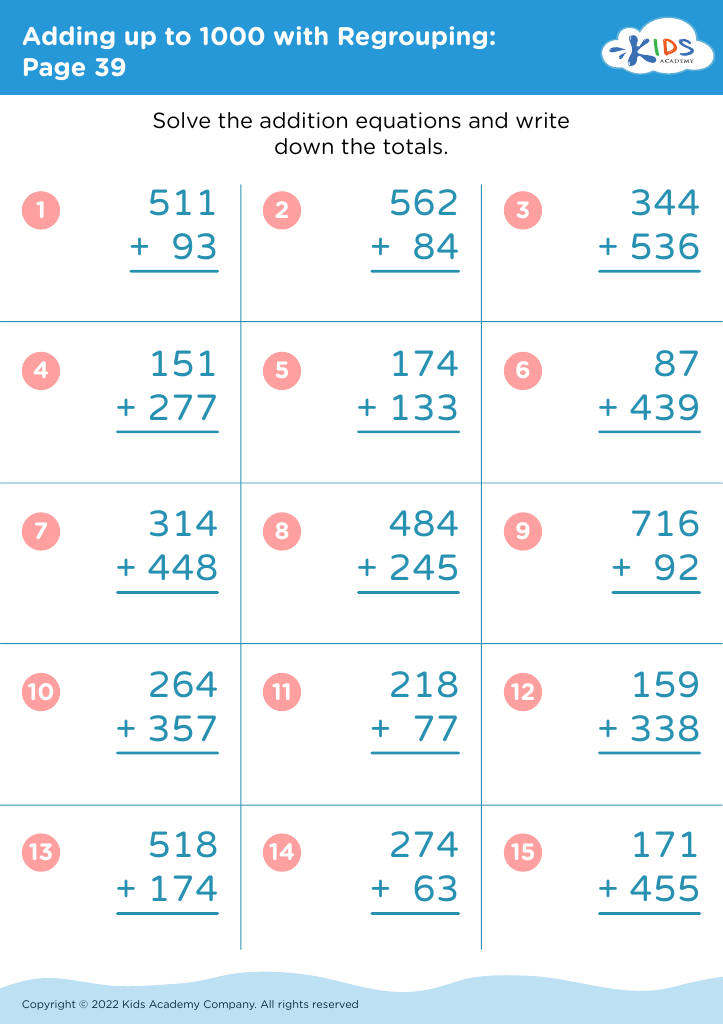



Understanding patterns and adding numbers up to 1000 hold significant importance for children ages 3-8. During these formative years, cognitive abilities and foundational mathematical skills take root, forming the bedrock for later learning. Patterns are a crucial part of this development. When kids recognize and predict patterns, they enhance critical thinking, problem-solving skills, and logical reasoning. This understanding is not limited to mathematics but extends to subjects like reading and science, where patterns abound in stories, experiments, and natural phenomena.
Adding numbers up to 1000 introduces young minds to more complex arithmetic. By mastering these additions early on, children build confidence and fluency in basic calculations, ensuring they're well-prepared for more advanced math concepts. This skill also promotes a sense of achievement and boosts self-esteem, as kids appreciate their growing abilities.
Moreover, engaging with math in a fun and meaningful way, such as through games or real-life scenarios like counting objects or playing with building blocks, can spark a lifelong interest in the subject. Parents and teachers who prioritize these mathematical skills help nurture well-rounded, intellectually curious children who are better equipped for academic challenges. Early engagement in pattern recognition and arithmetic operations lays a foundation for future success in all areas of education.








