Understanding quantity Adding up to 1000 Worksheets for Ages 3-8
3 filtered results
-
From - To
Explore our "Understanding Quantity: Adding Up to 1000 Worksheets" designed for children ages 3-8. These engaging resources help young learners grasp the concept of quantity through fun exercises that encourage them to visualize and manipulate numbers up to 1000. With colorful illustrations and interactive tasks, students can enhance their counting, addition, and estimation skills in an enjoyable way. Our worksheets are carefully curated to support early math development, making learning both effective and enjoyable. Perfect for home or classroom use, these activities are an excellent tool to foster number sense and prepare children for more advanced math concepts. Start their mathematical journey today!
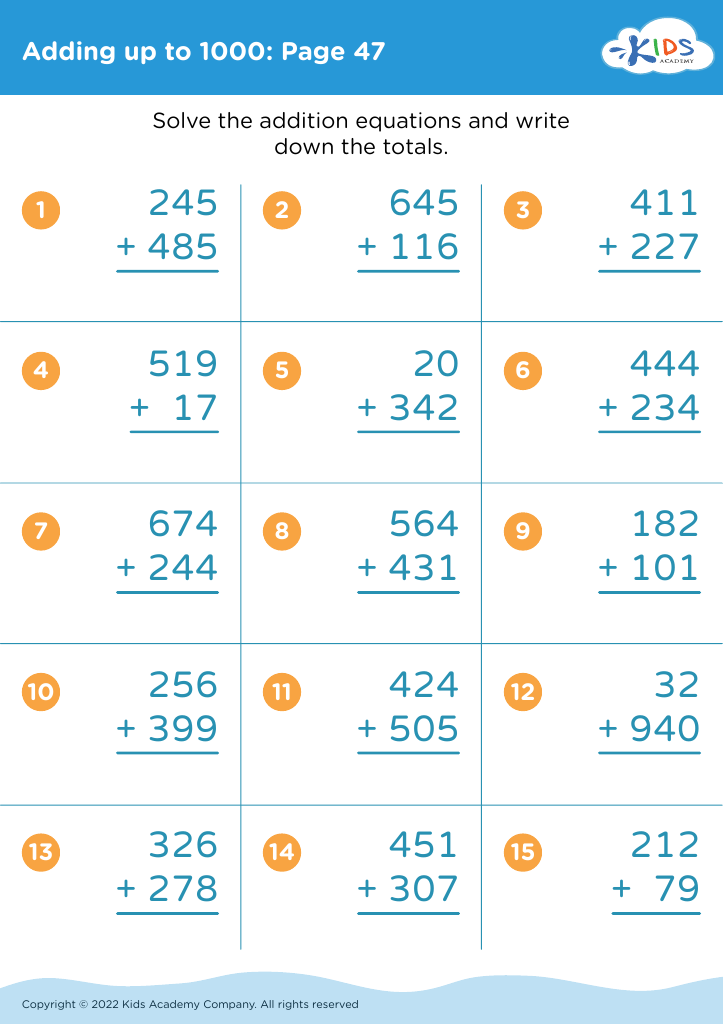
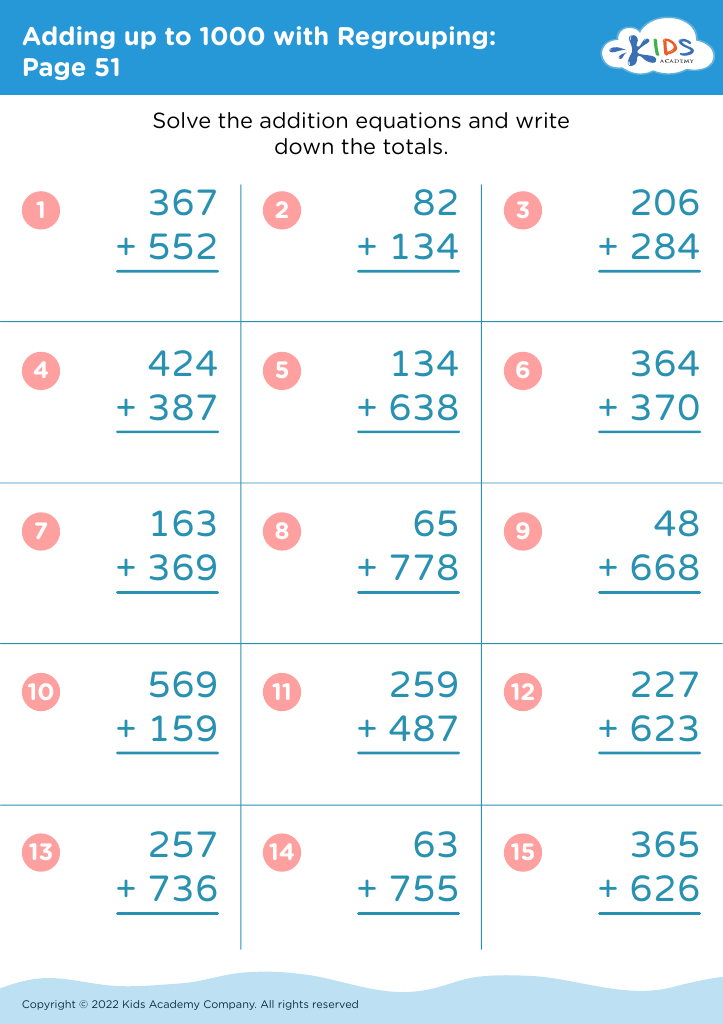
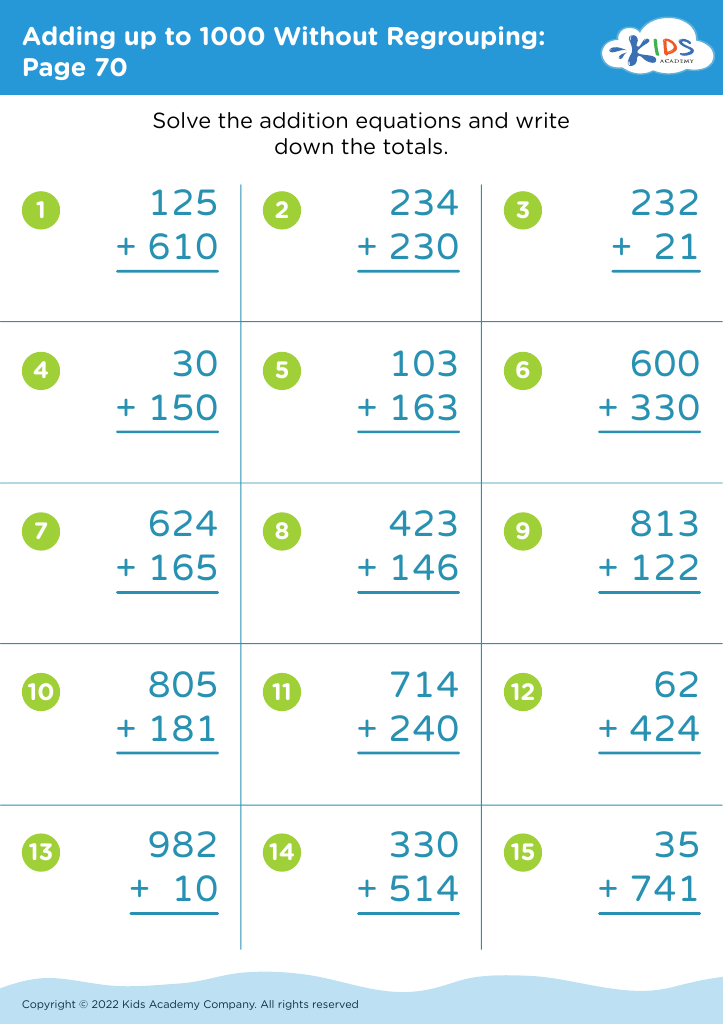



Understanding quantity and addition up to 1000 is crucial for children aged 3-8, as it lays the foundation for their mathematical skills and overall cognitive development. Early familiarity with numbers helps children grasp fundamental concepts, such as counting, comparing values, and understanding larger quantities. Learning to add up to 1000 empowers them with the ability to solve problems in everyday life, enhancing their critical thinking and reasoning skills.
Parents and teachers play a vital role in guiding children through this learning process. Engaging them in activities that promote counting and addition fosters a positive attitude towards math, making it less intimidating. Instilling confidence in these abilities is essential, as early math skills are linked to future academic success.
Furthermore, understanding quantities enhances children's ability to make connections in other subjects, such as science and economics. It encourages logical thinking and helps develop perseverance, traits that are valuable beyond the classroom. By prioritizing math literacy, parents and teachers can ensure that children build a strong foundation that supports lifelong learning. Such support will not only assist in their current education but also provide them with the tools needed to confidently tackle more complex mathematical concepts in the future.








