Understanding sequencing Adding up to 1000 Worksheets for Ages 3-8
3 filtered results
-
From - To
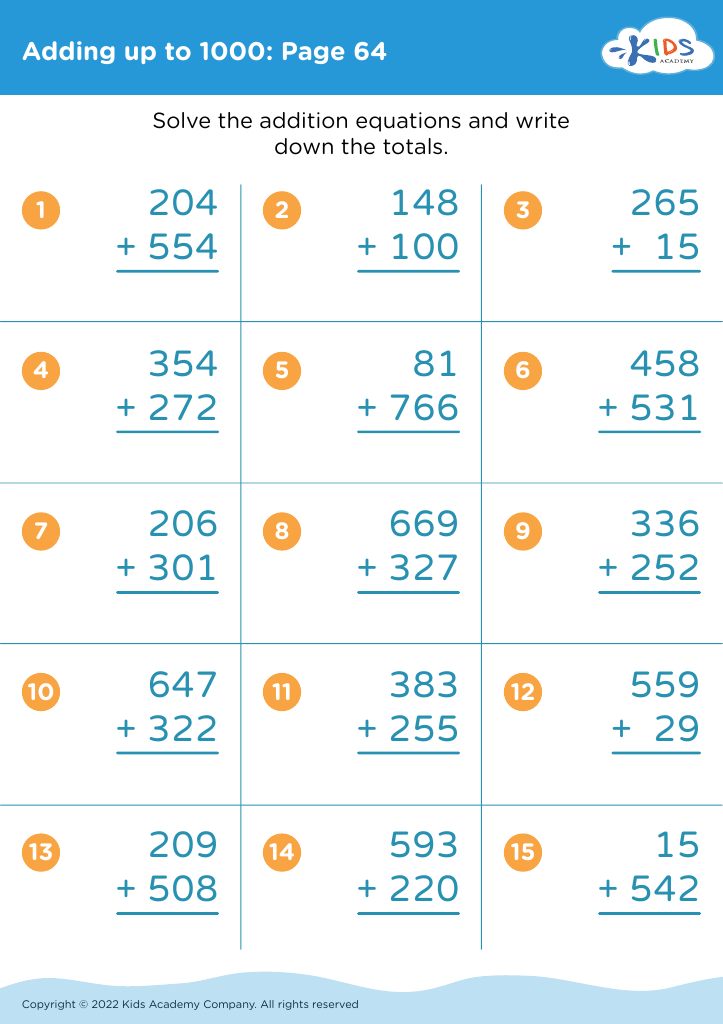
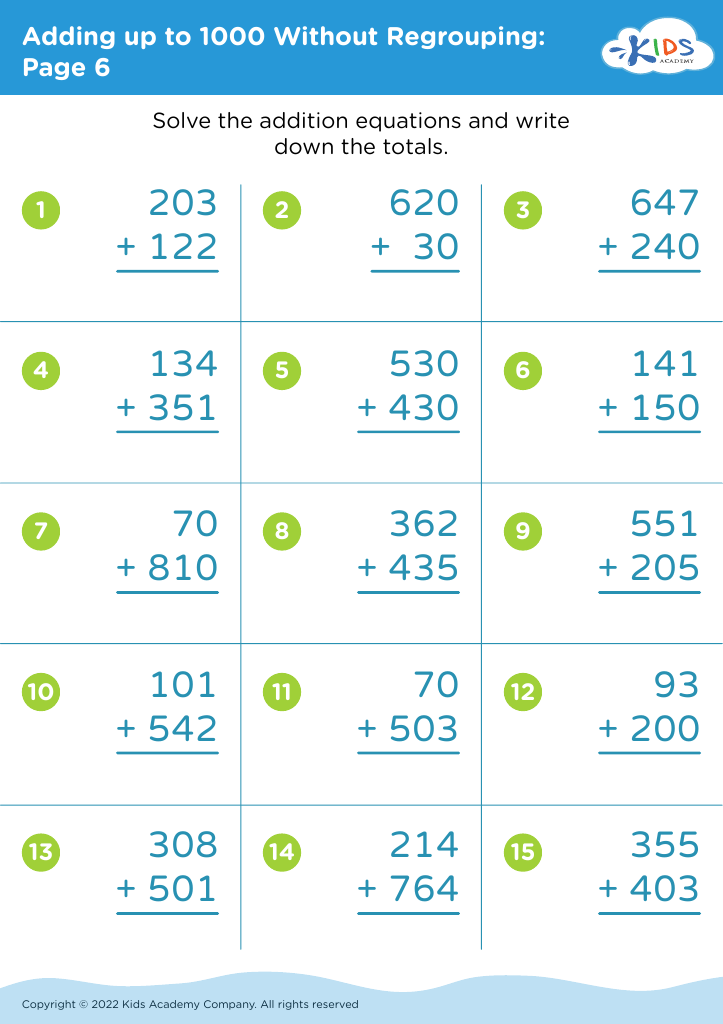
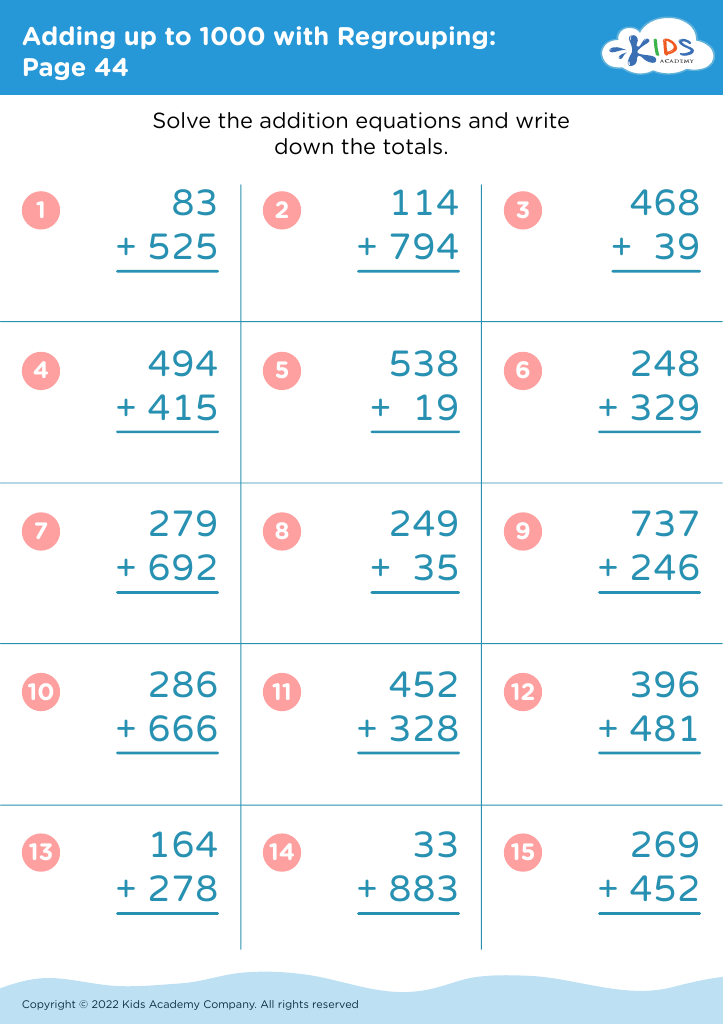
Unlock your child's potential with our user-friendly "Understanding Sequencing Adding Up to 1000 Worksheets for Ages 3-8". Designed to build essential math skills, these engaging worksheets help young learners grasp the concept of sequencing and number progression while mastering addition up to 1000. Perfect for both classroom settings and at-home practice, our worksheets cater to ages 3-8, making mathematical foundations both fun and accessible. With colorful visuals and age-appropriate challenges, your child will gain confidence in their arithmetic abilities while enjoying the process. Dive into a world of learning and ensure your child’s mathematical success with Kids Academy today!



Understanding sequencing and addition up to 1000 is integral for children ages 3-8, as this foundational knowledge sets the stage for future academic success. Sequencing, which involves recognizing and predicting patterns, helps develop critical thinking and organizational skills. When children grasp sequencing, they can better understand the order of events, a skill applicable across all subjects and daily activities. This enhances their reading comprehension by enabling them to make sense of storylines and instructions, and fosters problem-solving abilities.
Addition up to 1000 introduces young learners to more complex mathematical concepts. Early exposure to larger numbers aids in building numerical fluency, preparing them for advanced topics like multiplication and division. This practice also instills confidence, as children master each milestone and see tangible progress. Furthermore, such mathematical competence is crucial in everyday decision-making, reinforcing practical life skills like budgeting or time management.
Moreover, these cognitive and analytical skills are intertwined with emotional development. As children conquer these concepts, they boost their self-esteem, making them more willing to tackle challenging tasks. Providing children with these tools early on lays a robust groundwork for lifelong learning and success, emphasizing the need for parents and teachers to engage actively in their young learners' educational journey.








