Visual interpretation Adding up to 1000 Worksheets for Ages 3-8
3 filtered results
-
From - To
Boost your child's math skills with our "Visual Interpretation Adding up to 1000" worksheets, specially designed for ages 3-8. These engaging, age-appropriate worksheets make learning fun by using colorful pictures and visual aids to help young learners grasp the concept of addition up to 1000. Perfect for preschoolers and early grade students, each worksheet gradually enhances their problem-solving abilities, visual interpretation, and number sense. Ideal for classroom use or homeschooling, our worksheets are an excellent resource for laying a strong math foundation. Help your child enjoy and excel in math with these interactive learning tools.
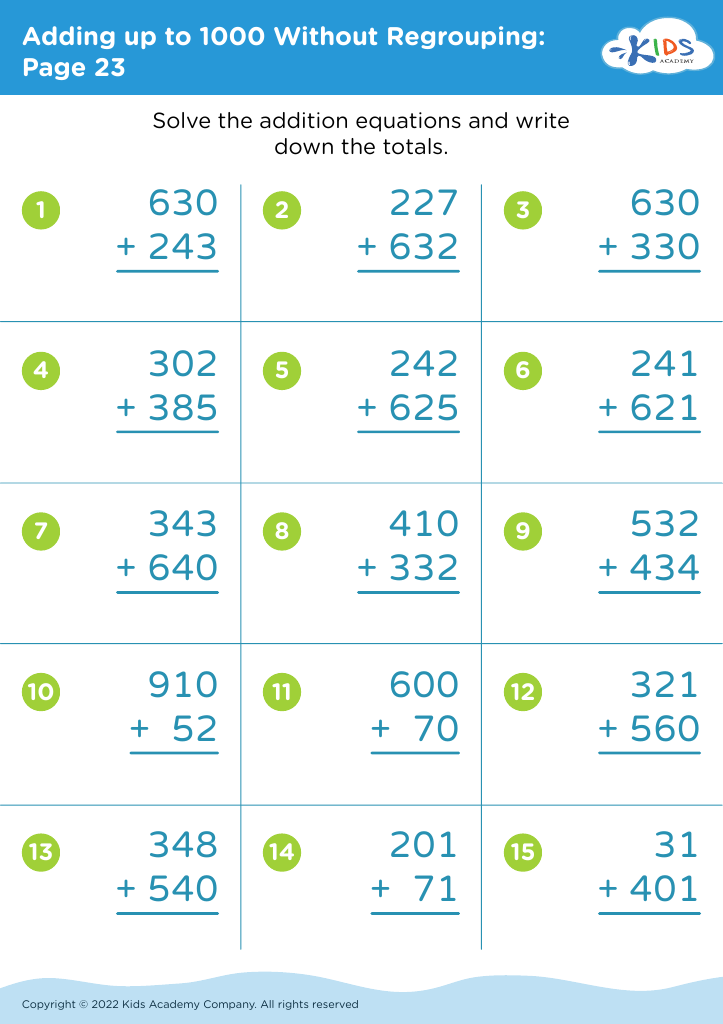
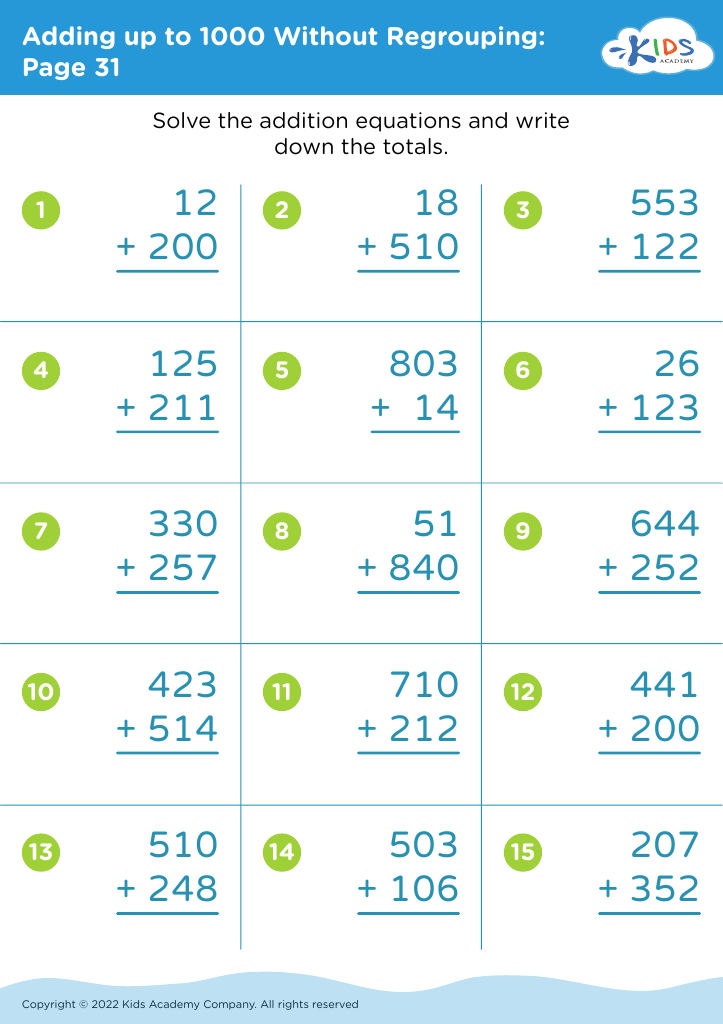
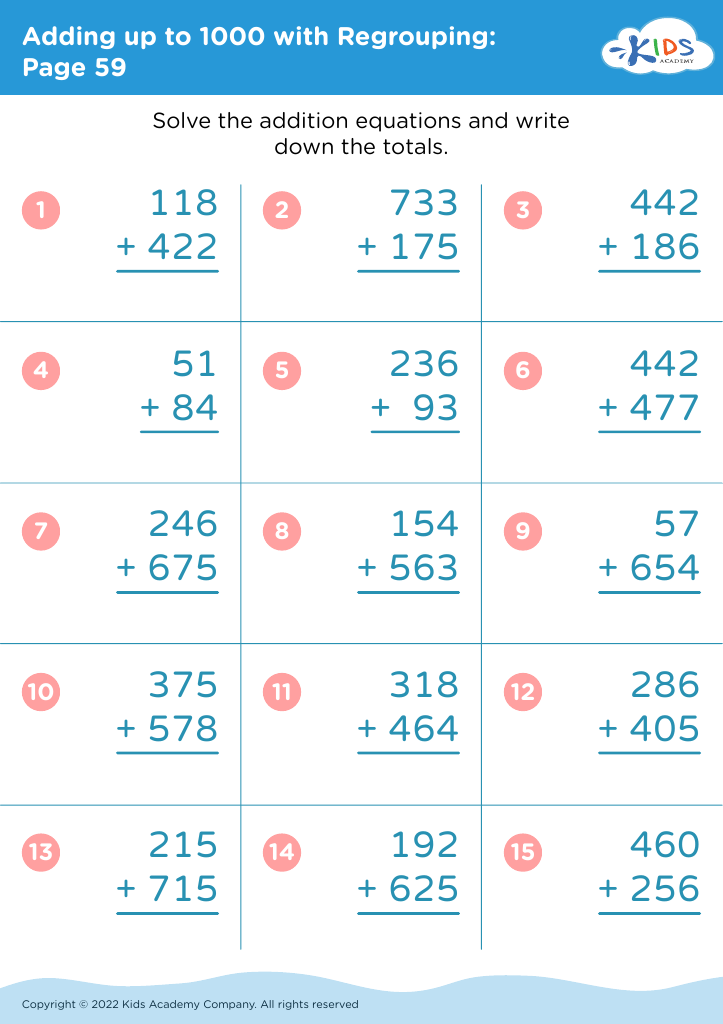



Parents and teachers should prioritize visual interpretation and basic arithmetic, such as adding up to 1000, for children aged 3-8 as they form an essential foundation for overall academic success. At this developmental stage, young minds are highly receptive to visual stimuli. Using visual aids like number lines, charts, and pictorial representations can make abstract concepts more tangible, enhancing comprehension and retention.
Introducing add-up-to-1000 exercises in a visually engaging manner helps build strong numeracy skills early on. Math is not just about numbers; it nurtures critical thinking, problem-solving ability, and logical reasoning. By using visual aids, parents and teachers can illustrate addition and place value concepts compellingly, making learning interactive and less intimidating.
Moreover, visual learning fosters patience and boosts confidence by progressively tackling more considerable numbers, lessening the gap in future academics. Early familiarity with mathematical concepts using playful, visual methods can cement foundational skills, making transitions to higher-level math more seamless.
Investing time in such education early on also prepares children for a world increasingly driven by STEM (Science, Technology, Engineering, Mathematics) fields, underscoring the importance of robust early academic foundations. Engaged and supportive teaching leveraging visual aids ensures that learning math is exciting and deeply effective.








