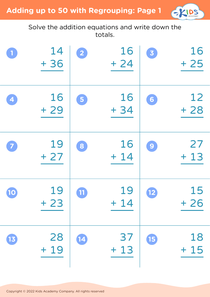
Enhance number recognition Adding up to 50 Without Regrouping Worksheets for Ages 3-8
3 filtered results
-
From - To
Boost your child's number recognition skills with our "Enhance Number Recognition: Adding Up to 50 Without Regrouping Worksheets." Designed for children ages 3-8, these engaging worksheets combine fun and learning, helping young learners master addition through interactive exercises. As children practice, they will develop a solid understanding of numbers and improve their confidence in math. Each worksheet focuses on adding numbers up to 50 without regrouping, ensuring a strong foundation for future mathematical concepts. Perfect for homeschooling or classroom use, our worksheets encourage independent learning while making math enjoyable. Explore our resources today and cultivate a love for numbers in your child!
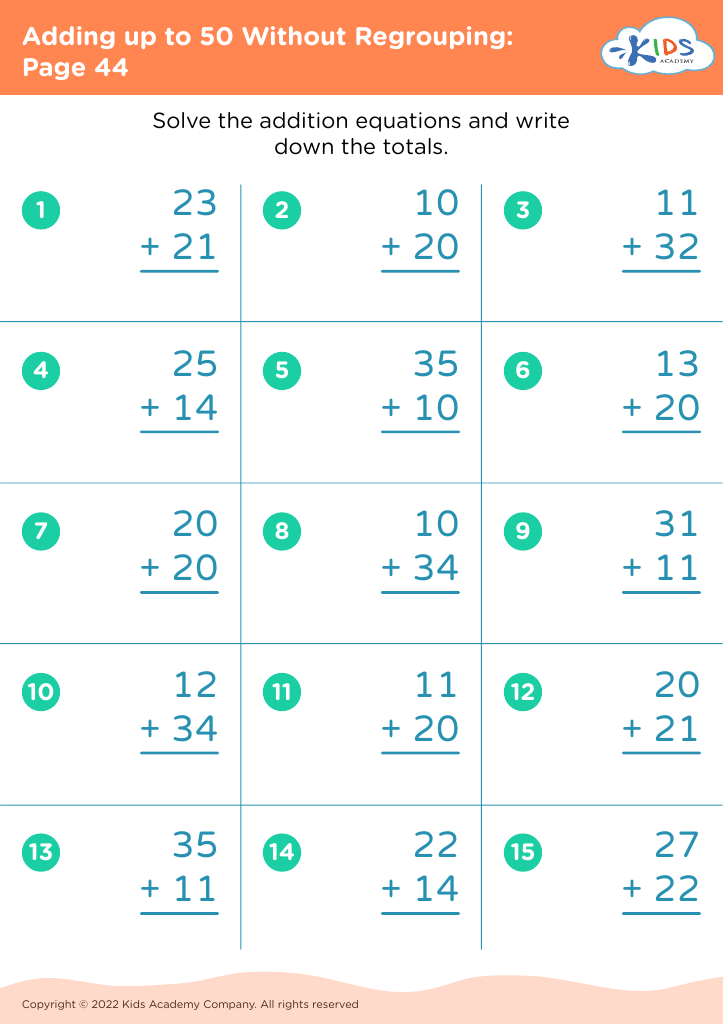
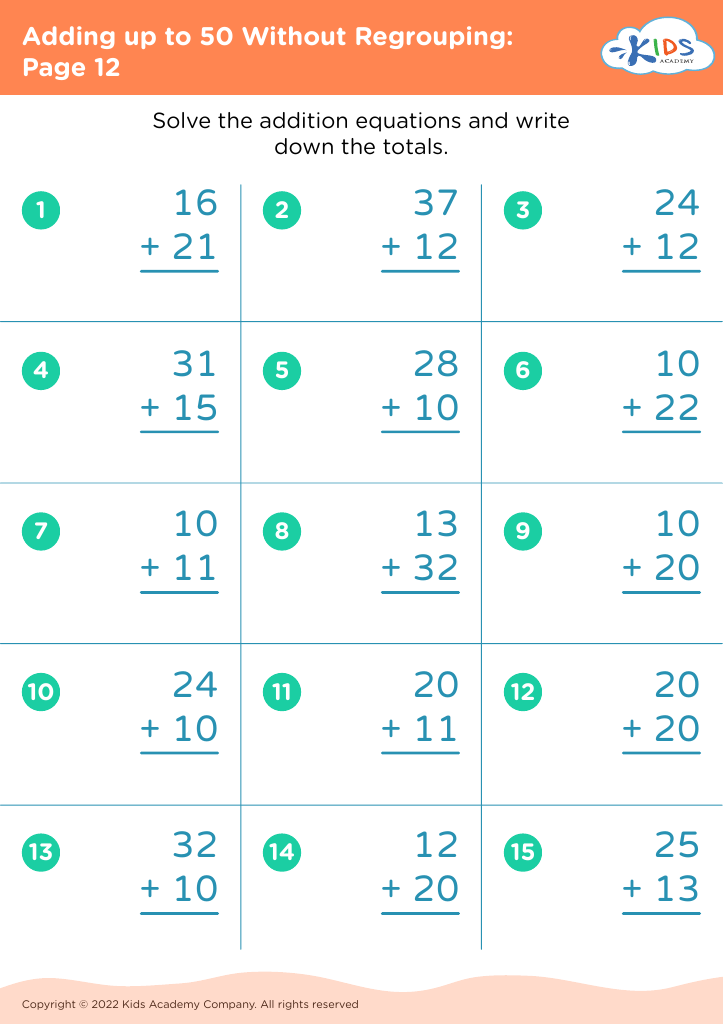
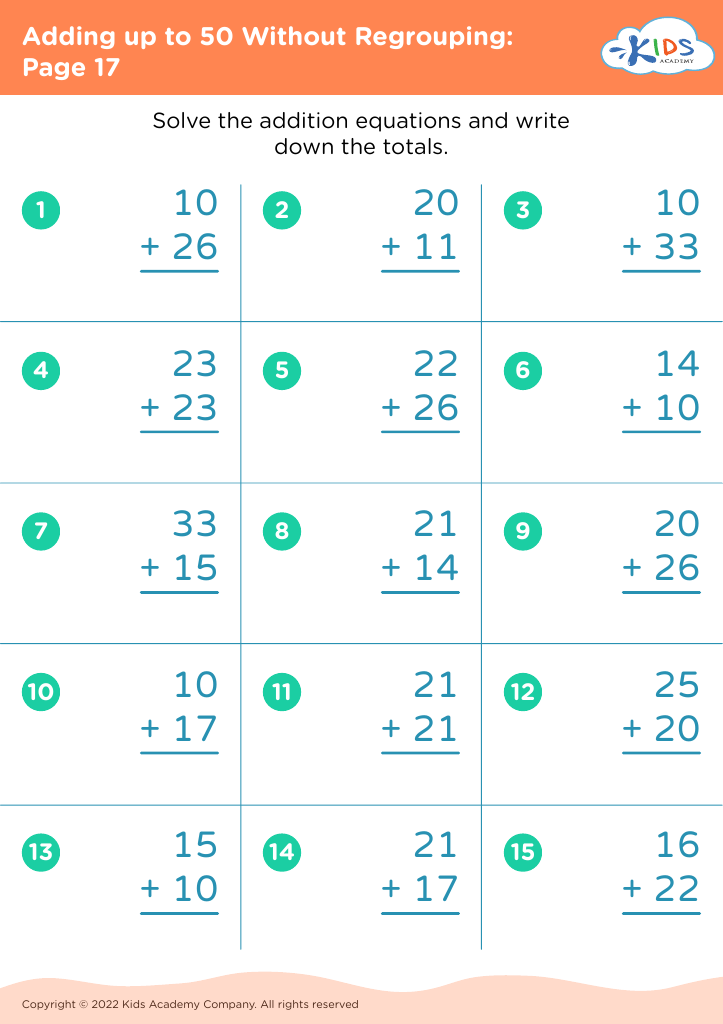


Enhancing number recognition and introducing addition skills, especially up to 50 without regrouping, is crucial for children ages 3-8 for several reasons. At this formative stage, children develop foundational numeracy skills that serve as the backbone for more complex mathematical concepts later on. Mastery of number recognition provides children with the ability to identify and understand quantities, forming the basis for all arithmetic operations.
When children learn to add sums up to 50 without regrouping, they engage in the practice of mental arithmetic, which sharpens their cognitive skills and lays the groundwork for more advanced problem-solving abilities. This skill also helps them achieve a sense of accomplishment, boosting their confidence in math.
Additionally, these skills can seamlessly integrate into everyday activities, helping children understand the practical application of mathematics in real-life scenarios, such as counting items, playing games, or managing money. Parents and teachers should emphasize these skills as they help children to develop not just mathematically but also socially and emotionally—building resilience and a growth mindset. By instilling these early competencies, we prepare children for future academic success and help foster a positive relationship with math, ensuring they approach it with enthusiasm rather than apprehension.