Subtraction skills Addition & Subtraction Worksheets for Ages 3-8 - Page 2
27 filtered results
-
From - To
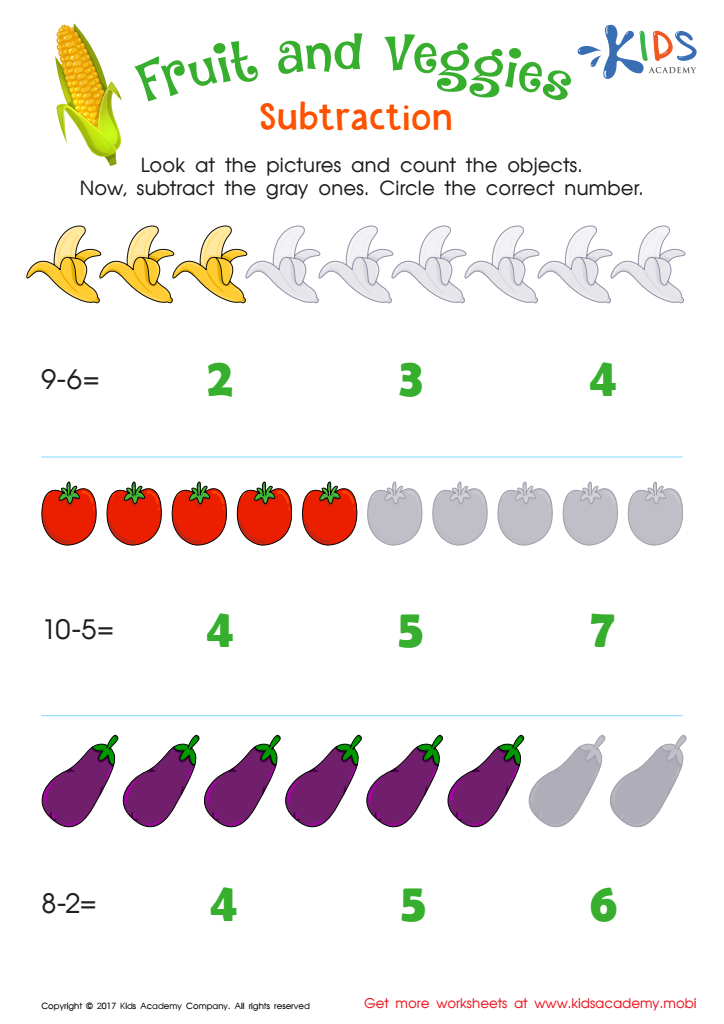
Fruit and Veggies Subtraction Worksheet
 Assign to My Students
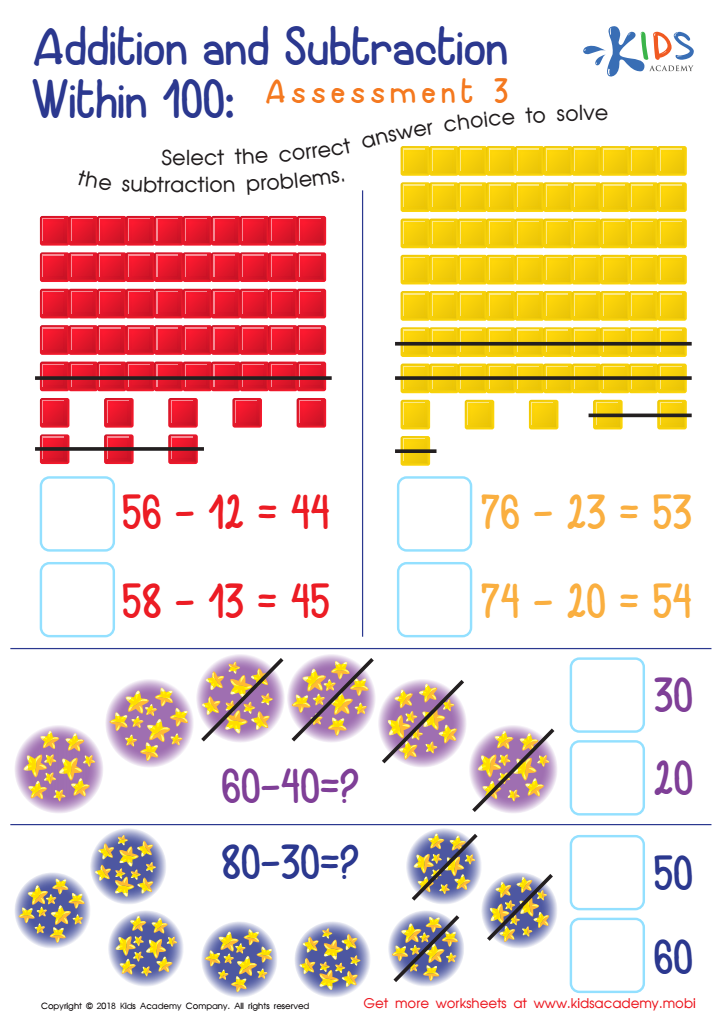
Addition and Subtraction Within 1: Assessment 3 Worksheet







Parents and teachers should prioritize subtraction skills for children aged 3-8 because these foundational math concepts are critical for cognitive development and problem-solving abilities. Mastering subtraction is essential for a child's overall numerical fluency, which builds a strong base for future mathematical learning. At this age, children are developing their understanding of quantity and number relationships; subtraction introduces them to the concept of 'taking away,' which helps interpret real-life situations.
Additionally, subtraction skills enhance critical thinking and analytical abilities. As children learn to subtract, they engage in logical reasoning and develop strategies to solve problems, which is vital in everyday tasks. Furthermore, strong subtraction skills correlate with improved performance in more complex mathematical operations as they progress.
Encouraging subtraction thinking through games, activities, and everyday scenarios reinforces learning, making it engaging and enjoyable. Parents and teachers play a pivotal role in guiding children through these concepts, fostering a positive attitude towards mathematics. This early encouragement not only boosts self-confidence but also empowers children to embrace challenges in mathematics as they grow. Overall, nurturing subtraction skills at this dynamic age lays the groundwork for a lifetime of mathematical understanding and appreciation.








