
Numerical recognition Math Worksheets for Ages 3-8
3 filtered results
Difficulty Level
Grade
Age
-
From - To
Subject
Activity
Standards
Discover our engaging Numerical Recognition Math Worksheets designed for children aged 3-8. Perfect for early learners, these printable resources help kids grasp numbers through fun, interactive activities. Each worksheet focuses on recognizing, tracing, and counting numbers, promoting foundational math skills in an exciting way. Whether at home or in the classroom, children enjoy these visually appealing exercises that transform learning into an adventure. Dive into a world where mastering numbers sets the stage for future math success. Explore our collection now and watch young minds light up with confidence and curiosity in numeracy studies!
Favorites
With answer key
Interactive
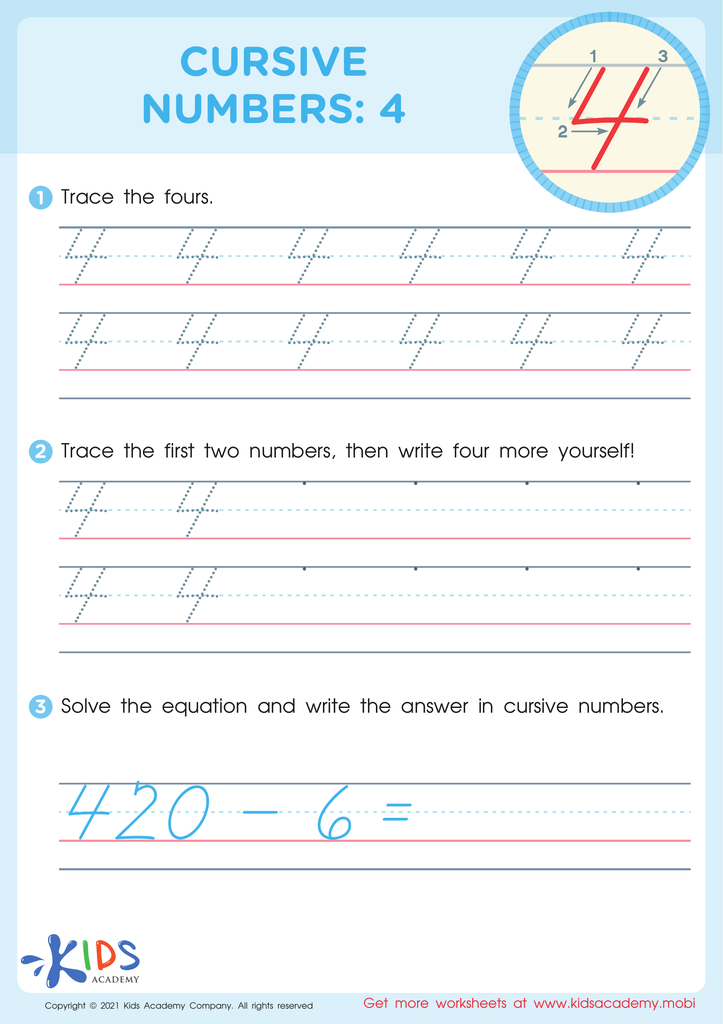
Cursive Numbers: 4 Worksheet
Math is challenging, and teaching cursive alongside it can be overwhelming. Make lessons enjoyable and your child will be more likely to stay engaged. Utilize worksheets to practice tracing the number 4 in cursive. With regular practice, your child can learn to write the number on their own.
Cursive Numbers: 4 Worksheet
Worksheet
Join Kids Academy for Free
Who is primarily going to use this learning content?








Numerical recognition is foundational for children's early cognitive development and academic success, making it essential for parents and teachers to prioritize it for ages 3-8. During these formative years, children's brains are exceptionally receptive to learning basic math concepts. Mastery in numerical recognition—identifying and understanding numbers—is crucial as it lays the groundwork for more complex mathematical operations such as addition, subtraction, multiplication, and division.
Numerical recognition enhances problem-solving skills, fosters logical thinking, and builds confidence. For instance, recognizing the number "5" is not just about naming it but also understanding that it represents a quantity, which is essential for manipulating numbers and comprehending word problems in the future. Early competence in numerical skills is closely linked to later academic achievement, as math proficiency is a strong predictor of success in other subjects, including science and technology.
Moreover, children regularly encounter real-world situations requiring numerical understanding, such as counting toys, understanding time, or managing small amounts of money. Therefore, nurturing numerical recognition in early childhood ensures they develop practical skills that enhance daily life. Creating a supportive, engaging learning environment at home and in classrooms helps instill a positive attitude toward math, reducing anxiety and encouraging a lifelong interest in the subject. Thus, numerical recognition is not just an academic requirement but a crucial life skill deserving early and focused attention.








