Understanding fact families Subtraction Worksheets for Ages 3-8
3 filtered results
-
From - To
Elevate your child's subtraction skills with our "Understanding Fact Families Subtraction Worksheets for Ages 3-8"! These engaging, age-appropriate worksheets help young learners grasp the concept of fact families and strengthen their subtraction abilities. Ideal for kids from preschool to early elementary school, these fun worksheets incorporate colorful illustrations and practical exercises that bolster confidence and proficiency in math. Available on Kids Academy, these printables provide a foundation for your child's future success in mathematics through hands-on learning. Prepare your little one for excellence with resources tailored for effective and enjoyable subtraction practice.
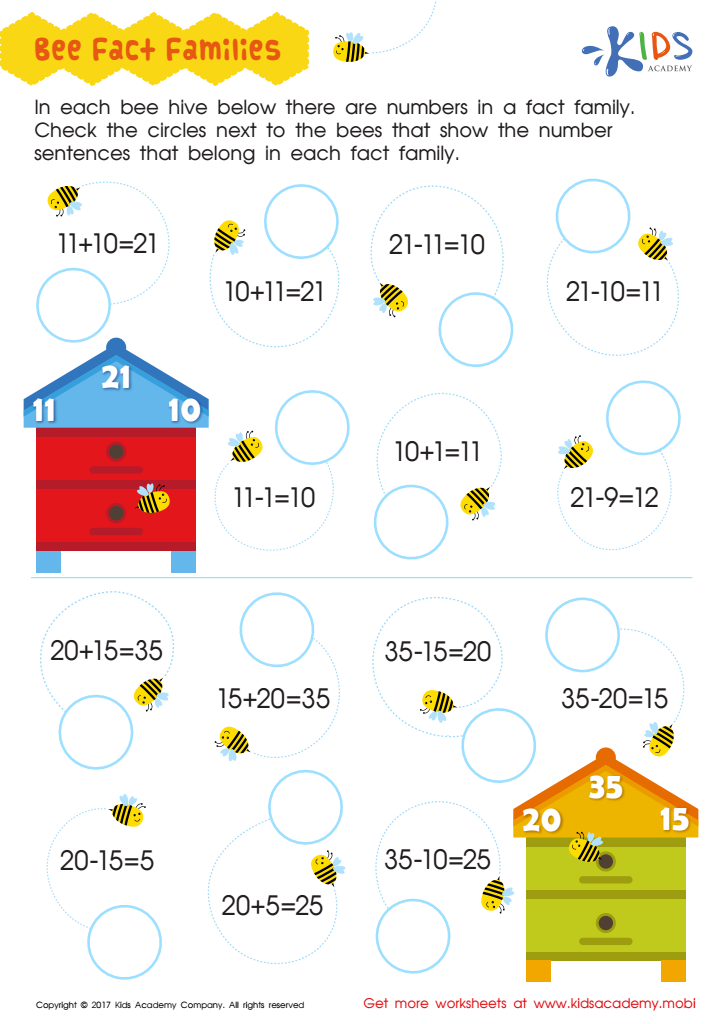
Fact Families Worksheet
 Assign to My Students
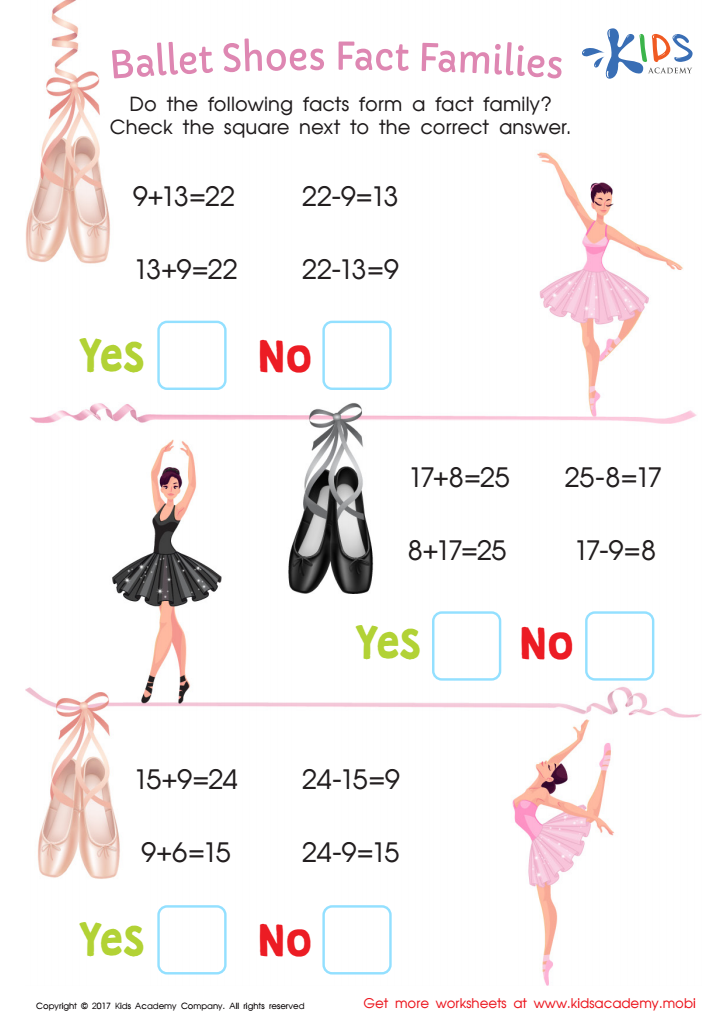
Ballet Shoes Fact Family Printable








Understanding fact families in subtraction is essential for young children, ages 3-8, as it lays the foundation for their mathematical comprehension and problem-solving skills. A fact family is a group of related math facts involving the same numbers. For example, in a fact family involving subtraction and addition, the numbers 9, 6, and 3 can create the equations 9 - 3 = 6, 9 - 6 = 3, 6 + 3 = 9, and 3 + 6 = 9.
Learning about fact families helps children recognize the relationships between numbers and operations, providing them with a stronger, more flexible understanding of math. This understanding fosters automaticity in basic arithmetic, making it easier for students to progress to more complex problems confidently. Being able to visualize number relationships aids in mental math skills, prompting quicker calculation and logical thinking.
Moreover, knowledge of fact families encourages mathematical communication. Children who grasp these concepts can explain their reasoning, benefiting their verbal and cognitive development. For parents and teachers, promoting understanding of fact families transforms abstract numbers into meaningful patterns. As children decipher these patterns, their enthusiasm for math can blossom, forming a solid early foundation crucial for future academic success in mathematics and other disciplines.








