
Mathematical understanding Worksheets for Ages 3-9
3 filtered results
Difficulty Level
Grade
Age
-
From - To
Subject
Activity
Standards
Discover our engaging Mathematical Understanding Worksheets designed specifically for children ages 3-9. These printable resources provide colorful, interactive activities that introduce essential math concepts such as counting, addition, subtraction, shapes, and patterns. Our worksheets promote hands-on learning, enabling young learners to develop critical thinking and problem-solving skills in a fun and approachable way. Ideal for both classroom use and at-home learning, our worksheets cater to various learning styles. Support your child’s early mathematical development while nurturing a love for learning. Explore our collection today to inspire confidence and competency in math from a young age!
Favorites
With answer key
Interactive
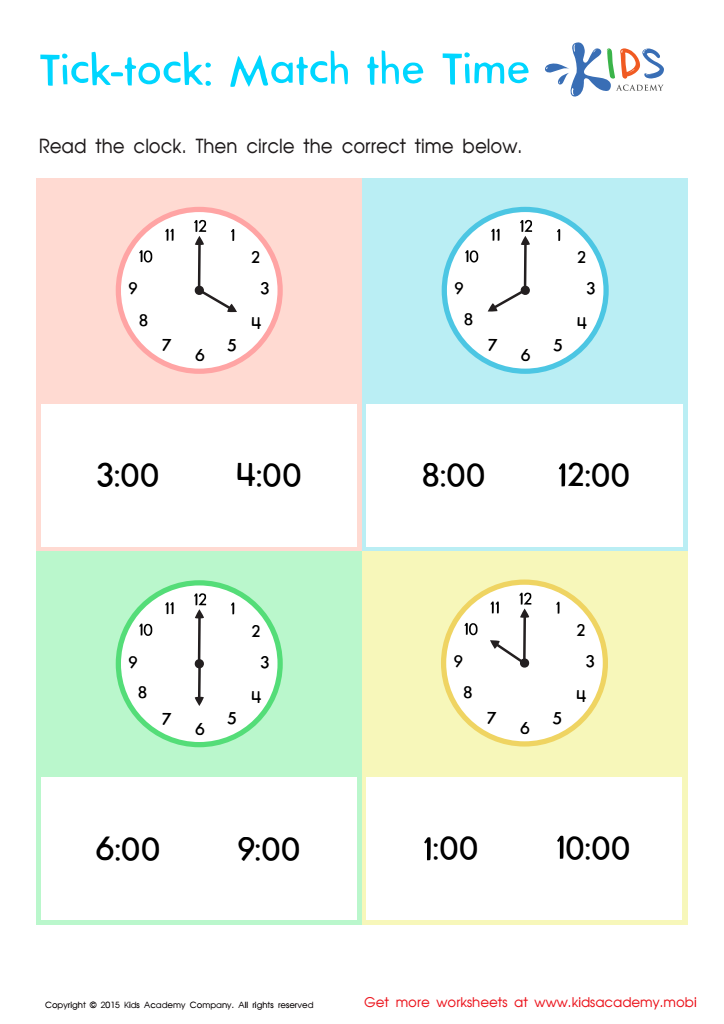
Telling The Time Worksheet: Part 4
Test your skills in telling the time! Circle the right time on 4 analog clock faces.
 Assign to My Students
Telling The Time Worksheet: Part 4
Worksheet
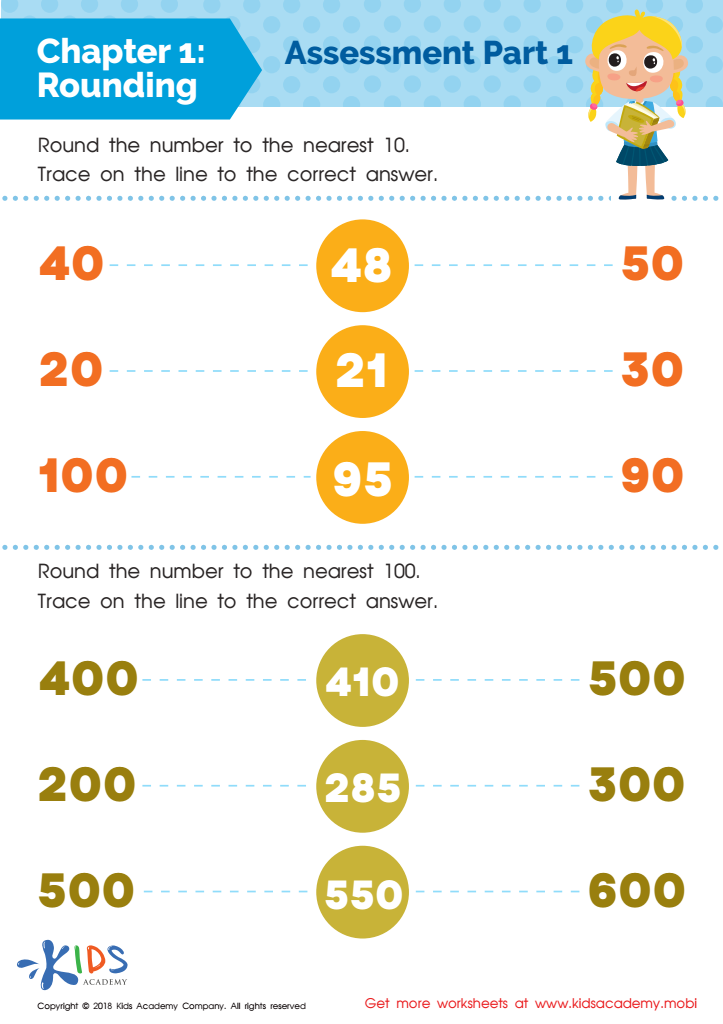
Rounding Worksheet 3rd Grade
Practice and refresh your child's 3rd grade rounding skills with this quick worksheet! Have them round each set of numbers to the nearest 10s or 100s. This simple exercise will help maintain math fluency.
Rounding Worksheet 3rd Grade
Worksheet
Join Kids Academy for Free
Who is primarily going to use this learning content?







Mathematical understanding for children aged 3-9 is foundational for developing essential critical thinking skills and cognitive abilities. During these formative years, children are naturally inclined to explore patterns, relationships, and problem-solving. Parents and teachers play a crucial role in nurturing this exploration, as a solid grasp of mathematical concepts fosters greater academic success later on.
Math is more than just numbers; it promotes logical reasoning, helps in understanding shapes and spatial relationships, and develops skills such as counting, measuring, and classifying. These skills are integrated into everyday activities—whether sorting toys, cooking, or even playing games—which means mathematical understanding can be reinforced in a fun and engaging way.
Additionally, early math skills have been linked to later academic achievement in various subjects, including literacy. It also boosts confidence and encourages persistence when facing challenges. Moreover, early exposure to mathematical language and concepts provides a framework for later advanced math learning, making it easier for children to navigate more complex topics as they grow.
In short, by prioritizing mathematical understanding, parents and teachers set the stage for lifelong learning and problem-solving abilities, helping children become competent, confident individuals prepared to face future challenges.








