Number counting Worksheets for Ages 3-9
4 filtered results
-
From - To
Discover the joy of learning with our Number Counting Worksheets for Ages 3-9 at Kids Academy! Expertly designed to foster number recognition and basic math skills, our fun and engaging worksheets help young minds grasp counting concepts from one to 100. Perfect for preschool, kindergarten, and early elementary students, these resources offer various activities including matching, sequencing, and simple addition. Created by educators, each printable sheet encourages independent learning and critical thinking. Support your child's numerical journey with our high-quality, easily accessible material. Start building a strong math foundation today! Visit [link] for endless learning fun.
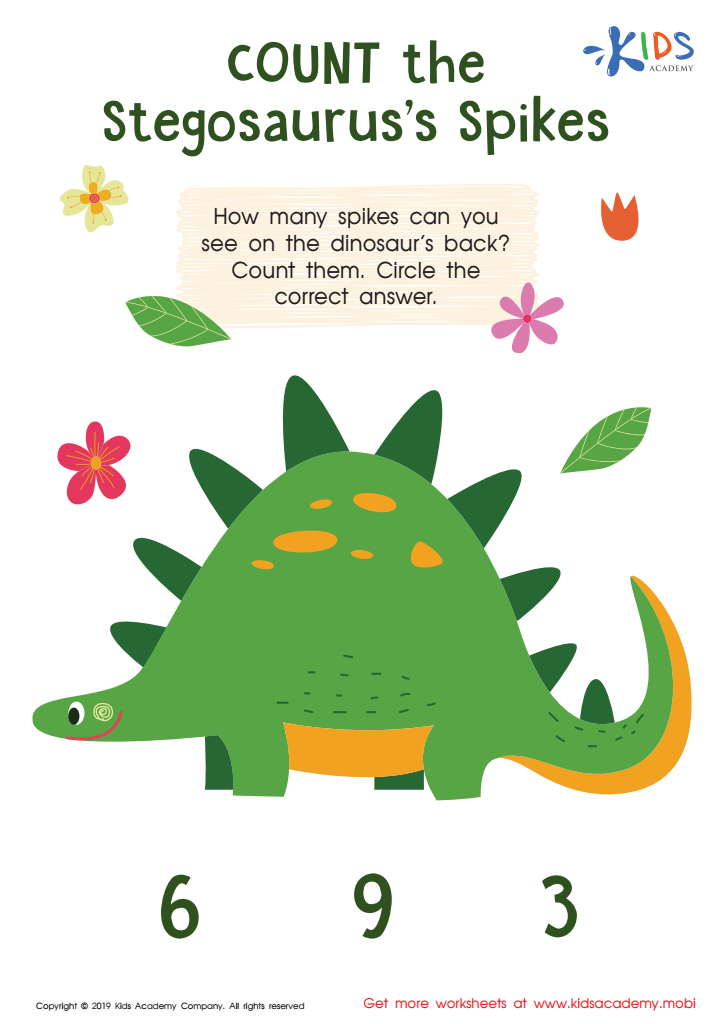
Count the Stegosaurus's Spikes Worksheet
 Assign to My Students
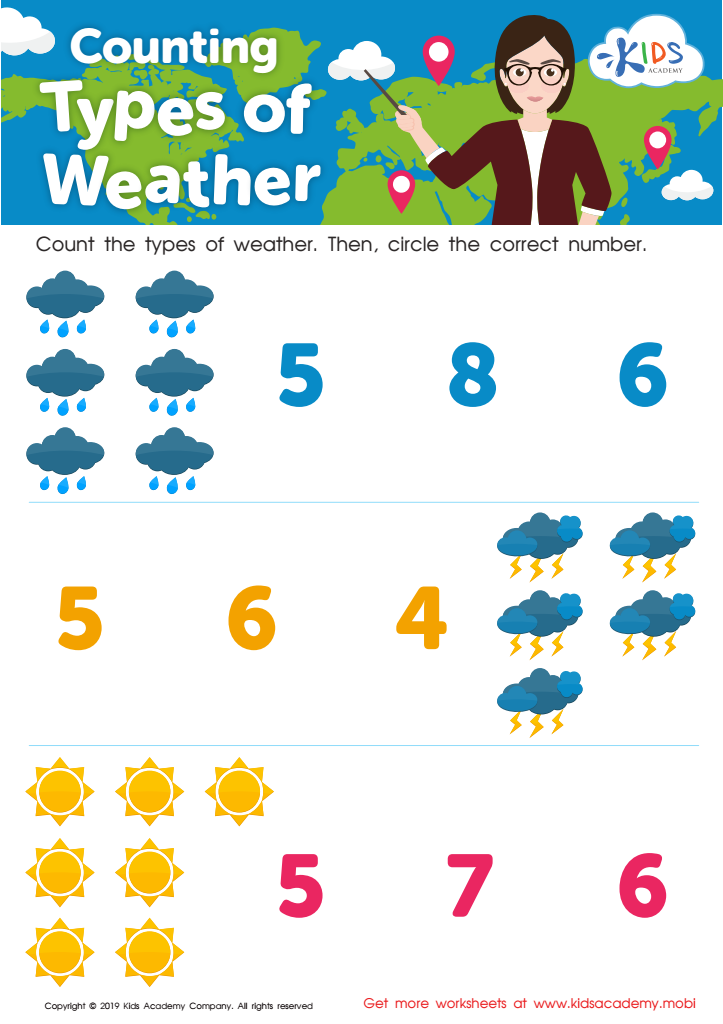
Counting Types of Weather Worksheet





Number counting is a foundational skill that is crucial for the cognitive development of children aged 3-9. In this critical period, children are like sponges, absorbing information rapidly. Number counting not only prepares them for more advanced mathematical concepts but also improves their overall logical reasoning and problem-solving skills.
For parents and teachers, embedding number counting in daily activities can foster a child's ability to understand sequences, measure quantities, and recognize patterns—all essential skills for academic success. Early competence in counting boosts a child's confidence and eagerness to tackle more complex mathematical challenges, such as addition, subtraction, and multiplication.
Furthermore, counting helps children develop fine motor skills when they use their fingers or objects to count. It enhances their attention and memory and introduces them to the concept of one-to-one correspondence, where each object being counted corresponds to one number, laying the groundwork for further educational activities.
Integrating counting in playful contexts like games, songs, or stories captures children’s interest and makes learning enjoyable. Thus, parents and teachers play a pivotal role in nurturing a child's early numeracy skills, setting them up for ongoing academic and real-world success. Taking an active interest in developing these skills not only benefits the child's mathematical understanding but also their overall intellectual growth.








