Numerical reasoning Worksheets for Ages 3-9
5 filtered results
-
From - To
Unlock your child's mathematical potential with our "Numerical Reasoning Worksheets for Ages 3-9." Designed to inspire young minds, these printable worksheets promote critical thinking and problem-solving skills through engaging activities. From counting and recognizing numbers to basic arithmetic and logic puzzles, each worksheet follows educational standards to ensure age-appropriate learning. Perfect for at-home practice or additional classroom resources, our worksheets help kids build a solid numerical foundation while making learning fun. Discover a variety of expertly crafted activities that cater to different abilities and boost your child's confidence in math. Start their journey to numerical mastery today!
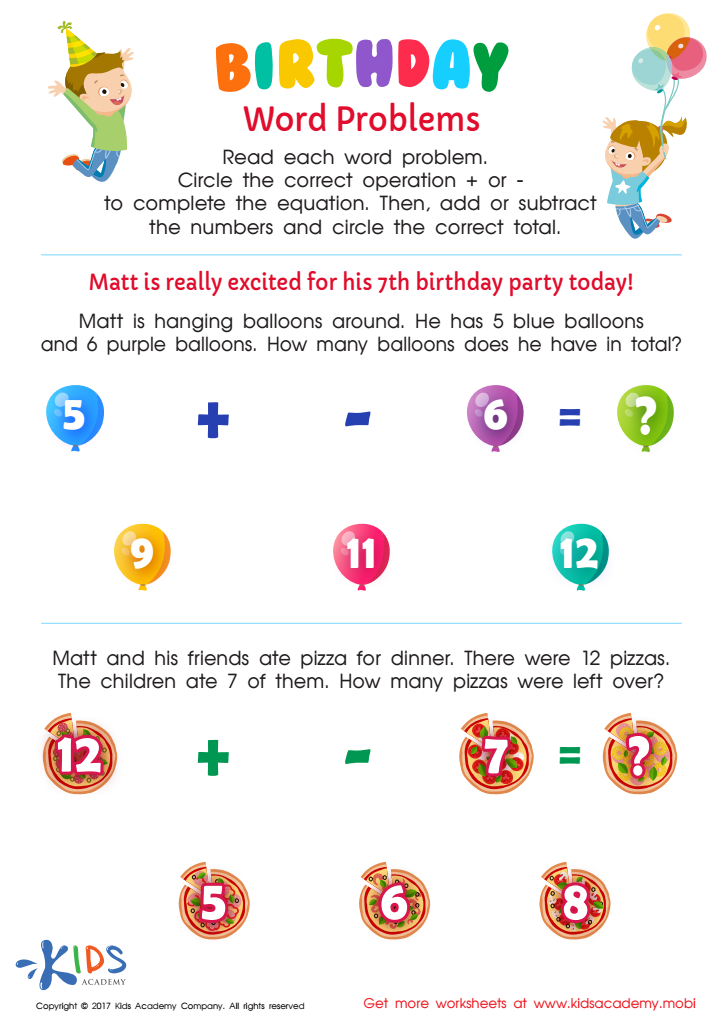
Birthday Word Problems Substraction Worksheet
 Assign to My Students








Numerical reasoning encompasses the ability to understand, interpret, and reason with numbers, and it forms the bedrock of later mathematical abilities. Parents and teachers of children ages 3-9 should prioritize numerical reasoning because it establishes early foundational skills essential for academic success. During this critical period, children are highly receptive to learning and can grasp basic mathematical concepts like counting, sorting, and recognizing patterns, which pave the way for more complex problem-solving abilities later on.
Fostering numerical reasoning enhances cognitive development. Skills such as logical thinking, spatial awareness, and the ability to make connections between different pieces of information are all strengthened. These cognitive abilities extend beyond mathematics, impacting areas like reading comprehension and even creative thinking.
Furthermore, early competence in numerical reasoning is linked to better performance in school. Children who develop strong number sense early on often exhibit higher confidence in tackling new problems, fostering a positive attitude toward learning in general. This can diminish math anxiety, which is beneficial as mathematical concepts become more complex.
In addition, numerical reasoning skills are practical and applicable in everyday life, from managing time to handling money. By actively engaging in numerically focused activities, parents and teachers equip children not only for academic milestones but for everyday decision-making and problem-solving, setting the stage for lifelong success.








