Telling time Worksheets for Ages 3-9
4 filtered results
-
From - To
Telling time is an essential skill for young learners, and our Telling Time Worksheets cater to children aged 3-9 to make learning time-telling fun and engaging! Designed to suit varying levels of understanding, these worksheets cover everything from basic hour and half-hour recognition for younger kids to more complex minute tracking and digital time for older children. They feature colorful, kid-friendly visuals and interactive activities that turn learning into play. These worksheets not only enhance time-telling skills but also boost confidence and critical thinking abilities. Ideal for both classroom and home use, they are a fantastic resource for effective learning.
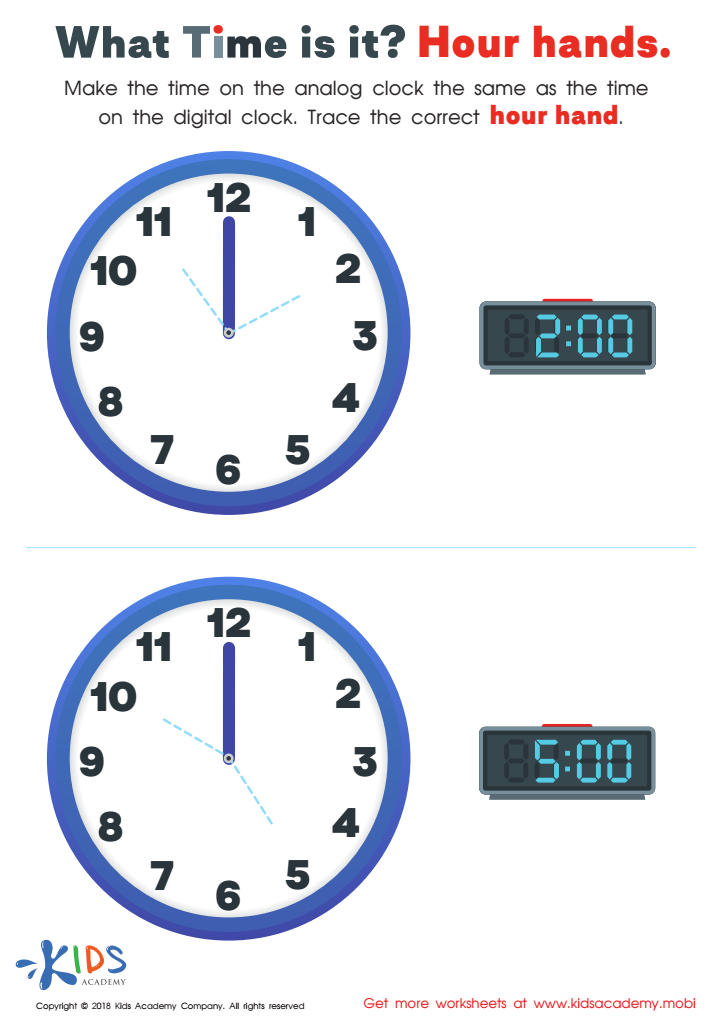
What Time Is it? Hour Hands Worksheet
 Assign to My Students




.jpg)

Teaching children to tell time from ages 3 to 9 is incredibly valuable for several reasons. First, understanding time fosters a sense of routine and consistency. Young children thrive on routines, and knowing how to tell time helps them anticipate daily events such as meal times, playtime, and bedtime, making them feel more secure and organized.
Second, learning to tell time teaches math skills. Reading a clock involves understanding numbers, skip counting by 5s, and basic addition and subtraction. It also introduces children to the concepts of hours, minutes, and seconds, building a natural bridge to more complex mathematical concepts they will encounter later.
Third, telling time enhances time management abilities. As children grow older, they need to be able to manage their own schedules, complete tasks within given time frames, and prioritize activities. Early familiarity with telling time aids them in these essential skills.
Moreover, telling time nurtures problem-solving and critical thinking. Figuring out how much time is left before a particular activity or converting time spans helps with cognitive development.
Lastly, it boosts their confidence and independence. When children can tell time, they feel more confident in navigating their days, making them more self-reliant individuals.
For all these reasons, parents and teachers should emphasize teaching time-telling skills to young children.








