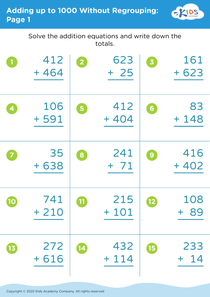
Fine Motor Skills Adding up to 1000 with Regrouping Worksheets for Ages 3-9
4 filtered results
-
From - To
Enhance your child's fine motor skills while mastering addition with our "Fine Motor Skills Adding Up to 1000 with Regrouping Worksheets" designed for ages 3-9. These engaging worksheets combine essential math practice with activities that promote hand-eye coordination, dexterity, and concentration. Children will enjoy tracing, coloring, and solving math problems, absorbing fundamental concepts while developing strength and control in their hands. Our printable resources provide a fun, hands-on approach to learning that keeps little learners motivated. Support your child's educational journey with effective tools that nurture their math abilities and fine motor development, setting the stage for future success in school!
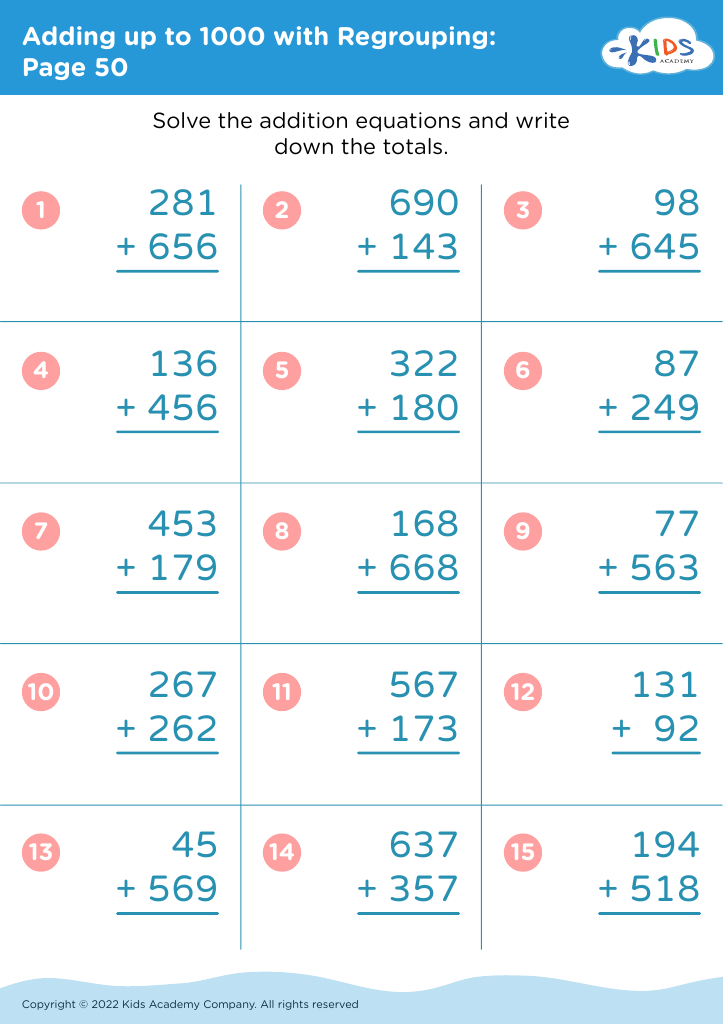
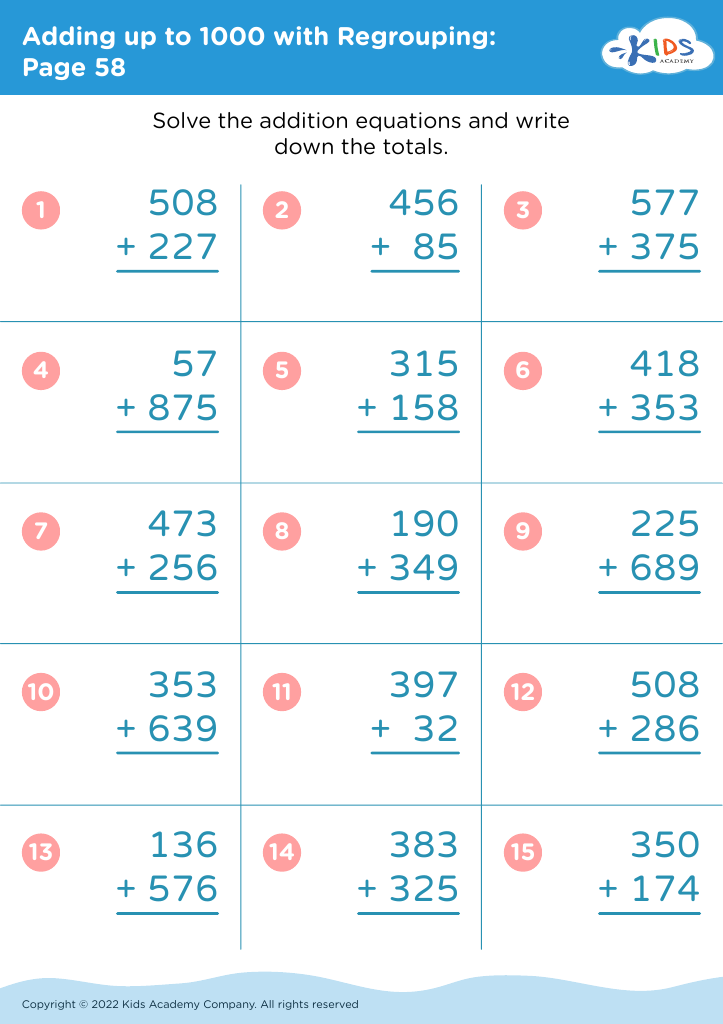
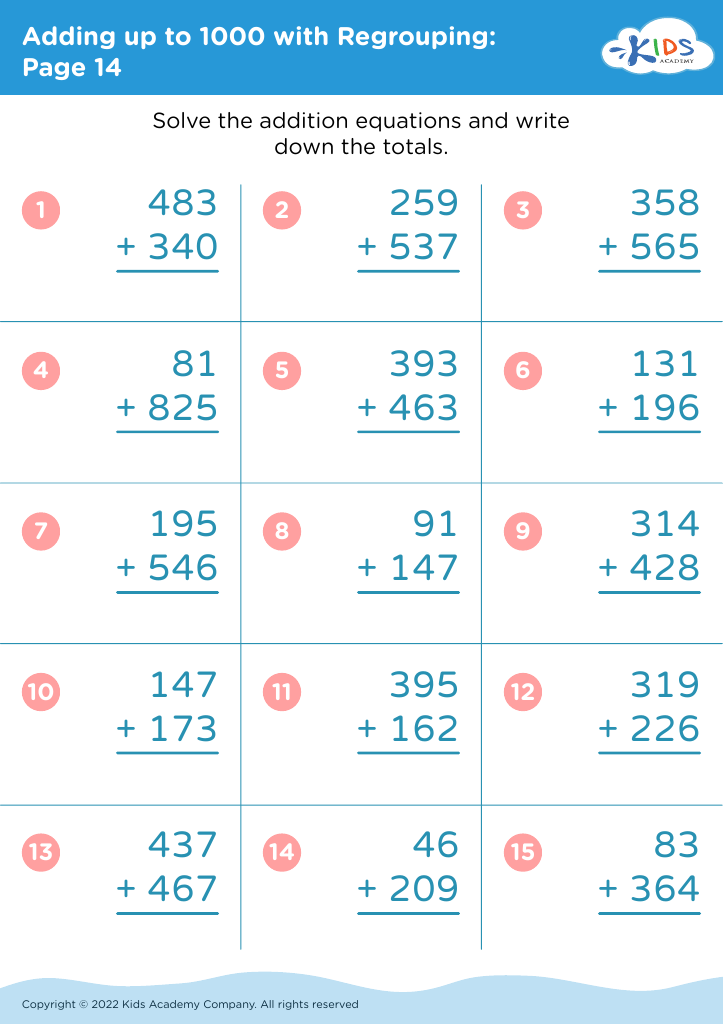
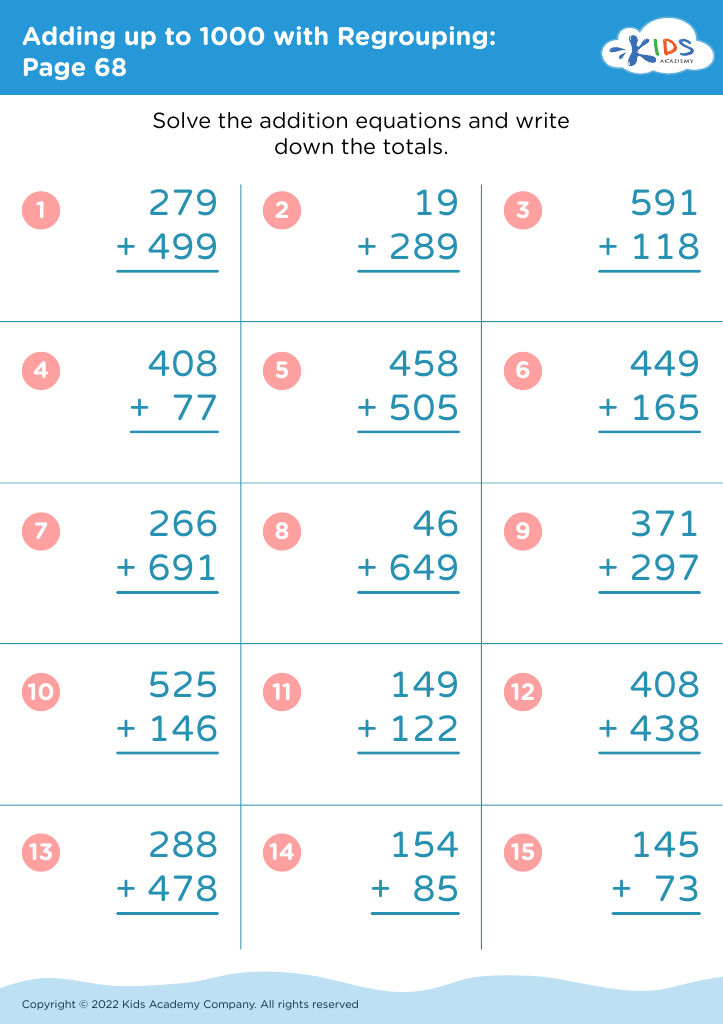


Fine motor skills are crucial for young children's overall development and are particularly important when learning complex concepts like addition with regrouping. For children ages 3-9, these skills support various daily activities, such as writing, drawing, and managing small items. When children possess well-developed fine motor skills, they find it easier to manipulate pens and pencils, which are essential for performing mathematical calculations.
Regrouping in addition can be conceptually challenging for young learners, as it requires a clear understanding of quantity and place value. Fine motor skills enhance this learning by enabling children to use manipulatives—like beads or counters—effectively. Handling these tools promotes kinesthetic learning, helping children visualize the problem's components as they move pieces to successfully regroup and add.
Moreover, strong fine motor skills can boost children's confidence, aiding in their willingness to tackle more complex math problems. When parents and teachers focus on developing fine motor skills, they not only improve children's math abilities but also lay a foundation for lifelong learning and problem-solving. Thus, investing time in fostering fine motor skills is essential for fostering academic success and ensuring children develop a strong mathematical aptitude from an early age.