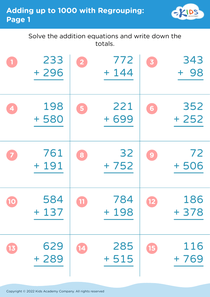
Recognizing shapes Adding up to 1000 Without Regrouping Worksheets for Ages 3-9
3 filtered results
-
From - To
Welcome to our "Recognizing Shapes and Adding Up to 1000 Without Regrouping" worksheets, specially designed for children aged 3-9! These engaging activities integrate shape recognition with fundamental addition skills, guiding young learners to explore geometric forms while mastering simple arithmetic. Our worksheets are interactive and visually appealing, making learning both fun and effective. Perfect for classroom enrichment or at-home practice, they help build a solid foundation in mathematics without introducing regrouping concepts. Encourage your child's creativity and critical thinking skills as they navigate through colorful shapes and numbers. Discover the joy of learning with our thoughtfully crafted resources today!
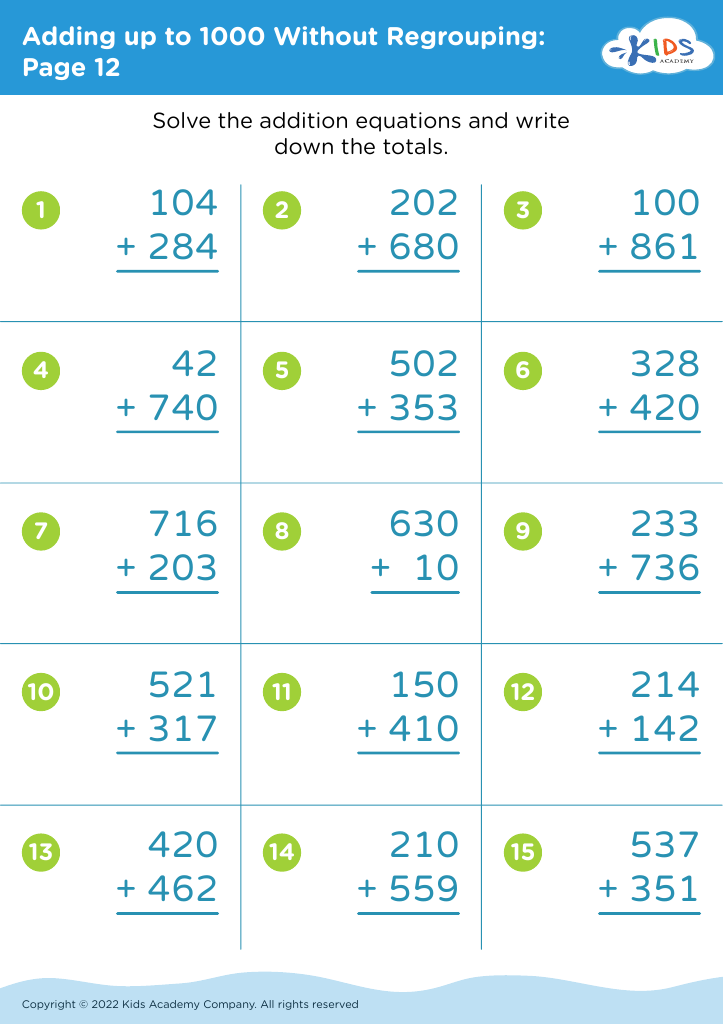
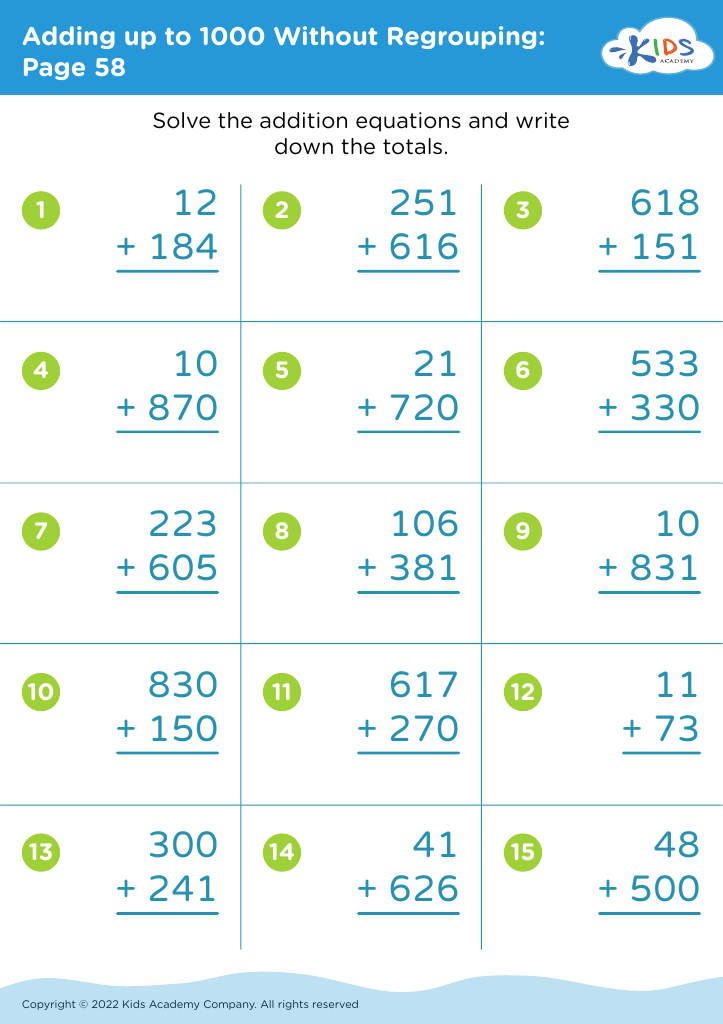
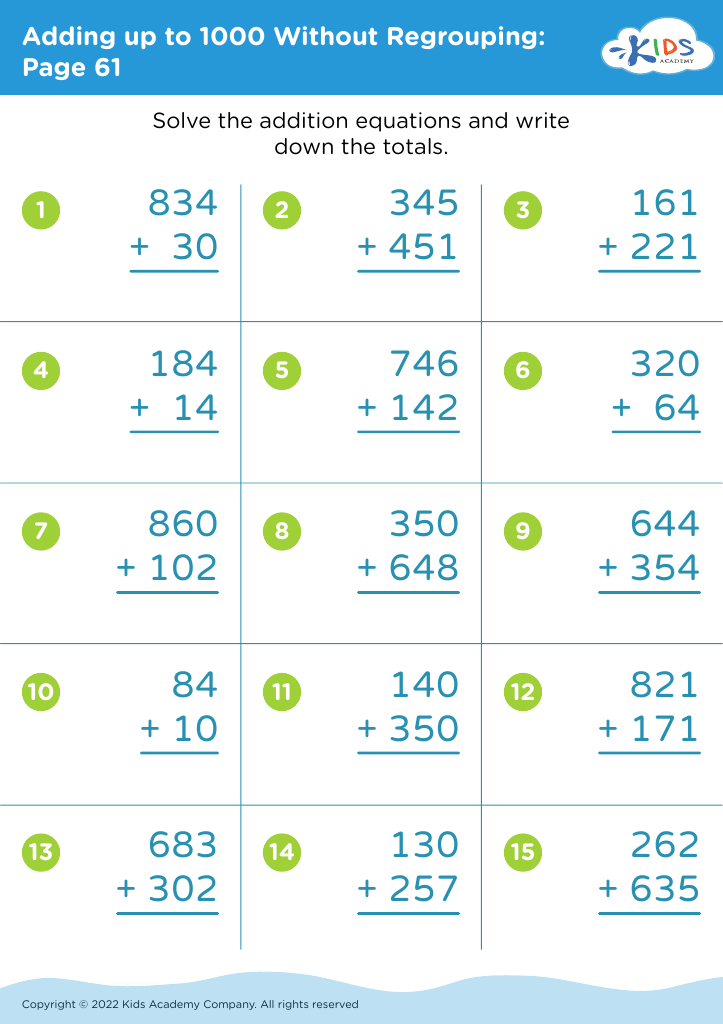


Recognizing shapes and adding up to 1000 without regrouping are foundational skills in early childhood education, pivotal for fostering cognitive development in children aged 3 to 9. Shape recognition lays the groundwork for critical thinking and spatial awareness, essential skills in mathematics, art, and everyday problem-solving. Understanding different shapes also supports early geometry concepts, enhancing children's ability to visualize and interpret the world around them.
Similarly, adding up to 1000 without regrouping engages computational skills, teaching children how to manipulate numbers with confidence. This skill helps youngsters develop a number sense, allowing them to understand basic arithmetic operations and comprehend larger numbers. By employing simple, familiar numbers, children can focus on building their addition strategies without the added complexity of regrouping, leading to a stronger mathematical foundation.
Parents and teachers should prioritize these skills, as they not only promote academic success but also encourage logical reasoning and perseverance. Early mastery of shapes and basic addition empowers children, providing them with the flexibility to tackle more complex mathematical concepts in the future. Ultimately, cultivating these skills enriches children's educational experiences and sets them up for lifelong learning and achievement.