Color Identification Addition & Subtraction Worksheets for Ages 3-9 - Page 2
27 filtered results
-
From - To
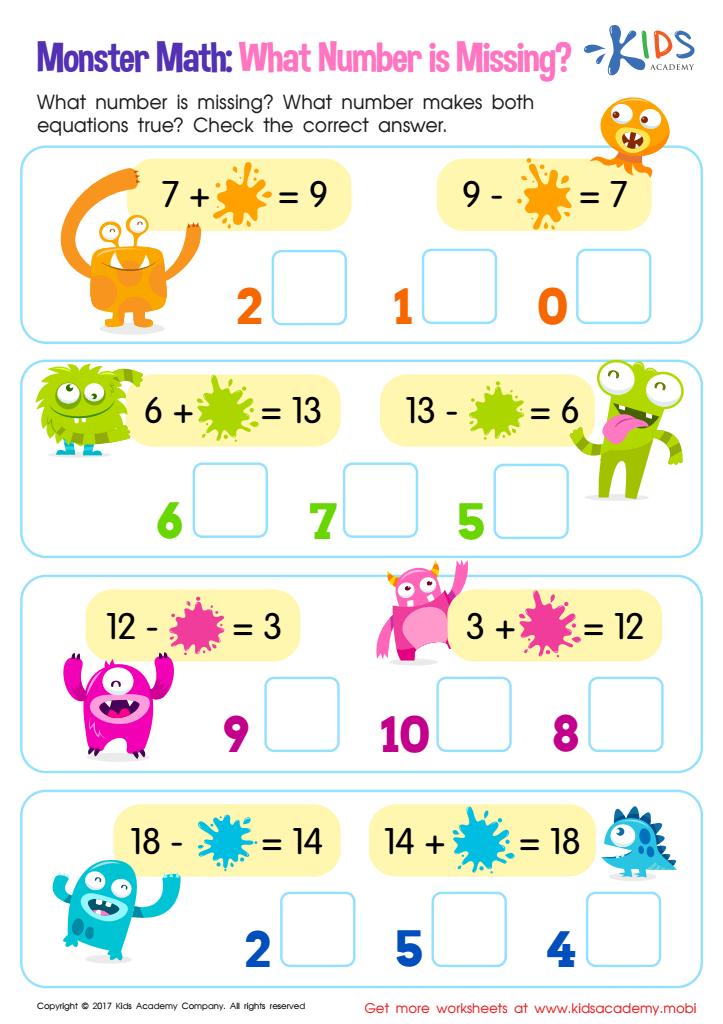
Missing Number: Monster Math Worksheet
 Assign to My Students








Color identification, along with addition and subtraction, is a vital component of early childhood education for children aged 3-9. Understanding colors helps develop cognitive skills, including recognition and categorization, which are foundational for literacy and numeracy. When children engage in activities that involve color identification while practicing basic math skills, they are not only enhancing their mathematical understanding but also boosting their overall motivation and enjoyment in learning.
Incorporating colors into addition and subtraction activities can make math more visually engaging and interactive, catering to various learning styles. For instance, using colored counters or blocks can help learners visualize mathematical concepts, making abstract ideas more tangible. This multisensory approach strengthens memory retention and fosters a deeper understanding of relationships between numbers.
Parents and teachers should prioritize these skills since early mastery sets the tone for more complex mathematical structures later on. Additionally, engaging in fun, colorful activities fosters positive parent-child or teacher-child interactions, promoting social-emotional development. As children build these foundational skills, they gain confidence and a love for learning, laying the groundwork for future academic success. Encouraging color identification and early math creates a well-rounded educational experience that can significantly impact a child's ability to learn.








