Identifying shapes Addition & Subtraction Worksheets for Ages 3-9 - Page 2
25 filtered results
-
From - To
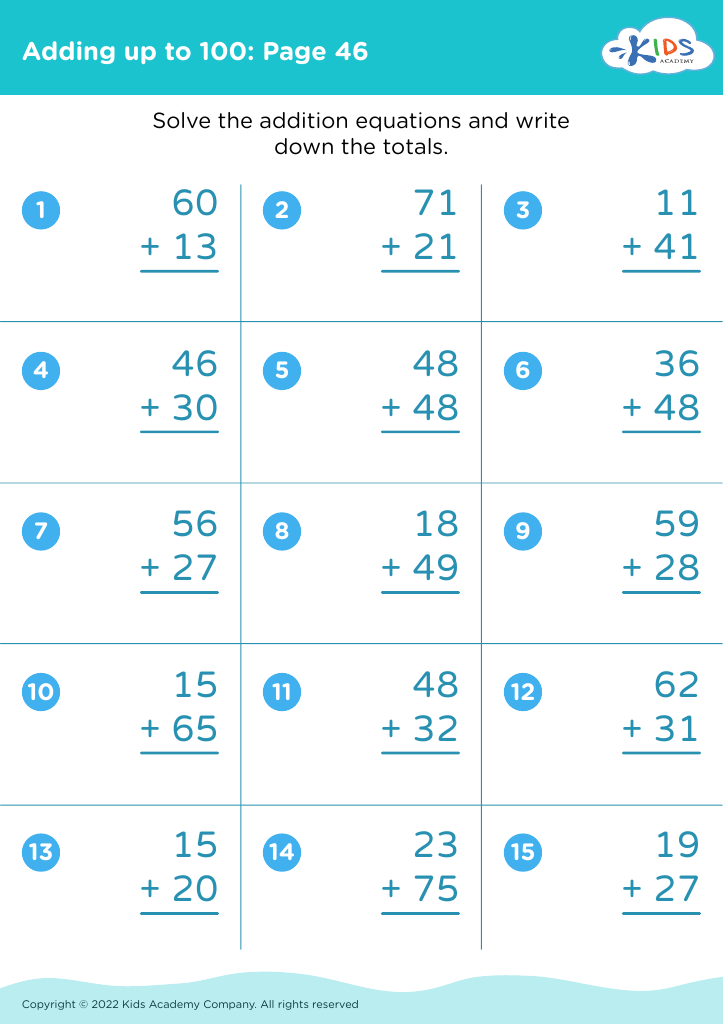








Identifying shapes and mastering basic addition and subtraction are foundational skills critical for children's cognitive development, particularly for those aged 3-9. These competencies are not merely academic; they contribute significantly to problem-solving, logical thinking, and spatial awareness, which are essential in everyday life.
For parents and teachers, fostering shape recognition helps children understand the properties and relationships of different objects around them, aiding in their ability to categorize and organize their environment. This skill can enhance fine motor skills as students engage in activities involving shapes, such as drawing, crafting, or building.
Addition and subtraction are equally crucial, serving as the building blocks for mathematical skills. Early mastery in these areas creates confidence and lays a strong groundwork for future mathematical learning. These skills teach children how to quantify, compare, and solve problems, which are vital in academic settings and real-world situations.
Furthermore, early engagement with shapes and basic operations builds a positive attitude toward learning. It promotes critical thinking and lays the foundation for more complex mathematical concepts in later years, making it imperative that parents and teachers prioritize these skills. Investing time and resources in this early education fosters a brighter future for children.








