
Understanding money Addition & Subtraction Worksheets for Ages 3-9
4 filtered results
Difficulty Level
Grade
Age
-
From - To
Subject
Activity
Standards
Help your child master the basics of money, addition, and subtraction with our engaging worksheets designed for ages 3-9. These printable exercises use fun and interactive methods to teach kids how to count money, make transactions, and understand value. Our worksheets combine math skills with practical real-world applications, ensuring a comprehensive learning experience. With colorful illustrations and easy-to-follow instructions, these worksheets make learning about money enjoyable and effective. Build a strong foundation in math while boosting financial literacy and confidence in young learners. Perfect for educators and parents aiming to support early childhood math education.
Favorites
With answer key
Interactive
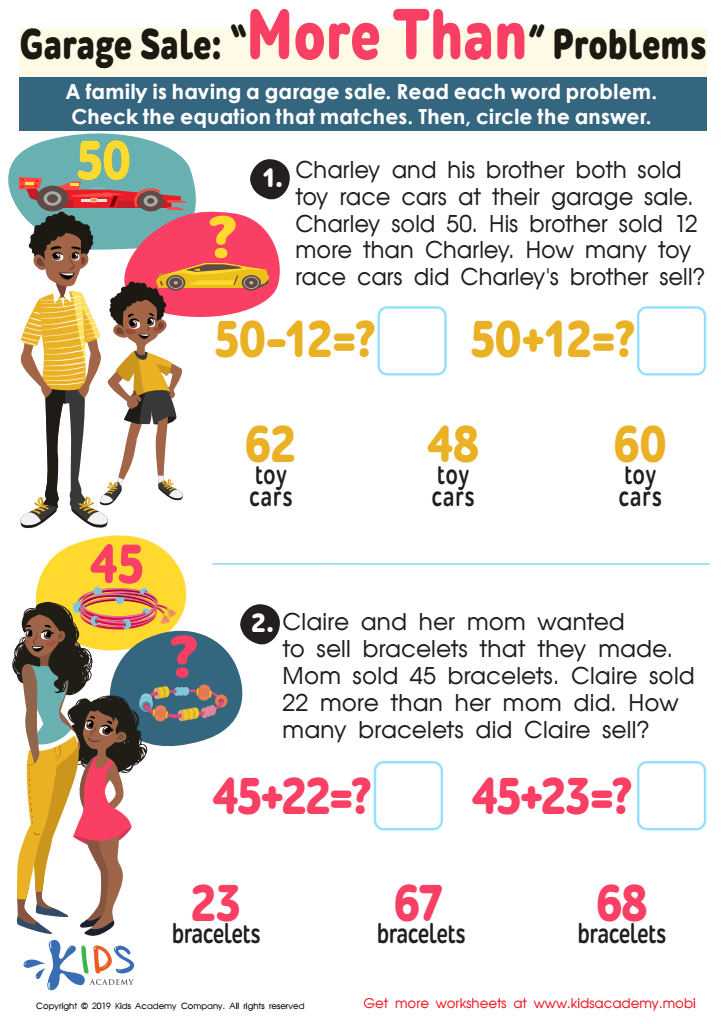
Garage Sale - More yhan Worksheet
The whole family can join in on the fun with this free worksheet! It helps kids practice math word problems while assisting their friends with a garage sale. Kids learn to identify "More Than" key words and pick the right equation, improving their order of operations skills. Download the PDF and get started!
 Assign to My Students
Garage Sale - More yhan Worksheet
Worksheet
Join Kids Academy for Free
Who is primarily going to use this learning content?








Understanding money addition and subtraction at an early age is crucial for children because it lays the foundation for essential life skills such as financial literacy and critical thinking. For ages 3-9, these concepts introduce the basics of mathematics in a practical, engaging manner, making learning fun and meaningful.
Firstly, teaching children how to add and subtract money helps them grasp the value of money. This understanding cultivates a sense of responsibility and encourages mindful spending habits. When children understand that buying a toy means giving up a certain amount of money, they begin to appreciate budgeting and the concept of saving.
Secondly, integrating money-related problems enhances their math skills. Solving real-world problems involving money strengthens their ability to perform addition and subtraction, which are fundamental math concepts. It makes abstract ideas concrete, solidifying their comprehension through everyday activities like shopping or playing store games.
Furthermore, early exposure to money concepts helps improve critical thinking and problem-solving skills. Children learn to make decisions based on numerical reasoning, enhancing their cognitive development.
In conclusion, teaching money addition and subtraction to children ages 3-9 is essential for developing strong math skills, financial awareness, and critical thinking. This early foundation empowers them with the tools needed for a financially responsible and mathematically competent future.








