Understanding patterns Addition & Subtraction Worksheets for Ages 3-9 - Page 2
34 filtered results
-
From - To
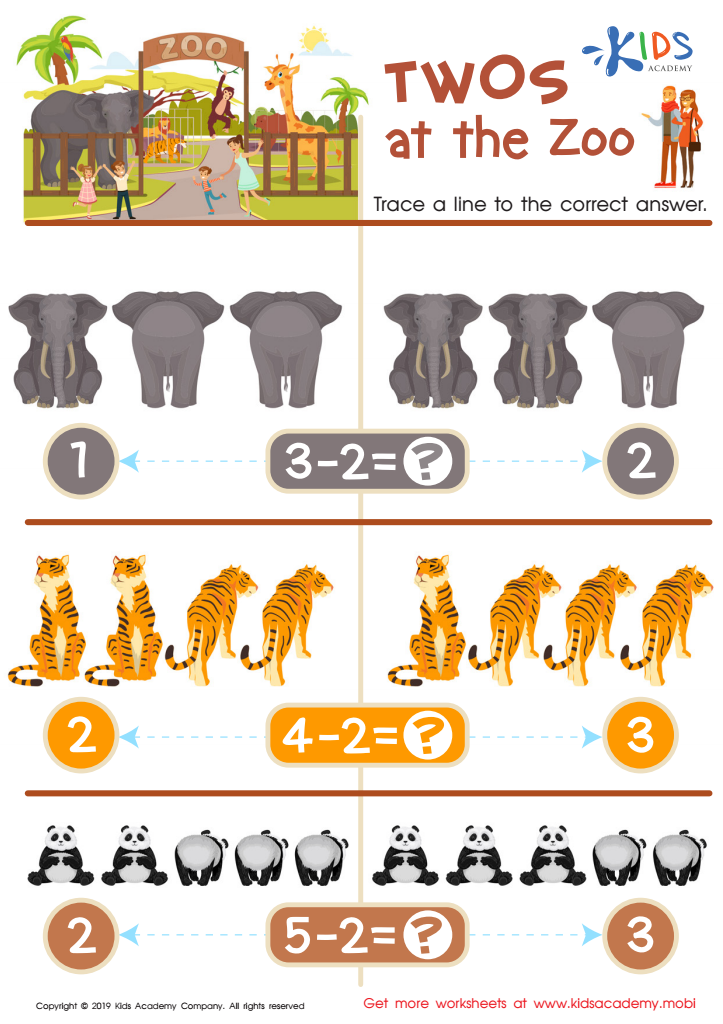
Twos at the Zoo Worksheet
 Assign to My Students








Understanding patterns of addition and subtraction is foundational for young children aged 3-9 because it sets the stage for all future mathematics learning. For parents and teachers, nurturing these skills early on equates to investing in a child’s cognitive development and problem-solving abilities.
Firstly, recognizing patterns helps children build number sense, which is the ability to understand and work with numbers flexibly. By spotting patterns in addition and subtraction, such as "adding one more each time" or "taking two away repeatedly," children grasp the concepts of these operations more intuitively. This early understanding bolsters their confidence and paves the way for tackling more complex mathematical challenges later on.
Moreover, pattern recognition aids in the development of critical thinking skills. Children learn to observe, predict, and check their work, skills that are valuable not just in mathematics but across all areas of learning and daily life. Furthermore, being adept at basic arithmetic supports their performance in school, boosts self-esteem, and fosters a positive attitude toward learning.
Lastly, connecting these patterns to real-world experiences makes learning more meaningful. Simple activities like counting toys, drawing shapes, or sharing fruits can apply addition and subtraction in everyday contexts, making them fun and relevant for children. For parents and teachers, this enhances engagement and helps instill a lifelong love for mathematics.








