
Improve vocabulary Math Worksheets for Ages 3-9
3 filtered results
Difficulty Level
Grade
Age
-
From - To
Subject
Activity
Standards
Enhance your child’s mathematical vocabulary with our expertly designed Math Worksheets for Ages 3-9 at Kids Academy. These engaging, printable worksheets not only bolster essential math skills but also enrich language development by introducing key terms and concepts. Perfect for preschoolers and elementary students, our activities cover counting, addition, subtraction, shapes, and more, ensuring a solid foundation. With vibrant illustrations and interactive exercises, learning becomes a fun and rewarding experience for young learners. Empower your child’s academic journey—explore our library of Math Vocabulary Worksheets today and see their confidence soar!
Favorites
With answer key
Interactive
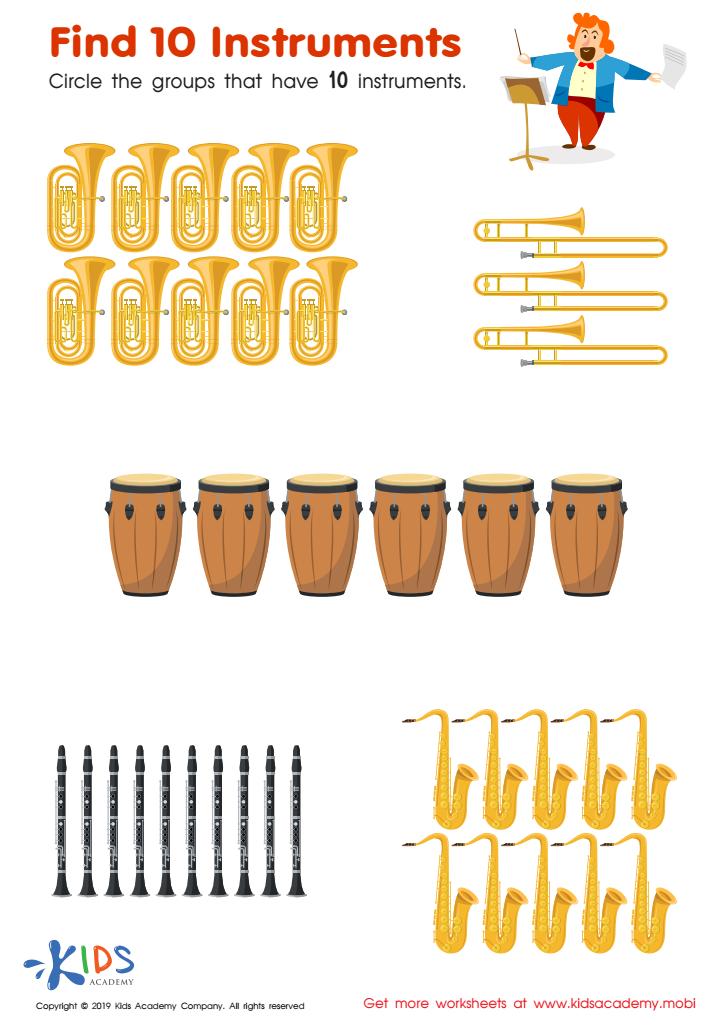
Find 10 Instruments Worksheet
Teach your kids to count with educational DVDs, video games and this worksheet. Show them the picture and help them count the instruments, then circle the groups of 10. It's a great way to practice counting numbers, one of the first things they'll learn.
 Assign to My Students
Find 10 Instruments Worksheet
Worksheet
Join Kids Academy for Free
Who is primarily going to use this learning content?








Improving vocabulary in math for children ages 3-9 is essential for both cognitive development and academic success. At these early stages, a robust math vocabulary helps children grasp fundamental concepts more quickly and accurately. Words like "equal," "add," "subtract," "more," and "less" form the building blocks of mathematical understanding. When children are familiar with these terms, they can follow instructions better, articulate questions, and solve problems more efficiently.
Additionally, a strong math vocabulary enhances overall literacy skills. Many math problems involve reading and interpreting sentences, so a better vocabulary can improve reading comprehension. This, in turn, supports learning across all subjects. It’s not just about numbers; math vocabulary connects to logical thinking and problem-solving skills that are invaluable throughout life.
For parents and teachers, focusing on math vocabulary can make learning more interactive and engaging. Through games, hands-on activities, and real-life scenarios, children can see the relevance and fun in math. Encouraging mathematical discussions at home and in the classroom builds confidence and reduces math anxiety.
Moreover, early exposure to math vocabulary sets the foundation for advanced math topics children will encounter later. It’s an investment in their future academic achievements and critical thinking skills. In short, fostering a strong math vocabulary for young learners is crucial for their comprehensive development and future success.








