
Practice problem-solving Math Worksheets for Ages 3-9
5 filtered results
Difficulty Level
Grade
Age
-
From - To
Subject
Activity
Standards
Enhance your child's problem-solving abilities with our targeted Math Worksheets for Ages 3-9. Designed by educational experts, these printable worksheets help young learners develop essential math skills in a fun and engaging way. From basic counting and number recognition to more complex addition and subtraction problems, our resources cater to various learning levels. Fun activities and colorful illustrations make math enjoyable, encouraging consistent practice and improvement. Unlock your child's potential and boost their confidence with our comprehensive math worksheets, tailored to support early learners on their educational journey. Start exploring now at Kids Academy!
Favorites
With answer key
Interactive
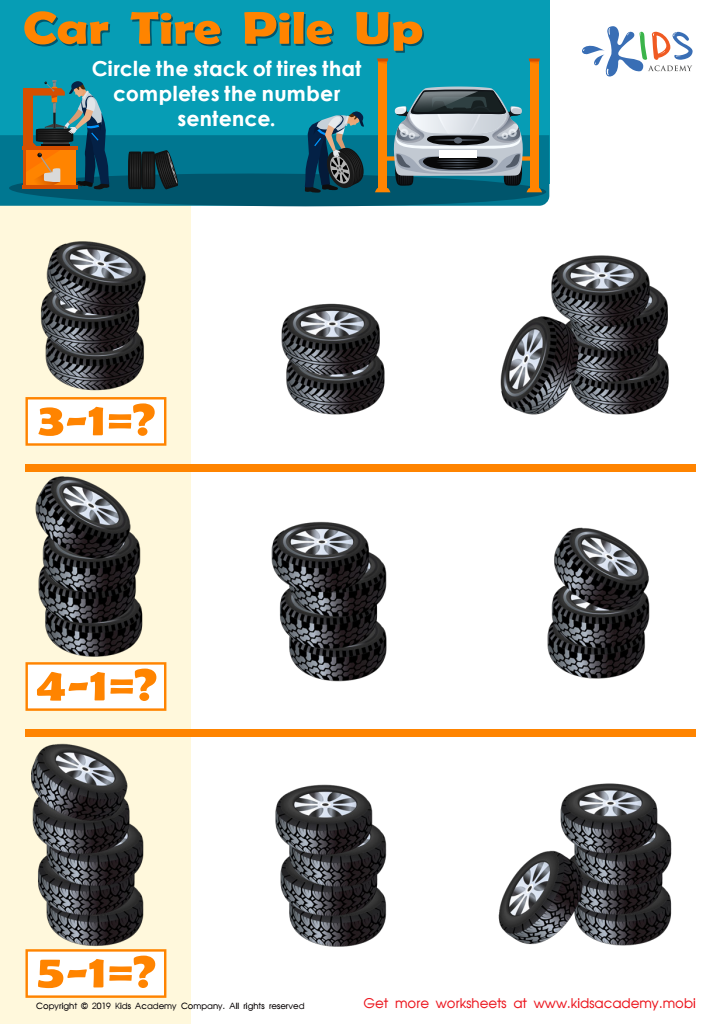
Car Tire Pile Up Worksheet
Examine the pic with your kids. Can they recognize the items piled up? The tires are organized in different quantities. Equations are on the left. Have your children work out the equations, counting the tire stacks to identify the correct answer.
 Assign to My Students
Car Tire Pile Up Worksheet
Worksheet
Join Kids Academy for Free
Who is primarily going to use this learning content?


.jpg)





Parents and teachers should recognize the importance of practice problem-solving math for children aged 3-9 as it lays a strong foundation for cognitive and academic development. At this young age, children's brains are highly receptive to new information, making it a critical period for establishing essential math skills. Engaging in problem-solving activities enhances logical thinking, spatial awareness, and numerical literacy.
By fostering problem-solving abilities early, children develop a growth mindset, learning that persistence and creative thinking can resolve challenges. Math problem-solving nurtures critical thinking and decision-making abilities, essential skills not just in mathematics but across various life scenarios and academic disciplines.
Moreover, early exposure to math problem-solving helps children build confidence and reduces math anxiety, which is crucial because positive early experiences in math can influence their attitudes and performance in the subject later on. Activities like puzzles, counting games, and simple arithmetic can make learning enjoyable and interactive, promoting a love for math.
Incorporating math problem-solving in early education also supports language development as children explain their reasoning and thought processes. Thus, parents and teachers who prioritize math problem-solving provide children with tools that benefit their overall intellectual capabilities, setting them up for long-term academic success and everyday problem-solving skills.








