
Understanding grouping Math Worksheets for Ages 3-9
3 filtered results
Difficulty Level
Grade
Age
-
From - To
Subject
Activity
Standards
Discover our engaging "Understanding Grouping Math Worksheets" designed for children ages 3-9! These worksheets aim to build essential foundational skills in math through fun, interactive activities that teach kids the concept of grouping. Young learners will explore various grouping scenarios, enhancing their ability to categorize objects and numbers effectively. Ideal for both classroom and home learning environments, our worksheets promote critical thinking and problem-solving in an enjoyable format. Empower your child's mathematical journey with colorful illustrations and easy-to-follow instructions that spark curiosity and boost confidence. Explore a world of fun learning experiences and pave the way for math mastery today!
Favorites
With answer key
Interactive
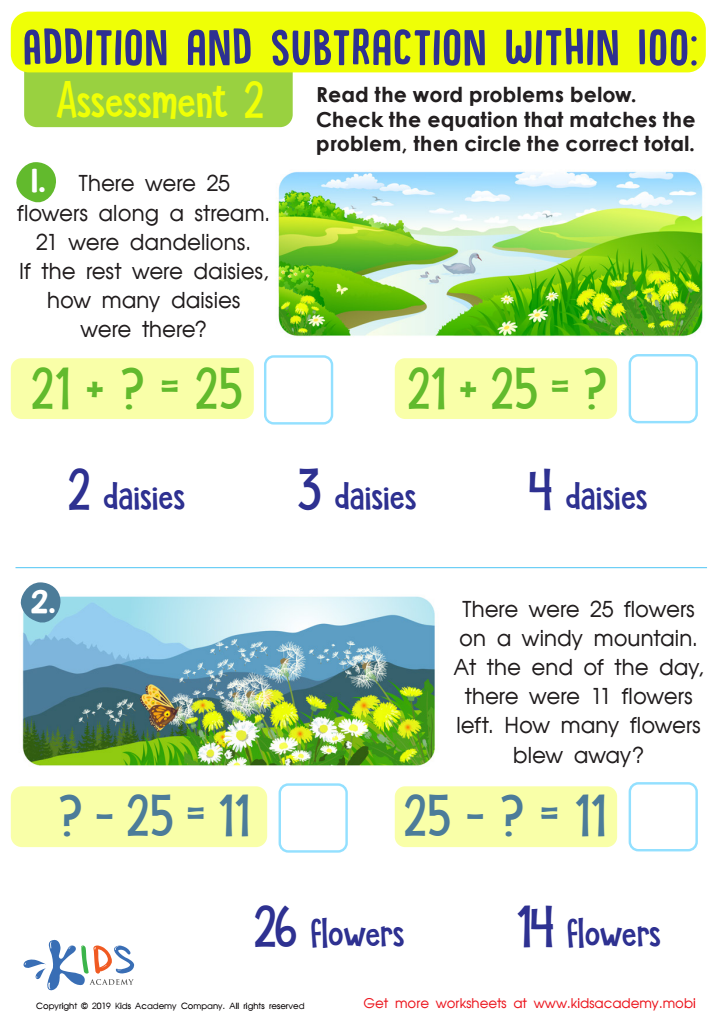
Assessment 2 Math Worksheet
Using fun exercises and pictures, you can get kids excited about math. With practice and reminders of what they've learnt, they'll be solving simple addition and subtraction equations with ease. Read the word problems in the picture to them, then help them check the equation and choose the correct answer.
 Assign to My Students
Assessment 2 Math Worksheet
Worksheet
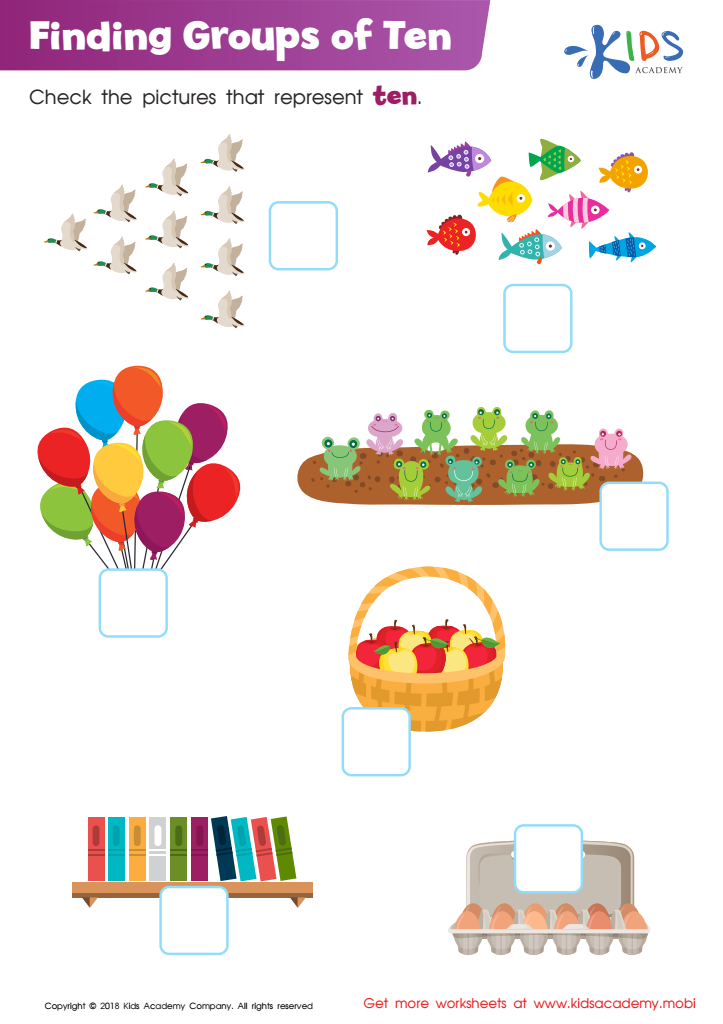
Finding Groups of Ten Worksheet
Can your kids count? If they can't go higher than tens, introduce them to this worksheet. Counting can be fun and easy with this exercise. Ask if they can identify the pictures, then help them count each group. Help them check the pictures that represent ten.
Finding Groups of Ten Worksheet
Worksheet
Join Kids Academy for Free
Who is primarily going to use this learning content?







Understanding grouping in math is crucial for children ages 3-9 as it lays the foundation for their overall mathematical development. Grouping helps young learners to conceptualize numbers and improve their counting skills, enhancing number sense. By learning to group quantities together, children begin to understand concepts of addition and subtraction, as well as the idea of 'part-whole relationships,' which are essential for more complex operations later on.
Parents and teachers should recognize that early cognitive mapping through grouping prepares children for more advanced math concepts like multiplication, division, and even algebra. By grouping objects, children develop problem-solving skills and critical thinking, as they learn to see patterns and relationships within numbers.
Additionally, the social aspect of grouping—working with peers or family members—promotes teamwork and communication skills. Encouraging children to classify and organize objects cultivates a sense of order and logical thinking. Therefore, understanding grouping not only benefits mathematical success but also fosters a love for learning and exploration in young minds. Supporting children through engaging group activities can make learning math enjoyable and effective, ensuring they develop a strong foundation for their future academic journeys.








