Understanding number value Math Worksheets for Ages 3-9
4 filtered results
-
From - To
Explore our comprehensive "Understanding Number Value Math Worksheets" designed for kids ages 3-9. These engaging, age-appropriate worksheets help children grasp essential math concepts such as identifying, comparing, and sequencing numbers. Delivered through fun activities, our worksheets foster critical thinking and number sense. Perfect for young learners, each worksheet connects playful learning with educational standards, ensuring a solid math foundation. Kids can enhance their numerical skills, while parents and teachers find them convenient for guided teaching or independent practice. Visit Kids Academy to unlock your child's potential and make math learning an enjoyable experience.
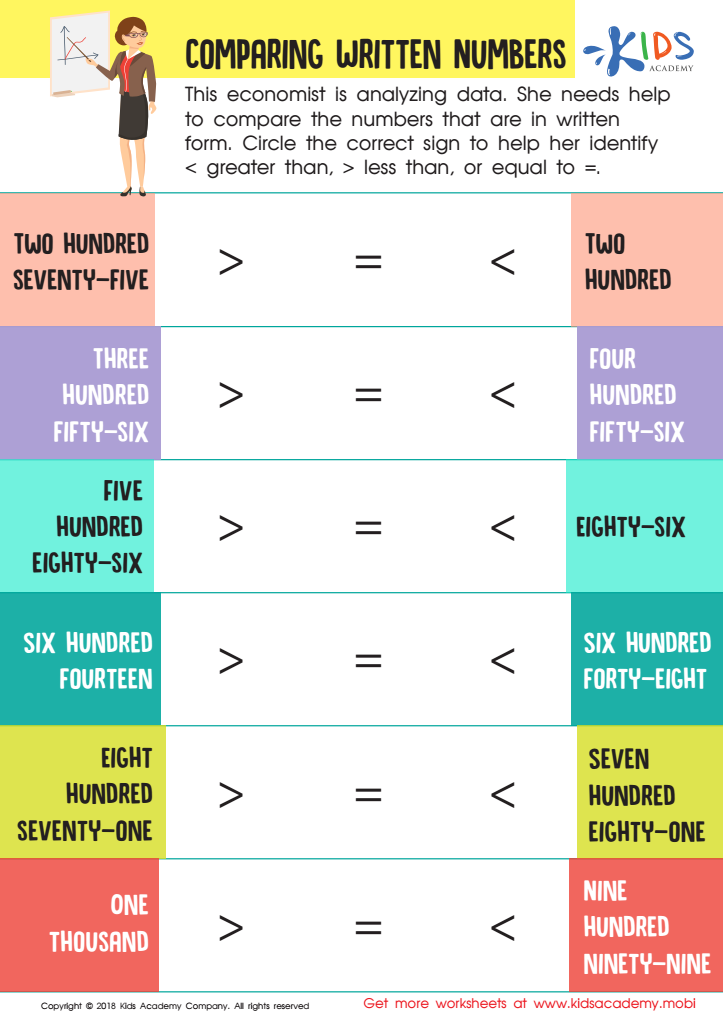
Comparing Written Numbers Worksheet
 Assign to My Students







Understanding number value is foundational for young children (ages 3-9) as it sets the stage for future math success and life skills. When parents and teachers prioritize this early math skill, they enable children to conceptualize quantities, understand the relationship between numbers, and develop essential problem-solving abilities.
By age three, children can start recognizing numbers and associating them with quantities, which helps in consistent and logical thinking. This understanding evolves into more complex skills like counting, addition, subtraction, and eventually, more advanced mathematical concepts. Strong number sense cultivates confidence and reduces anxiety around math, creating a more positive learning experience.
Moreover, math skills are intrinsically linked to everyday activities such as sorting objects, sharing fairly, and making sense of time and money. When children grasp number value, they perform better in various school subjects and life scenarios requiring approximate judgment and measurement. Early math competence also correlates with later achievements in not just mathematics but also science and technology.
Parents and educators have a pivotal role in introducing fun, hands-on activities and games that incorporate counting and recognizing numbers, laying a solid groundwork for lifelong numerical literacy and critical thinking skills essential for future academic and personal success.








