
Logical thinking development Subtraction Worksheets for Ages 3-9
3 filtered results
Difficulty Level
Grade
Age
-
From - To
Subject
Activity
Standards
Boost your child's logical thinking skills while mastering subtraction with our engaging worksheets designed for ages 3-9! Our printable activities incorporate fun, visually stimulating challenges that enhance critical thinking and problem-solving abilities. With a range of exercises tailored to different skill levels, your child will explore the concepts of subtraction through puzzles, games, and real-world scenarios. Worksheets promote not only arithmetic skills but also analytical reasoning, allowing kids to apply logical thinking in various situations. Encourage your child's cognitive development in an enjoyable way today! Visit our site to discover the perfect resources for young mathematicians on their learning journey.
Favorites
With answer key
Interactive
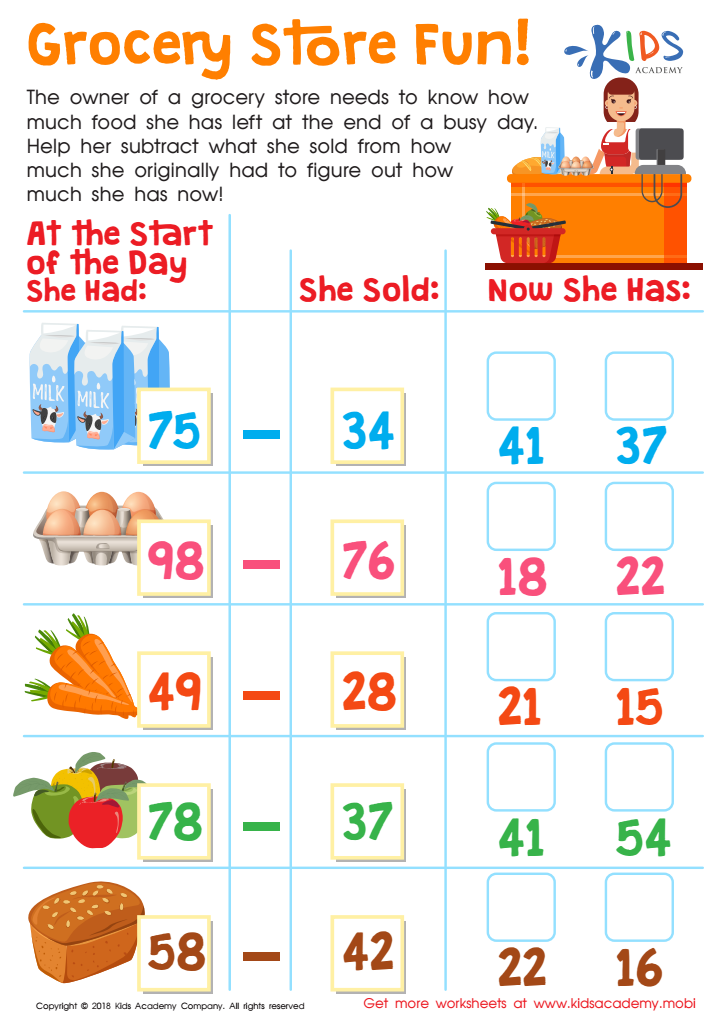
Grocery Store Fun! Worksheet
Let your kids have fun with this store worksheet. It requires them to help the owner by subtracting what she has sold from the original amount to figure out how much is left. Have them read and solve the equations in the printout to give the store owner the answer.
 Assign to My Students
Grocery Store Fun! Worksheet
Worksheet
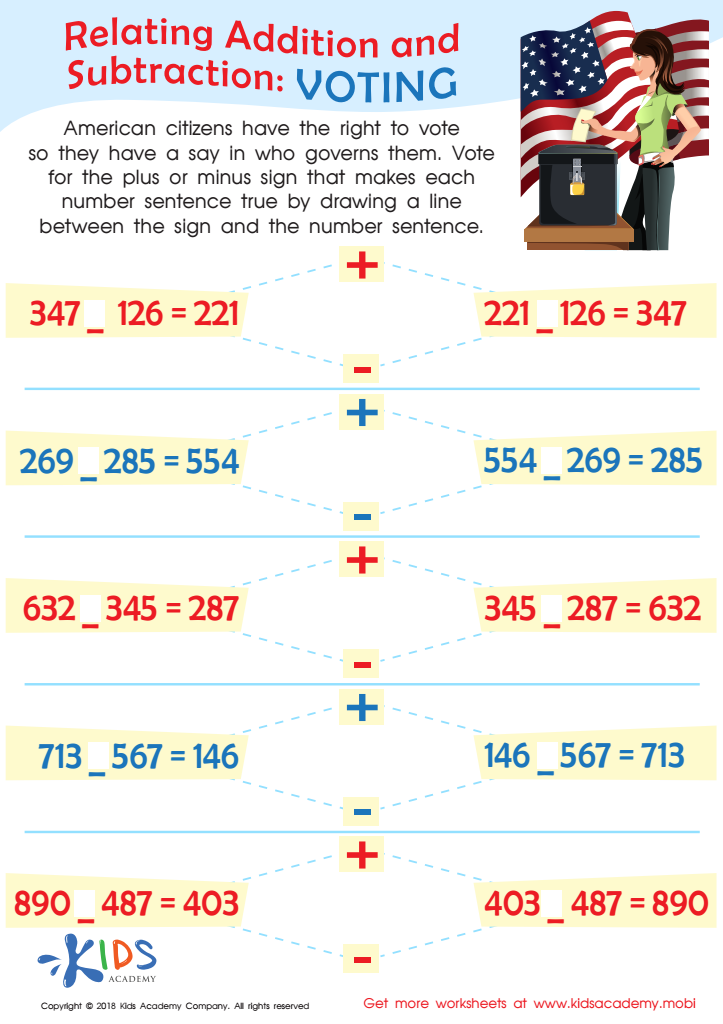
Voting Worksheet
This worksheet combines Social Studies and Math, teaching kids the democratic concept of voting. Guide learners to observe the problem, and decide if it needs a plus or minus. They "vote" for the correct answer by drawing a line from the problem to the correct operation symbol. Tally up the votes to check the answers!
Voting Worksheet
Worksheet
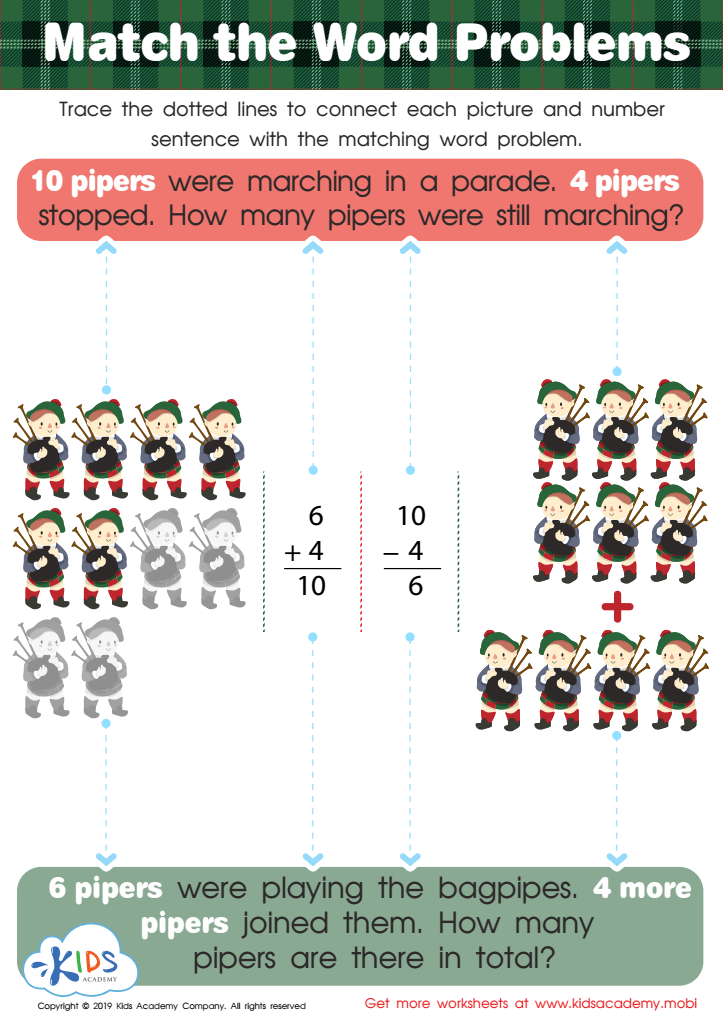
Match the Word Problems Worksheet
Read this word problem to your kids: Help them understand how it can be translated into a number problem. Trace the dotted lines to see how each picture and number sentence match the problem. With this worksheet, you can show your kids how easy it is to transform a word problem into a number problem.
Match the Word Problems Worksheet
Worksheet
Join Kids Academy for Free
Who is primarily going to use this learning content?








Logical thinking development, particularly in the context of subtraction, is crucial for children aged 3-9 as it lays the foundation for their future mathematical understanding and problem-solving skills. During these formative years, children are developing cognitive abilities that enable them to reason, analyze, and approach challenges systematically. Subtraction, as a fundamental mathematical operation, helps them understand the concept of taking away, counting backwards, and comprehending the relationship between numbers.
Parents and teachers should care about fostering this development because early mathematical skills have been linked to later academic success. When children learn to think logically about subtraction, they enhance their numerical literacy, which is vital not only in math but also in everyday situations such as budgeting, cooking, and time management.
Moreover, logical thinking promotes perseverance and resilience, as children learn to tackle problems and the notion that making mistakes is part of learning. Engaging children in subtraction activities, such as using physical objects for hands-on practice or incorporating games that require logical decision-making, can make learning enjoyable and effective. Supporting logical thinking in young learners ultimately contributes to building their confidence and competence in mathematics and encourages a lifelong love of learning.








