Mental math skills Times Tables Worksheets for Ages 3-9
4 filtered results
-
From - To
Enhance your child's mental math skills with our engaging Times Tables Worksheets designed for ages 3-9. These thoughtfully crafted resources are perfect for building a strong foundation in multiplication concepts. With a focus on fun and interactive learning, our worksheets encourage children to improve their number recall, boost confidence, and develop essential problem-solving abilities. Whether used in the classroom or at home, these printable activities provide a variety of exercises to suit diverse learning styles. Help your child master their times tables and enjoy the benefits of quick calculation skills that will last a lifetime. Start your math adventure today!
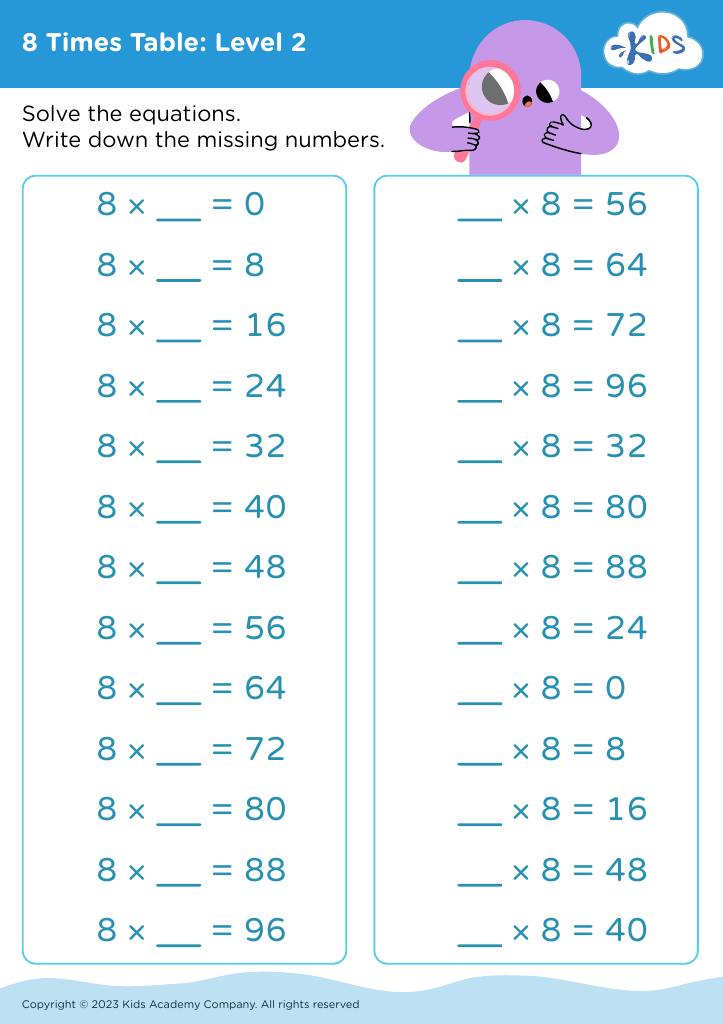
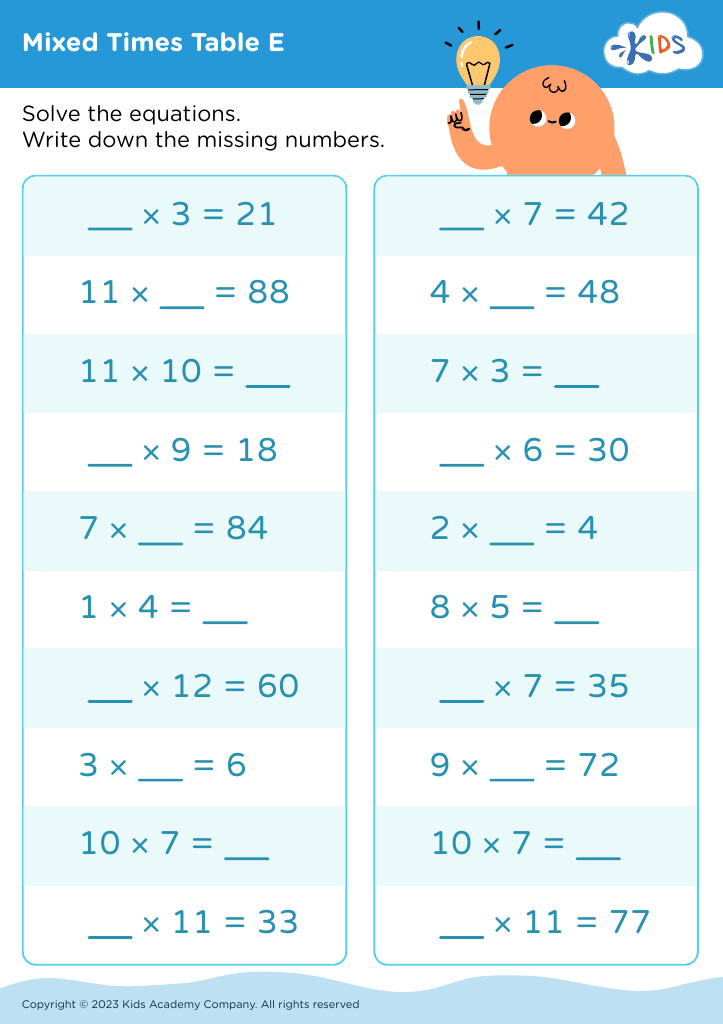
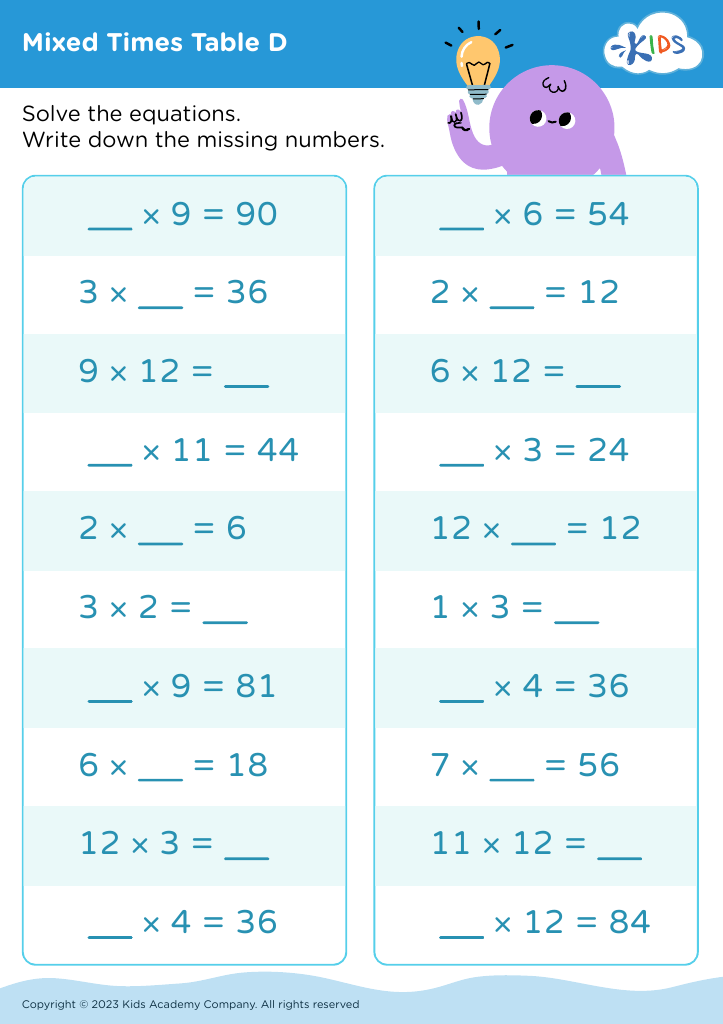
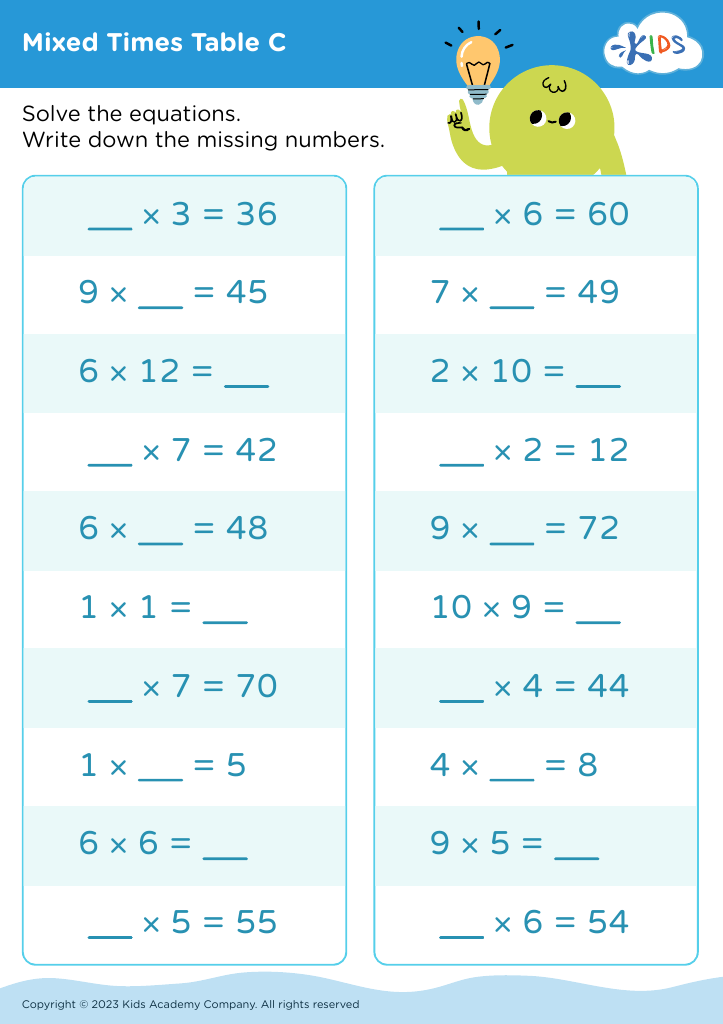





Mental math skills, particularly in mastering times tables, are essential for children aged 3-9 as they lay the foundation for a lifetime of mathematical understanding and problem-solving abilities.
Firstly, early mastery of times tables boosts confidence in children. When they can quickly recall multiplication facts, they feel more empowered in mathematical situations, encouraging a positive attitude towards learning. This early confidence can lead to a more profound interest in mathematics as they progress.
Furthermore, mental math supports cognitive development. Engaging in activities that enhance mental arithmetic can improve focus, critical thinking, and memory skills. These cognitive skills are crucial for grasping more complex mathematical concepts as children grow.
Additionally, proficiency in times tables streamlines future learning. Operations like long division and algebra rely heavily on multiplication knowledge. By cultivating these early skills, parents and teachers enable smoother academic transitions for students.
Ultimately, investing time in developing mental math skills means fostering independent learners who become efficient problem solvers. This not only impacts their academic performance but also prepares them for a variety of real-life situations where quick mathematical reasoning is beneficial, enhancing their overall academic journey.








