
Real-life application Word Problems Worksheets for Ages 3-9
3 filtered results
Difficulty Level
Grade
Age
-
From - To
Subject
Activity
Standards
Explore our engaging "Real-life Application Word Problems Worksheets" designed specifically for children aged 3-9. These worksheets promote critical thinking and problem-solving skills by presenting relatable scenarios that reflect everyday situations. Young learners will tackle exciting mathematical challenges while enhancing their comprehension and reasoning abilities. With a variety of themes and difficulty levels, our worksheets cater to each child’s unique learning journey. Ideal for both classroom use and at-home practice, these resources ensure that students can connect mathematical concepts to real-world applications. Foster a love for math with fun, interactive problems that prepare children for lifelong learning!
Favorites
With answer key
Interactive
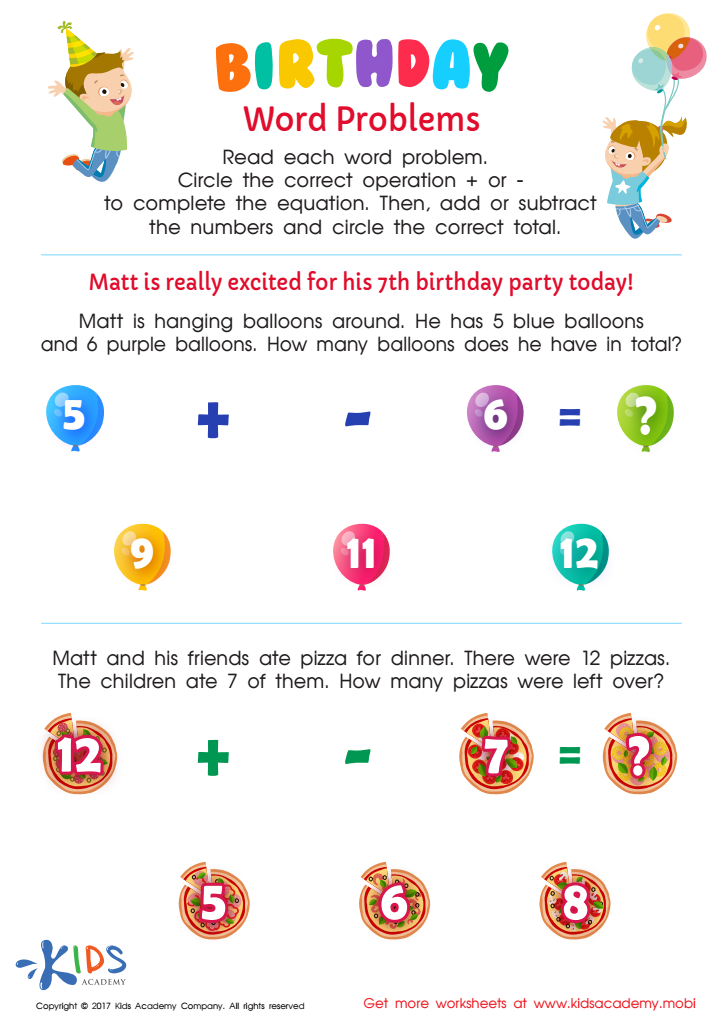
Birthday Word Problems Substraction Worksheet
This worksheet, Birthday Word Problems, is a great way to improve your child's math and literacy skills. It features tricky subtraction equations based on a birthday celebration - perfect for kids who love birthdays!
 Assign to My Students
Birthday Word Problems Substraction Worksheet
Worksheet
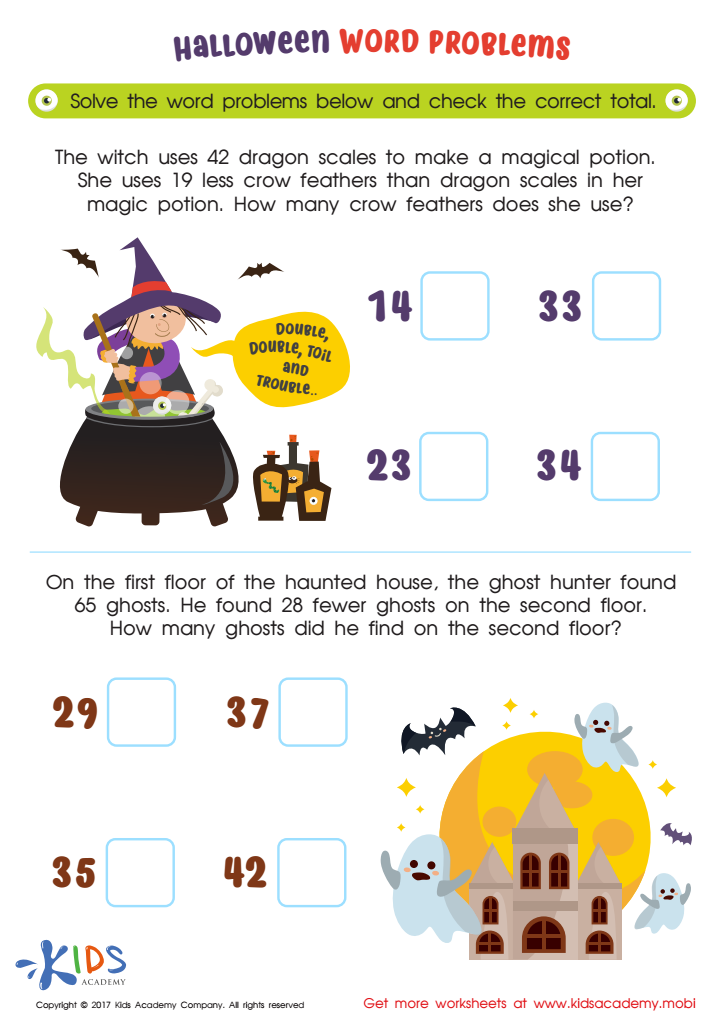
Halloween Word Problems Printable
Ghosts, witches, and other spooky characters make these problems exciting and interactive. Get ready to have some math fun!
Halloween Word Problems Printable
Worksheet
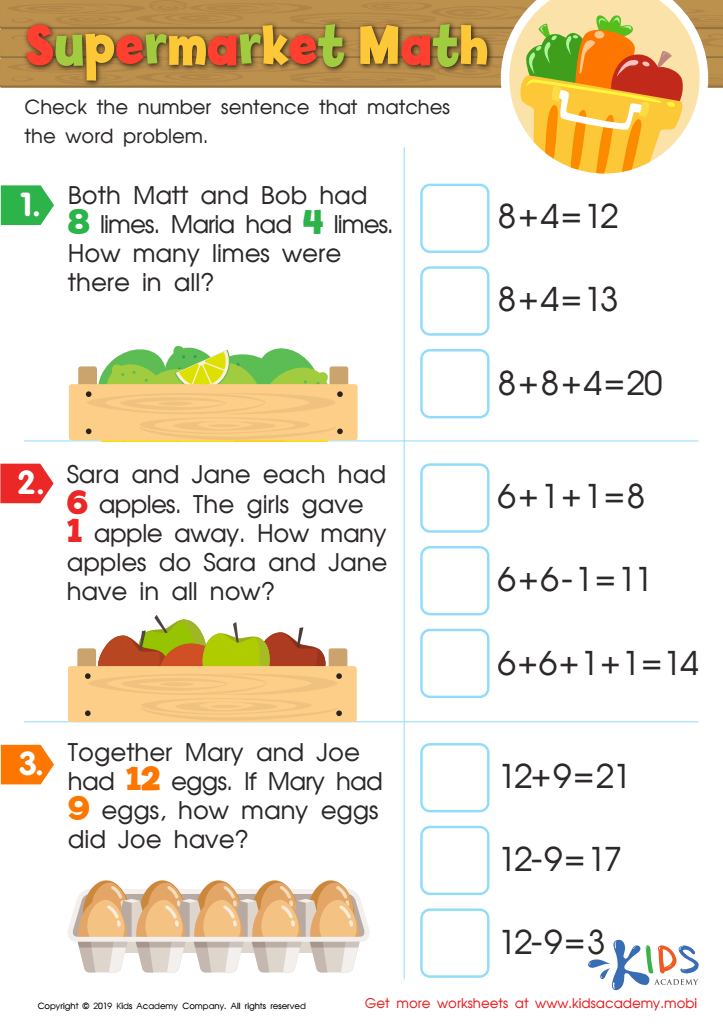
Supermarket Math Worksheet
Take your kids to the supermarket and ask what they're looking forward to buying. Help them solve the three questions in the worksheet by interpreting each one into an equation, then choose the right answer.
Supermarket Math Worksheet
Worksheet
Join Kids Academy for Free
Who is primarily going to use this learning content?








Real-life application word problems are crucial for children aged 3-9 as they serve as bridges connecting mathematical concepts to their everyday experiences. Engaging young learners in these practical scenarios enhances their critical thinking and problem-solving skills. By presenting math within contexts they understand—like shopping, cooking, or sharing toys—children are more likely to relate to the subject matter, making math feel relevant and meaningful.
Additionally, these word problems promote language development as children learn to read and understand various vocabulary and sentence structures. They also improve comprehension skills as students decipher what is being asked, enhancing their ability to think logically and systematically.
Moreover, tackling real-life word problems fosters persistence and resilience. Children learn that problems can vary in complexity and that finding solutions often requires multiple attempts and strategies. This experience is essential for their overall development, equipping them with tools to approach challenges with a positive mindset.
Finally, teachers and parents play a vital role in nurturing curiosity and enthusiasm for learning. By emphasizing the importance of real-world application, they motivate children to explore math outside the classroom, thus laying a strong foundation for future academic and life success.








