
Subtraction practice Addition Worksheets for 5-Year-Olds
3 filtered results
Difficulty Level
Grade
Age
-
From - To
Subject
Activity
Standards
Explore our fun and engaging Subtraction Practice Addition Worksheets designed specifically for 5-year-olds! These worksheets provide young learners with essential skills in subtraction while enhancing their understanding of addition. Each activity is colorful and visually appealing, making math enjoyable and accessible. With a variety of exercises that promote critical thinking and problem-solving, kids will gain confidence in their abilities. Perfect for classroom and home use, these worksheets support early math education in a playful manner. Help your child build a solid foundation in mathematics with our well-structured worksheets that foster a love for learning and ensure readiness for future challenges!
Favorites
With answer key
Interactive
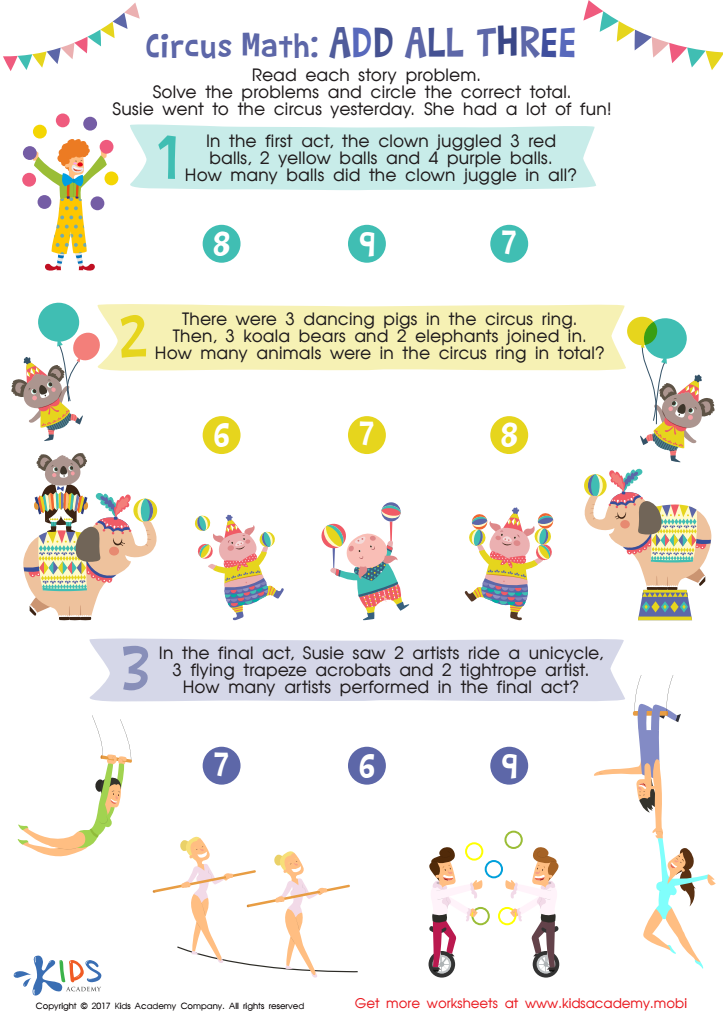
Circus Math Printable
Let's take the kids to the circus and combine literacy and numeracy skills! Our circus math printable worksheet will encourage creativity and higher-order thinking by connecting addition to real-life examples. Kids will learn to love math while they explore the fun, real-life applications of math. Ignite their passion today!
 Assign to My Students
Circus Math Printable
Worksheet
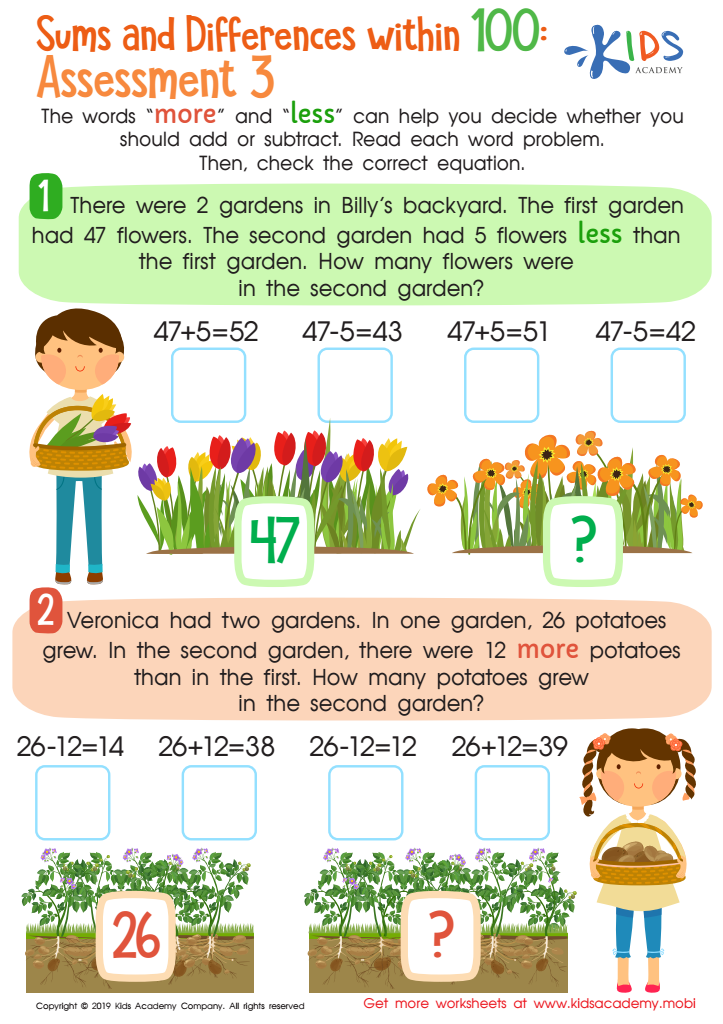
Sums and Differences Within 1 - Assessment 1 Worksheet
Help your child understand school topics better with your assistance. For math, go over their worksheet together and discuss the instructions and text. Solve the questions and check the right equation. This will take their learning to the next level.
Sums and Differences Within 1 - Assessment 1 Worksheet
Worksheet
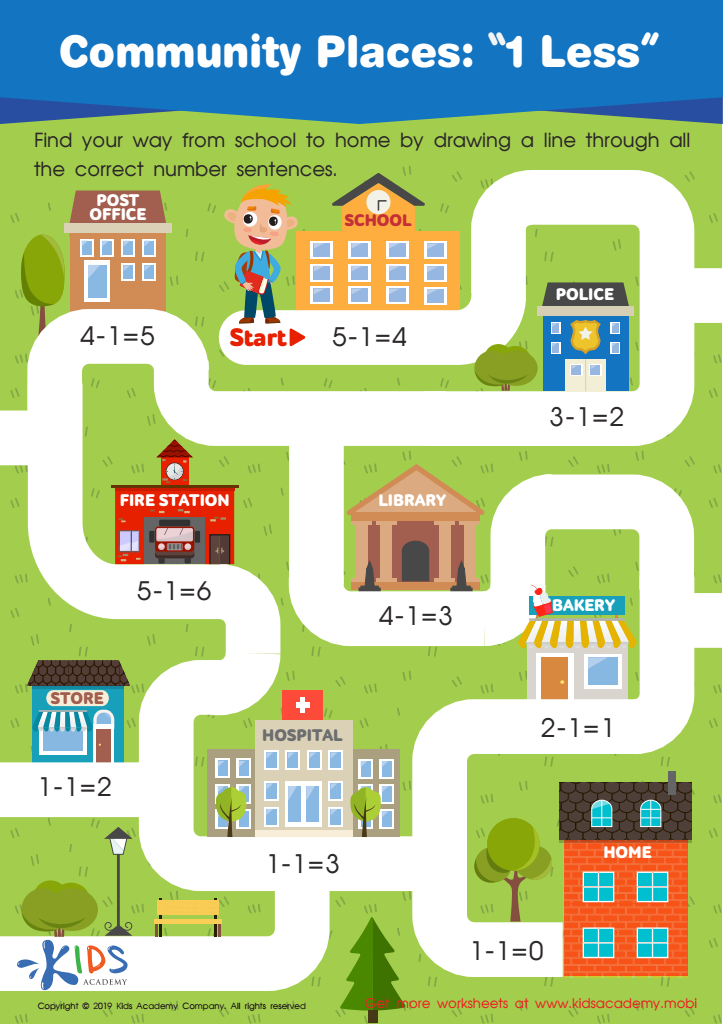
Community Places: 1 Less Worksheet
Have your kindergarteners draw a line through the correct number sentences as they find their way home from school. Ask them to identify the people, places, and buildings in their community and the jobs they do.
Community Places: 1 Less Worksheet
Worksheet
Join Kids Academy for Free
Who is primarily going to use this learning content?








Subtraction practice is essential for 5-year-olds as it lays the groundwork for critical mathematical skills. At this age, children develop number sense, which involves understanding how numbers relate to one another. Practicing subtraction alongside addition helps children grasp the foundations of these operations, fostering an interconnected understanding of mathematics.
Engaging in subtraction practice widens cognitive development, enabling children to think critically and solve problems. It provides opportunities for them to learn how to remove items from a group, allowing them to visualize the concept of "taking away," which is crucial when transitioning to more complex math in later grades.
Additionally, consistent subtraction practice builds confidence and independence. Children gain a sense of achievement as they master these skills, leading to a positive attitude towards math. When parents or teachers emphasize subtraction, they encourage a natural curiosity about numbers and their relationships.
Moreover, reinforcement at home and in school creates a supportive learning environment. As students practice subtraction, they hone their social-emotional skills such as patience and perseverance. Overall, integrating subtraction practice into a 5-year-old’s learning journey is vital for their holistic development and future mathematical success.








