Vocabulary enhancement Grade 1 2D Shapes Worksheets
3 filtered results
Difficulty Level
Grade
Age
-
From - To
Subject
Activity
Standards
Boost your child's geometry skills with our engaging "Vocabulary Enhancement Grade 1 2D Shapes Worksheets." These expertly designed resources help first graders grasp essential shape terminology while reinforcing their understanding of 2D shapes like circles, squares, and triangles. Utilizing fun activities and vivid illustrations, our worksheets make learning interactive and enjoyable. Kids will expand their mathematical vocabulary, learn to identify and describe various shapes, and build a solid foundation for future geometric concepts. Perfect for classroom use or at-home practice, these worksheets support young learners in developing their critical thinking and problem-solving abilities.
Favorites
With answer key
Interactive
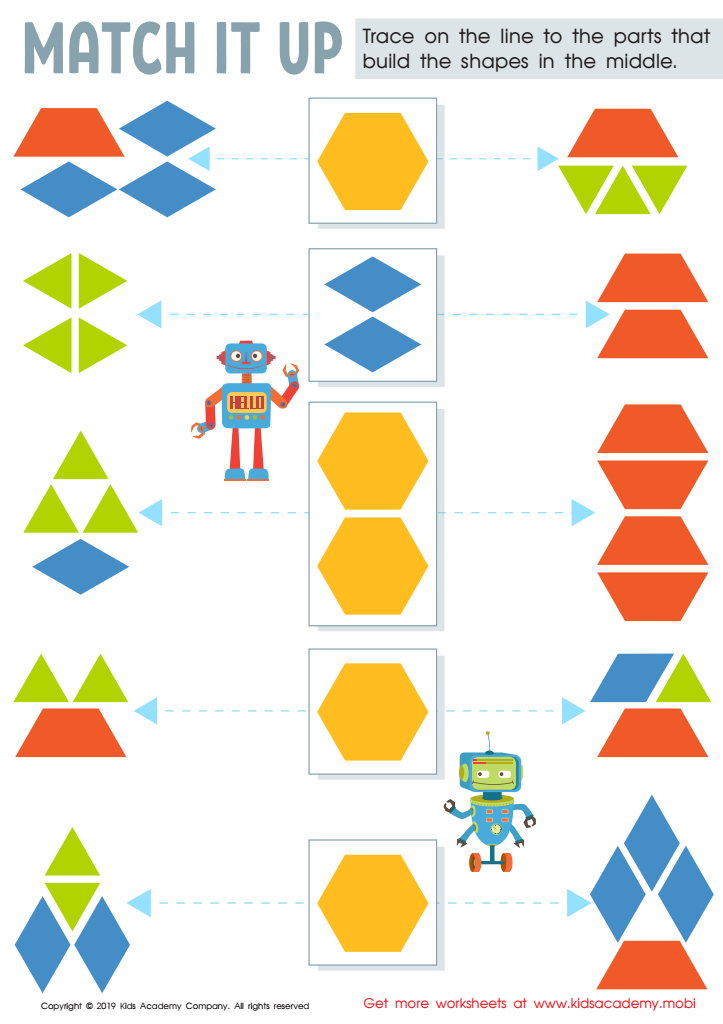
Match It up Worksheet
If your kids are into robots, they'll be thrilled to work on this worksheet. Ask them to name shapes they know, and help them draw and identify these shapes. Look at the shapes in the middle, and the sides. Finally, help your kids trace the lines to build the shapes in the middle.
 Assign to My Students
Match It up Worksheet
Worksheet
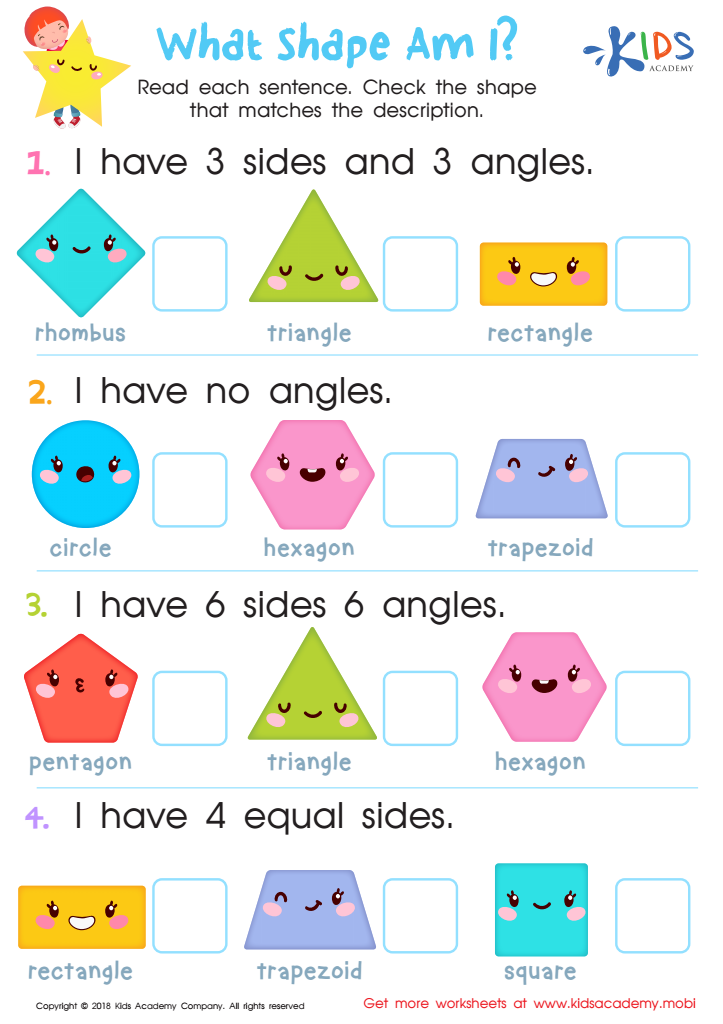
What Shape Am I? Worksheet
Help your child read each sentence in this colorful worksheet. Have them identify the shapes described and check the boxes. To prepare, ask simple questions like "How many sides does a triangle have?" and "Which shape has 4 equal sides?" Your child will become more skilled at shapes by the end of this activity.
What Shape Am I? Worksheet
Worksheet
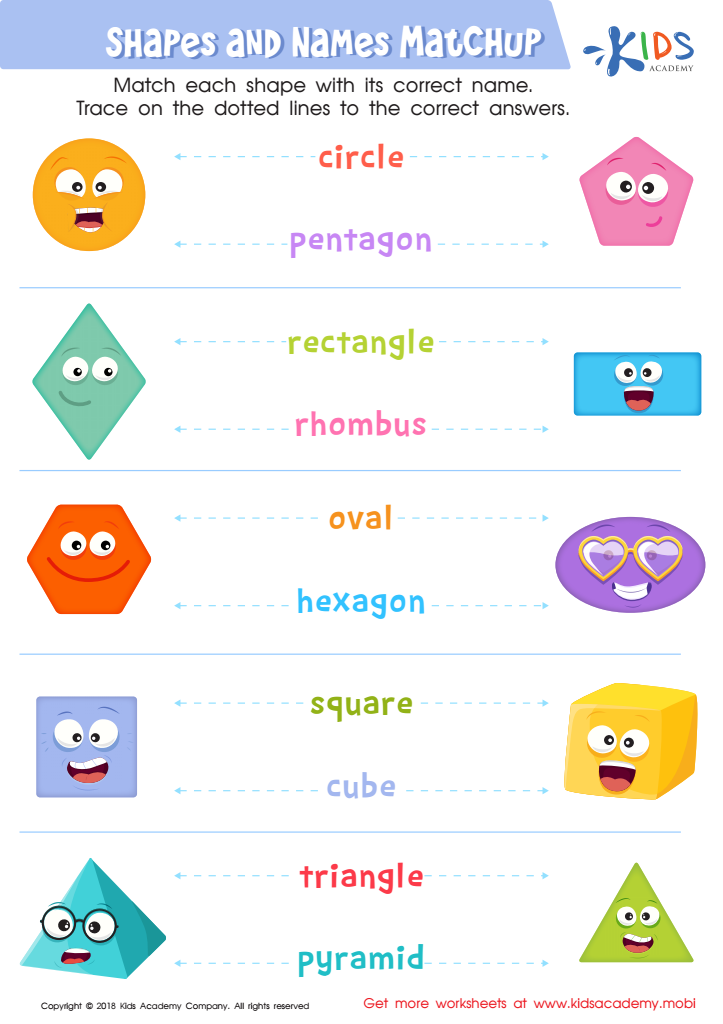
Shapes and Names Matchup Worksheet
Introduce your students to shapes if they aren't familiar. Look at the sheet with them and ask them to identify shapes. Help them match each shape to its name, then trace the dotted lines to the answers. Even if they haven't seen shapes before, this exercise will be easy - with your help!
Shapes and Names Matchup Worksheet
Worksheet
Join Kids Academy for Free
Who is primarily going to use this learning content?





Vocabulary enhancement for Grade 1 students, especially concerning 2D shapes, is crucial for multiple reasons. Firstly, knowing shape names like circle, square, and triangle builds the foundation for geometric understanding, essential in math and other subjects. Shapes aren’t just abstract concepts; they relate to everyday objects and environments, helping children make sense of the world around them.
When parents and teachers focus on vocabulary for 2D shapes, they are promoting language skills. Describing shapes improves communication abilities by expanding a child's descriptive language, vital for talking about their thoughts and understanding instructions.
Enhanced vocabulary also aids cognitive development. Sorting, classifying, and distinguishing between shapes encourage critical thinking and problem-solving. It indirectly teaches categorization and comparison, which are fundamental cognitive skills.
Moreover, early exposure to geometric vocabulary sets the stage for advanced math learning. Familiarity with shapes leads to a smoother transition to learning about 3D shapes, spatial reasoning, and even more complex geometry in later grades.
In summary, vocabulary enhancement regarding 2D shapes in Grade 1 is more than just learning terms. It nurtures broader educational skills, fosters cognitive development, and better prepares children for future academic challenges, making it essential for early education.