Understanding measurements Extra Challenge Math Worksheets for Ages 4-6
4 filtered results
Difficulty Level
Grade
Age
-
From - To
Subject
Activity
Standards
Unlock your child’s potential with our "Understanding Measurements Extra Challenge Math Worksheets for Ages 4-6." Precisely designed to enhance early math skills, these engaging worksheets make learning measurements fun and interactive. They cover concepts such as length, weight, and volume through vibrant illustrations and simple activities tailored for young learners. Perfect for classroom or home practice, these worksheets foster a strong mathematical foundation, boost problem-solving abilities, and build confidence. Equip your 4-6-year-old with the tools they need to master measurements and achieve academic success with our expertly crafted worksheets today!
Favorites
With answer key
Interactive
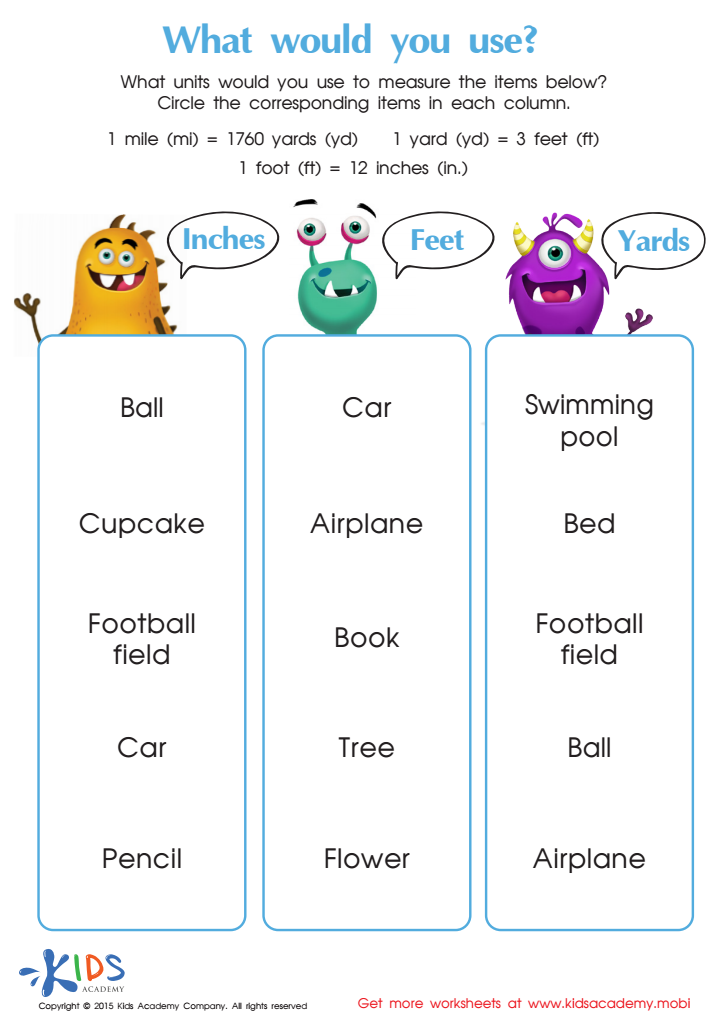
Learning about measuring objects in inches, feet and yards Worksheet
Download, cut and let your preschoolers learn and have fun estimating objects like pencils, airplanes and swimming pools in inches, feet and yards!
 Assign to My Students
Learning about measuring objects in inches, feet and yards Worksheet
Worksheet
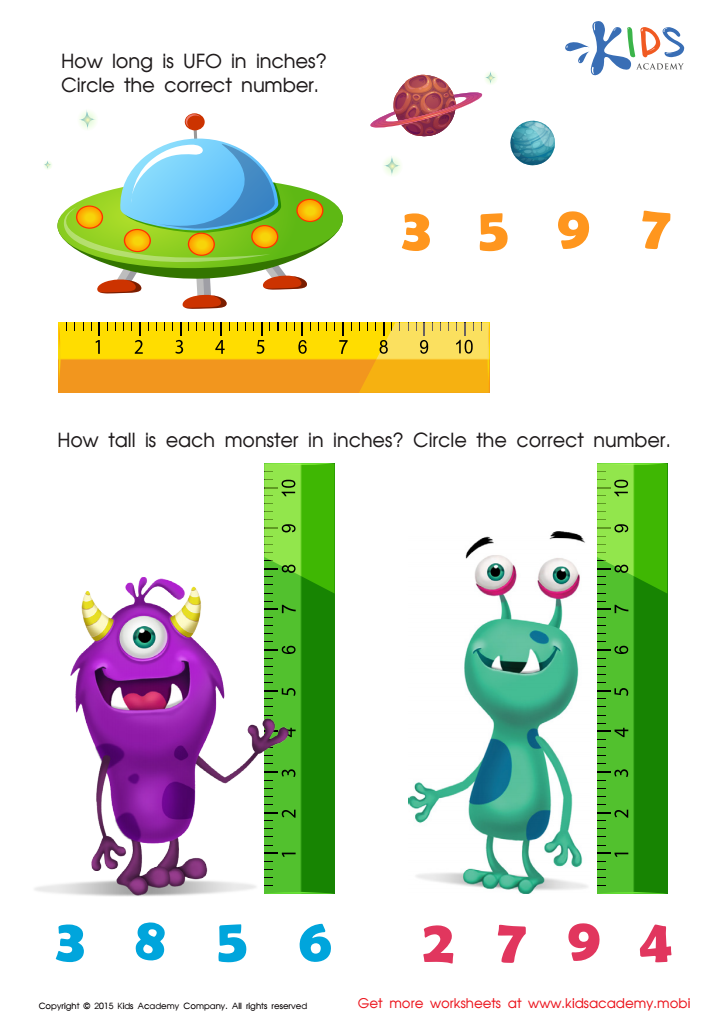
Measuring in Inches Worksheet
Look at the picture, can you measure the UFO & monsters? Write down how long each is. Which is tallest? Circle it. Get more free printable math worksheets for kindergarten at our website.
Measuring in Inches Worksheet
Worksheet
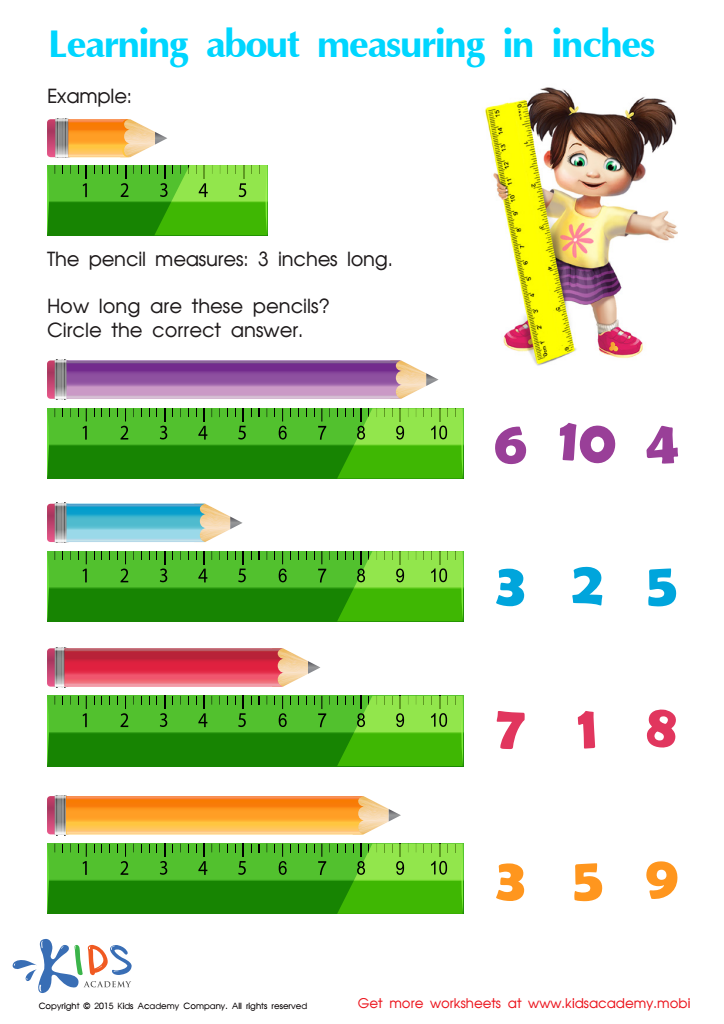
Learning About Measuring In Inches Printable
Print this free worksheet and measure pencils together with kids. See who finds the longest and the shortest! Enjoy learning math with your kids.
Learning About Measuring In Inches Printable
Worksheet
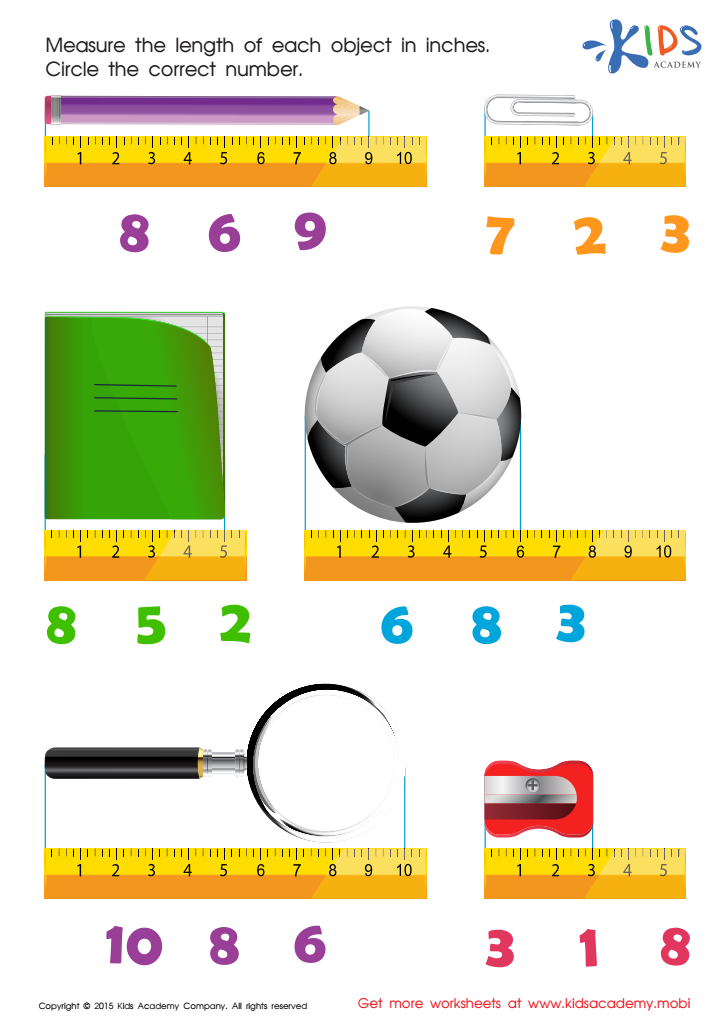
Learning measuring objects in inches Worksheet
Help your little learners gain confidence in using a ruler! Print out our free worksheet, cut out the inch ruler, and let them measure and record objects' width and length. Kids Academy has a variety of math worksheets to make learning math fun! Check out our website for more free printables!
Learning measuring objects in inches Worksheet
Worksheet
Join Kids Academy for Free
Who is primarily going to use this learning content?








Understanding measurements is a fundamental aspect of early math education for children aged 4-6. Parents and teachers should care about this because it lays the groundwork for the development of essential life skills and future academic success. At this critical age, children are cognitively prepared to grasp basic concepts of size, length, weight, and volume, which are integral to their everyday experiences.
Incorporating measurement activities stimulates young minds by enhancing their problem-solving skills and critical thinking. By engaging with these concepts early on, children build a robust mathematical foundation that will support their learning in more advanced topics like geometry, science, and technology. Measurements also introduce kids to important mathematical vocabulary and concepts such as bigger/smaller, taller/shorter, and heavier/lighter, enriching their language and understanding.
Moreover, working on measurement problems helps improve fine motor skills and hand-eye coordination. Measuring objects, comparing sizes, and using rulers or balance scales develop both their cognitive and physical abilities.
Parent and teacher involvement is crucial as it provides an encouraging environment that fosters curiosity and enthusiasm for learning. When children see that adults value and are excited about measurements, they are more likely to develop a positive attitude towards math, building confidence that will benefit them throughout their educational journey and beyond.