
Counting skills Normal Alphabet Worksheets for Ages 5-7
3 filtered results
Difficulty Level
Grade
Age
-
From - To
Subject
Activity
Standards
Discover engaging Counting Skills Normal Alphabet Worksheets designed specifically for children ages 5-7. These printable worksheets combine fundamental counting exercises with alphabet learning, ensuring a fun and effective educational experience. Ideal for early learners, these resources help reinforce number recognition and counting skills while integrating letters of the alphabet. Grounded in a playful approach, our worksheets promote cognitive development and boost fine motor skills through varied activities. Parents and educators will find these worksheets perfect for at-home learning or in-class activities. Enhance your child's learning journey today with our thoughtfully crafted worksheets that make counting and letter learning enjoyable!
Favorites
With answer key
Interactive
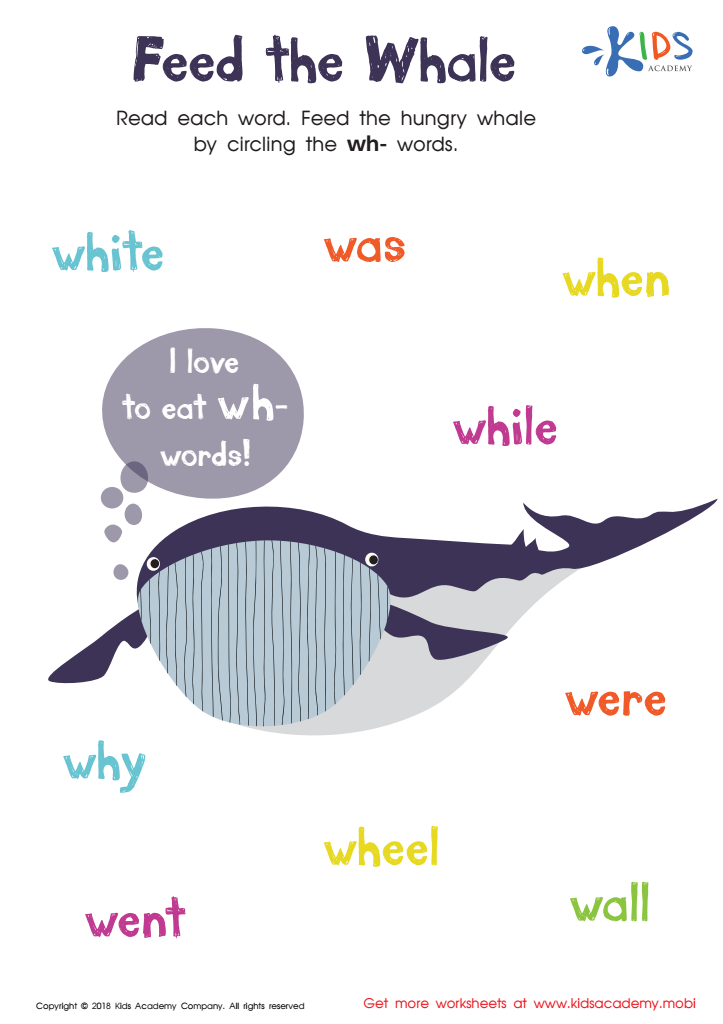
Feed the Whale Worksheet
Help your early reader build beginning consonant and blend recognition with this fun whale worksheet! They'll feed the whale wh- words, circle sight words, and build fine motor skills—all while discriminating between differently colored words.
 Assign to My Students
Feed the Whale Worksheet
Worksheet
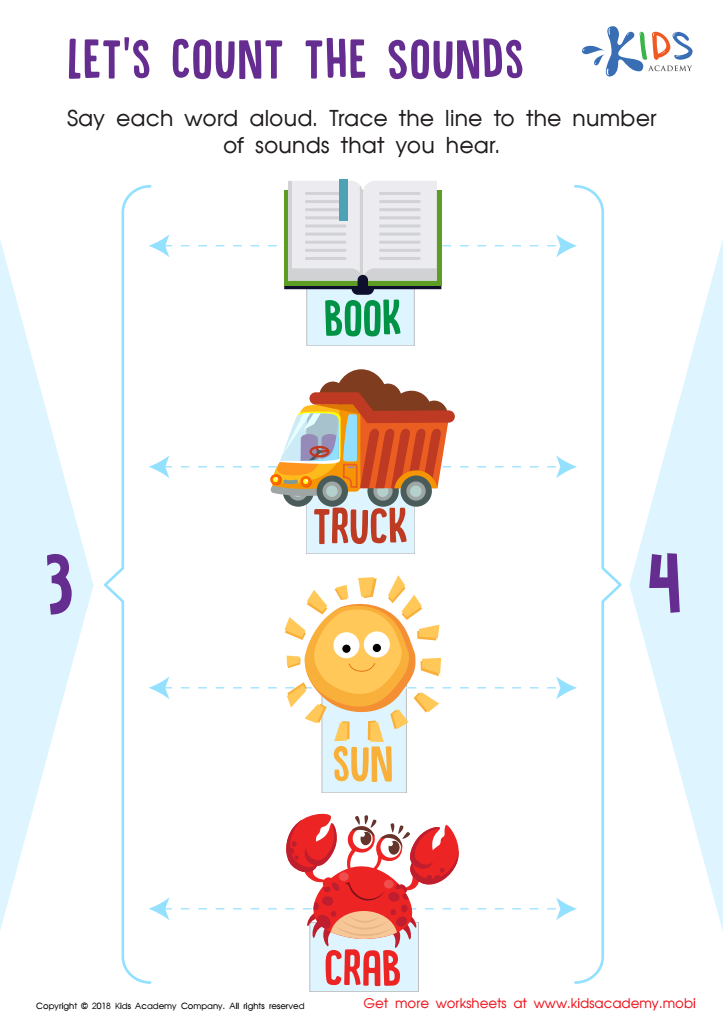
Let's Count the Sounds Worksheet
This bright and cheery traceable worksheet encourages children to practice auditory discrimination and phonological awareness. Using picture clues, they read each word and trace the line that represents the number of sounds heard. This builds decoding skills and helps them become successful readers.
Let's Count the Sounds Worksheet
Worksheet
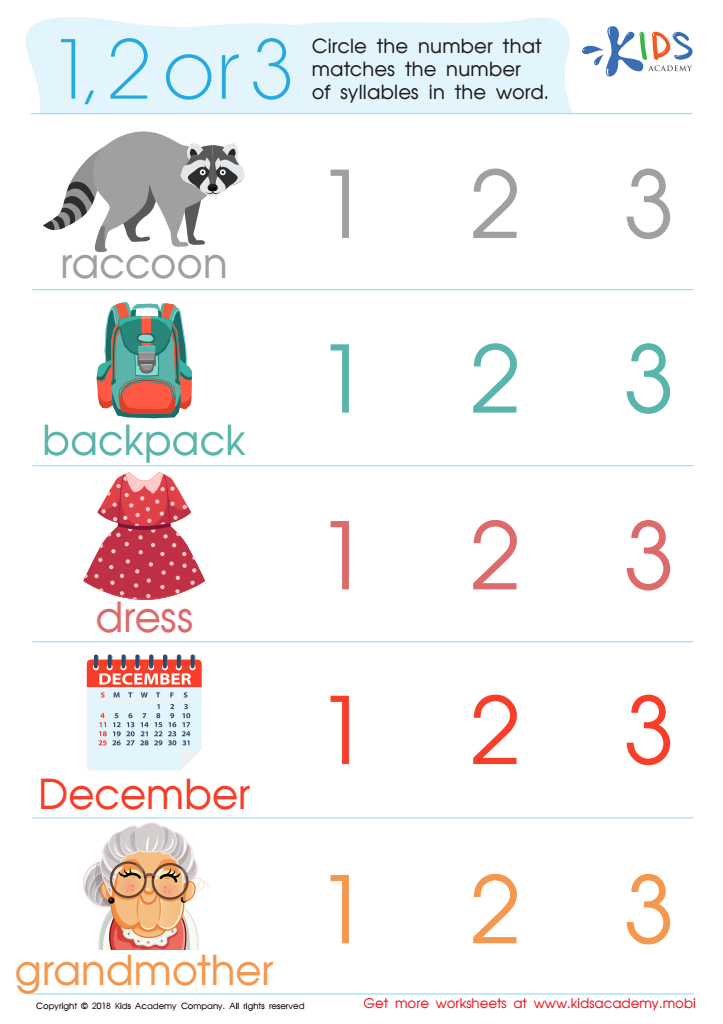
1, 2 or 3? Worksheet
Do your kids know about syllables? Test their understanding with this worksheet. Read the words aloud and ask them to say them with you. Help them circle the number that matches the number of syllables in each word. Perfect for expanding knowledge or testing how much they've already learned.
1, 2 or 3? Worksheet
Worksheet
Join Kids Academy for Free
Who is primarily going to use this learning content?







Counting skills, often intertwined with literacy, are crucial for children aged 5-7 as they form the foundation for later mathematical understanding and overall cognitive development. At this age, children begin to grasp the concepts of numbers and their relationships, which are essential for everyday tasks and future academic success. Parents and teachers should care about counting skills because they bolster children's reasoning abilities, problem-solving skills, and critical thinking.
Mastering counting also enhances a child’s confidence in their academic journey. When children can count reliably, they feel more empowered to participate in classroom activities and discussions, particularly in subjects like math and science, which increasingly demand understanding of numerical concepts.
Moreover, counting is closely related to literacy, as both skills involve sequencing and recognizing patterns. Developing strong counting skills can improve a child’s ability to recognize sequences in language, facilitating reading and comprehension. Parents and teachers can support this growth through fun, engaging activities that incorporate counting into everyday situations. By nurturing counting skills, adults can provide a comprehensive skill set, laying the groundwork for lifelong learning and development, ensuring that children are well-prepared for future educational challenges.







