Understanding prefixes Normal Building Vocabulary Worksheets for Ages 7-8
3 filtered results
-
From - To
Expand your child's vocabulary with our "Understanding Prefixes: Normal Building Vocabulary Worksheets for Ages 7-8". Designed specifically for young, developing minds, these engaging worksheets help children discover the meanings of familiar prefixes. Our comprehensive exercises encourage students to build new words and enhance their language skills, all while keeping learning fun and interactive. Essential for grasping how prefixes change word meanings, these resources are perfect for at-home reinforcement or classroom support. Equip your child with the tools they need to become more confident and fluent readers with these expertly crafted, educational worksheets. Start learning today!
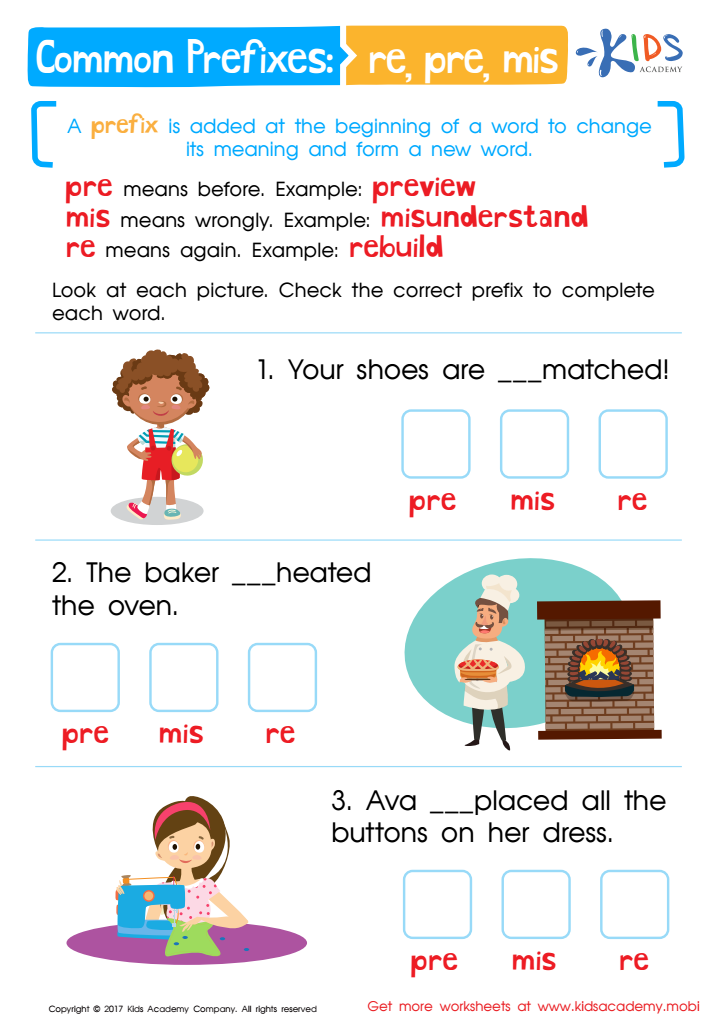
Common Prefixes Worksheet: RE, PRE, MIS
 Assign to My Students











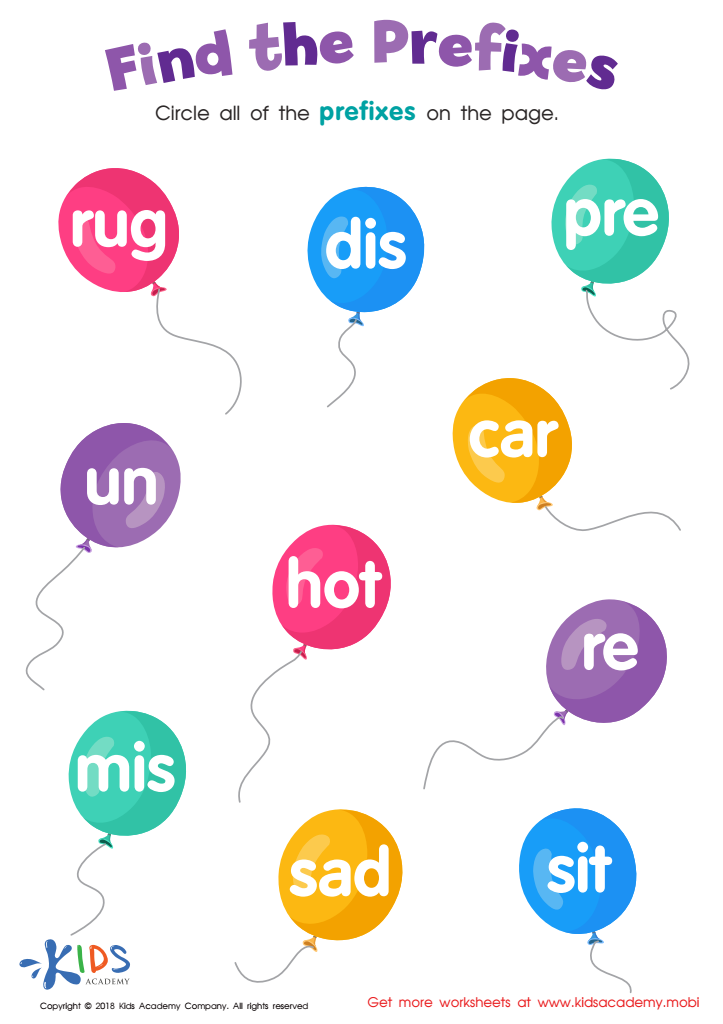
Reading: Find the Prefixes Worksheet
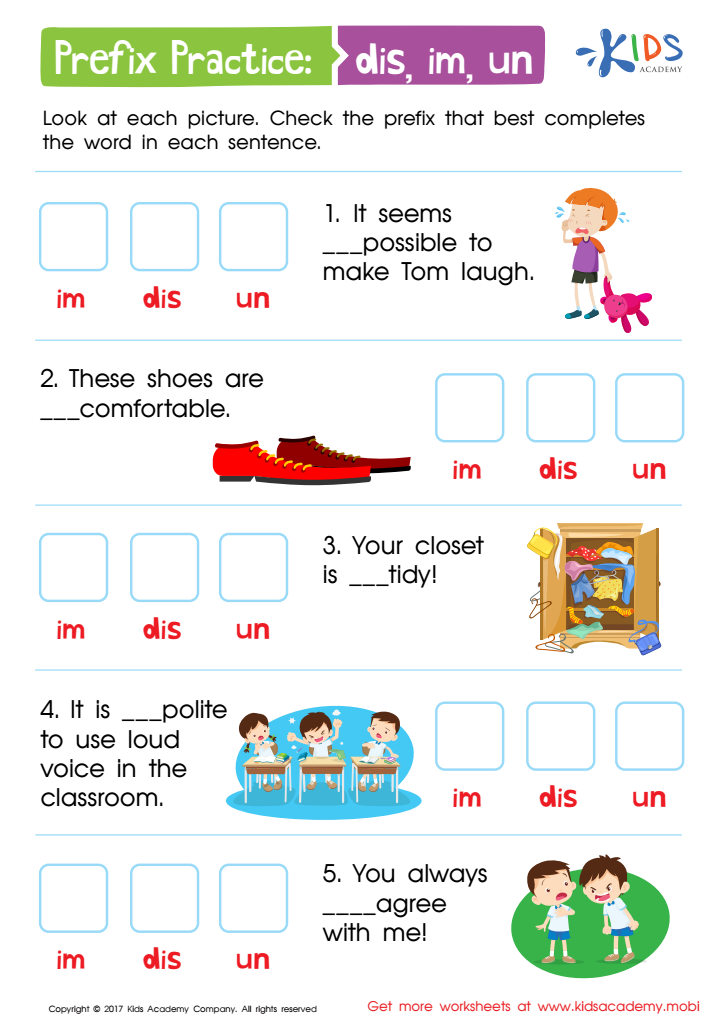
Prefix Practice Worksheet: DIS, IM, UM








Understanding prefixes at ages 7-8 is crucial for young learners' vocabulary development and reading comprehension. At this formative age, children's brains are particularly receptive to language acquisition. Grasping the meaning and use of prefixes, such as "un-," "re-," or "pre-," allows children to expand their vocabulary exponentially. For instance, knowing that "un-" means "not" can help children deduce that "unknown" means "not known."
Parents and teachers who invest time in teaching prefixes are equipping kids with the tools to understand complex words independently. This knowledge enhances reading skills, as children can break down unfamiliar words into more understandable components. Consequently, this not only improves reading fluency and comprehension but also boosts confidence in handling challenging texts.
Moreover, understanding prefixes bolsters spelling skills. When children recognize patterns in words, they're better at spelling new and similar-sounding words, which further reinforces learning.
In essence, teaching prefixes at this pivotal stage fosters critical thinking, enabling children to decode and infer meanings on their own. This empowerment is beneficial across all subjects, making it easier for them to grasp new concepts and excel academically. Therefore, parents and teachers who emphasize prefix learning are laying down a solid foundation for future linguistic success.








