Handwriting improvement Preschool Tracing Letters Worksheets
3 filtered results
Difficulty Level
Grade
Age
-
From - To
Subject
Activity
Standards
Enhance your child's handwriting skills with our engaging Preschool Tracing Letters Worksheets! Designed to foster early literacy, these worksheets provide a fun and interactive way for preschoolers to practice letter formation. With a variety of tracing exercises, each worksheet helps children develop fine motor skills and build confidence in writing. Our user-friendly PDFs are perfect for at-home learning or classroom use, making handwriting improvement enjoyable. Watch your child progress from tracing to independent writing as they master each letter. Explore our collection and give your little one the foundational skills they need for academic success! Start tracing today!
Favorites
With answer key
Interactive
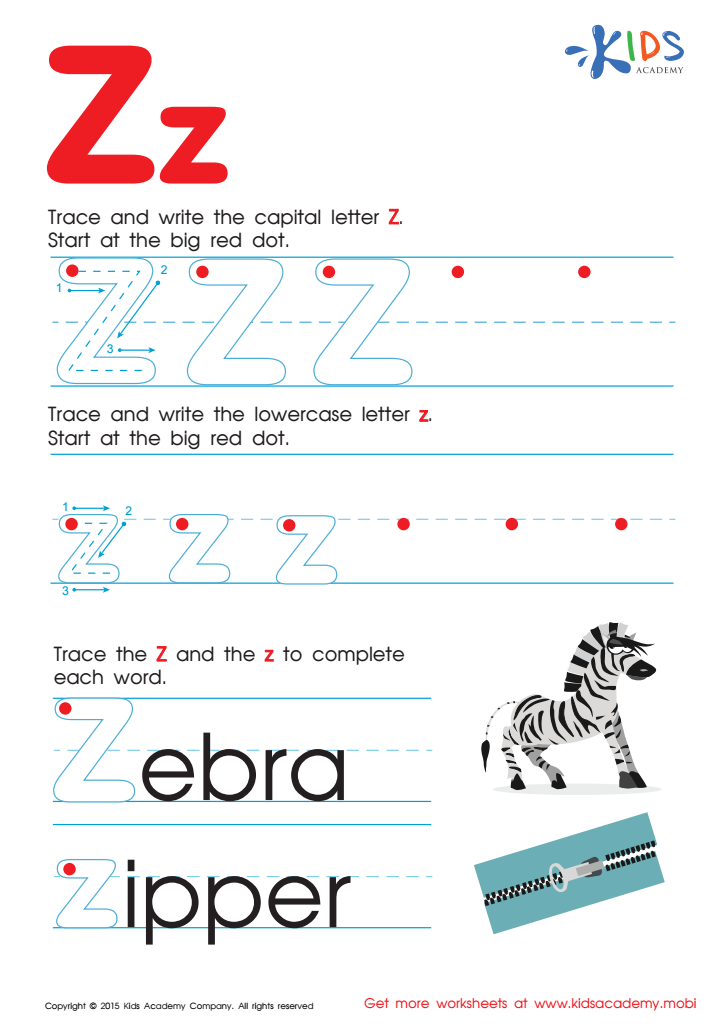
Letter Z Tracing Page
Trace and write capital "Z" and lowercase "z". Complete words "zebra" and "zipper". Be attentive and have fun! (80 words)
 Assign to My Students
Letter Z Tracing Page
Worksheet

Letter J Tracing Page
Trace and write the letter "J" with our ABC worksheet - start at the big red dot! Have fun completing words like jewelry, jellyfish and more. Check out our kindergarten activities for more alphabet practice.
Letter J Tracing Page
Worksheet

Letter B Tracing Page
Ready to learn the Alphabet? Put your pencil on the red dot and trace & write both capital & lowercase "B". Then have a look at the pictures. Catch the bee, cross the bridge & write the letters to complete the words. More ABC worksheets for kindergarten available!
Letter B Tracing Page
Worksheet
Join Kids Academy for Free
Who is primarily going to use this learning content?




Handwriting improvement, particularly through activities like preschool tracing letters, is crucial for a child’s developmental journey. Parents and teachers should prioritize this skill because it lays a strong foundation for literacy and communication. Effective handwriting promotes proper letter formation and spacing, which are essential for reading readiness. When children practice tracing letters, they refine their fine motor skills, eye-hand coordination, and overall dexterity, which are necessary for various tasks beyond writing.
Furthermore, proficient handwriting often builds a child’s confidence and encourages expression. Children who can express their thoughts clearly on paper are more likely to engage in writing activities and develop a love for learning. Additionally, good handwriting can positively impact a child's academic performance as they advance to higher grades, where writing becomes more rigorous and is often a part of assessments.
Moreover, early handwriting experiences enhance cognitive development through the integration of sensory and motor pathways in the brain. By investing time in preschool tracing letters, parents and teachers foster an environment that supports holistic growth, contributing to better academic outcomes and emotional development. Ultimately, a strong emphasis on handwriting creates engaged learners who are prepared to tackle the educational challenges ahead.