Recognizing shapes Worksheets for Ages 3-4
8 filtered results
-
From - To
Introduce your little learner to the world of geometry with our "Recognizing Shapes Worksheets for Ages 3-4." Perfectly tailored for preschoolers, these fun and educational worksheets help children identify and learn basic shapes like circles, squares, triangles, and more. Designed to engage young minds, each activity nurtures cognitive development, fine motor skills, and hand-eye coordination. Ideal for parents and educators aiming to lay a solid foundation in early math skills, our worksheets make learning shapes enjoyable and interactive. Set your child on a path to academic success with these vibrant, easy-to-use practice sheets!
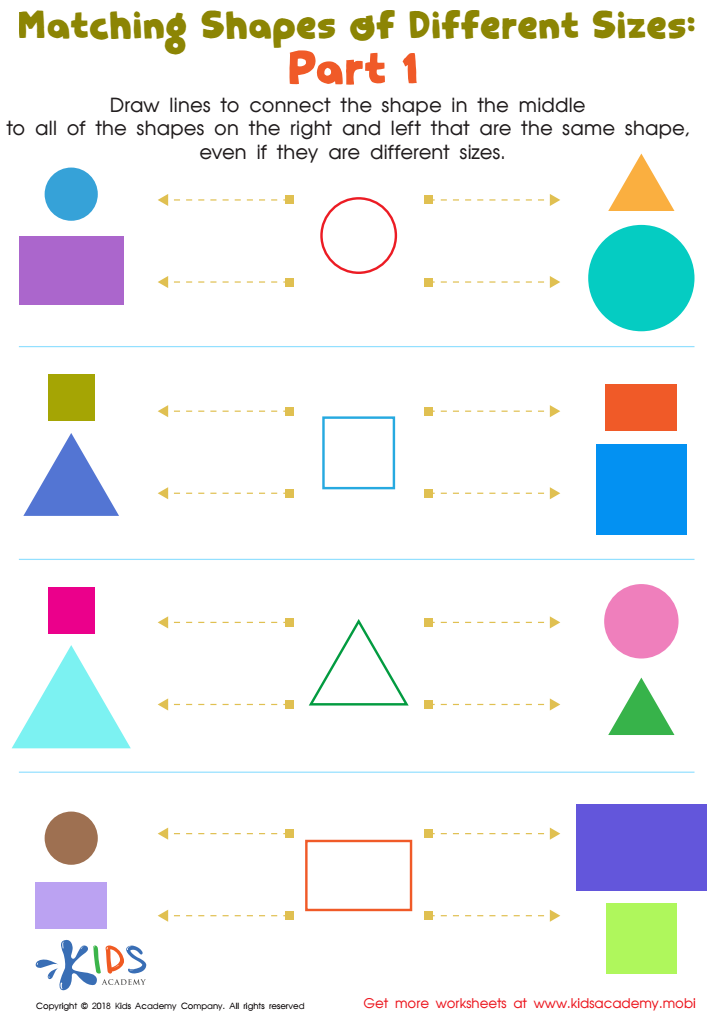
Geometry: part 1 Worksheet
 Assign to My Students
Ramps Worksheet
Easter Word Search Worksheet








Recognizing shapes is a fundamental skill for children aged 3-4 because it lays the groundwork for essential cognitive and motor development. Parents and teachers should care deeply about this early learning milestone for several reasons. Firstly, recognizing shapes helps young children develop visual discrimination skills, which are critical for reading and writing. When children identify shapes, they become adept at spotting differences and similarities, an ability that will assist them in recognizing letters and numbers later on.
Secondly, shapes are foundational to understanding mathematics. By learning about circles, squares, and triangles, children start to grasp basic geometric principles and spatial relationships. This early exposure is crucial as it sets the foundation for more complex mathematical concepts they will encounter in school. Additionally, talking about shapes enriches vocabulary. When children learn terms like “square,” “triangle,” and “circle,” they are also improving their language skills and ability to express themselves.
Moreover, shape recognition activities often involve hands-on play, such as sorting different shapes or assembling puzzles, which enhances fine motor skills and hand-eye coordination. These motor skills are important for tasks like writing, buttoning clothes, and using utensils. Lastly, engaging with shapes can spark creativity and imagination as children use simple shapes to create pictures and build structures, nurturing their artistic skills. Recognizing shapes might seem simple but its benefits are profound and long-lasting.








