Mental arithmetic skills Worksheets for Ages 3-6
3 filtered results
-
From - To
Boost your child's math proficiency with our engaging Mental Arithmetic Skills Worksheets, specially designed for ages 3-6. These worksheets provide fun and interactive exercises to enhance early math skills, helping young learners grasp essential concepts like counting, addition, and subtraction. Our thoughtfully crafted activities encourage critical thinking, boost confidence, and make learning arithmetic enjoyable. Parents and teachers can use these resources to create a structured learning environment, sparking a love for mathematics from an early age. Discover the joy of learning with our vibrant, easy-to-use worksheets that promote essential cognitive development and prepare your child for future academic success!
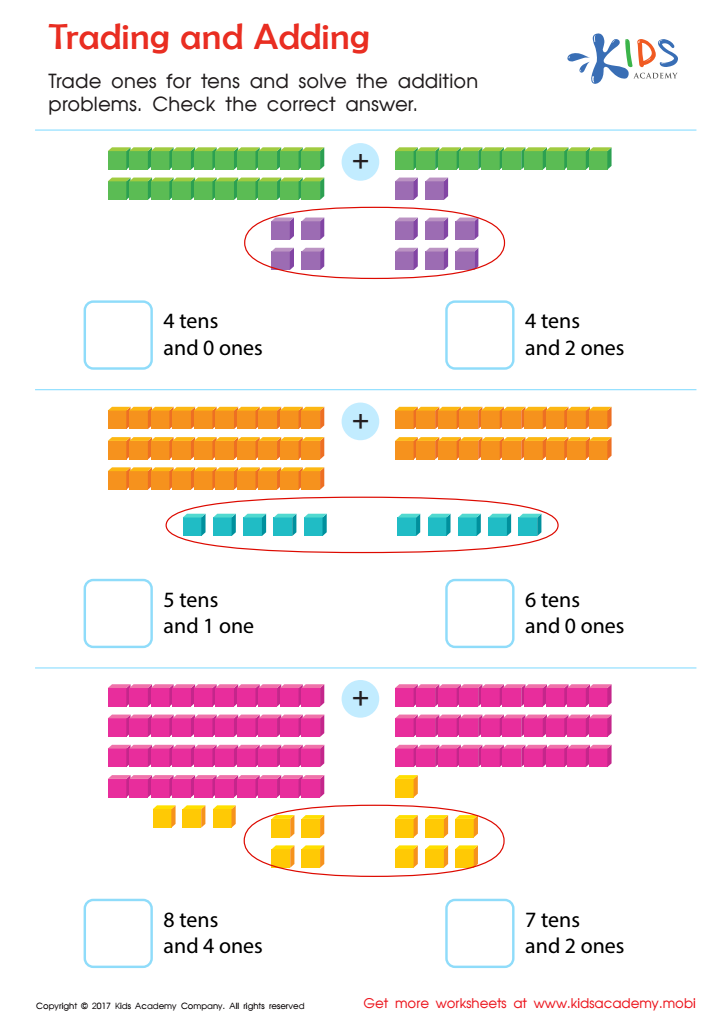
Trading and Adding Worksheet
 Assign to My Students








Parents and teachers should prioritize mental arithmetic skills for children aged 3-6 because these foundational skills significantly contribute to a child's cognitive development and academic success. At this age, children are naturally inclined to explore numbers through play and everyday experiences. Engaging them in mental arithmetic reinforces their understanding of basic mathematical concepts, enhances problem-solving abilities, and builds critical thinking skills.
Moreover, mental arithmetic develops a child’s confidence and fluency in mathematics. When young learners overcome simple calculations mentally, they gain a sense of accomplishment, fostering a positive attitude towards learning. This confidence can lead to greater engagement and resilience when faced with more challenging mathematical concepts in later years.
Early mental arithmetic also supports language development, as children learn to verbalize their thought processes and articulate numerical reasoning. Furthermore, these skills are interrelated with other learning areas, such as science and logic, helping children make connections across subjects.
In addition, nurturing mental arithmetic skills can help bridge any educational gaps and prepare children for more advanced concepts. Thus, investment in these skills during early childhood can set the stage for a lifelong positive relationship with mathematics and learning overall.








