
Number formation Worksheets for Ages 3-6
3 filtered results
Difficulty Level
Grade
Age
-
From - To
Subject
Activity
Standards
Welcome to our engaging "Number Formation Worksheets for Ages 3-6" page! Designed to support young learners in mastering number writing, these worksheets provide a fun and interactive way for children to develop their fine motor skills and number recognition. With colorful illustrations and easy-to-follow exercises, our resources encourage creativity while reinforcing essential math concepts. Worksheets focus on tracing, writing, and identifying numbers, making learning a joyful experience. Parents and teachers can seamlessly integrate these printable resources into educational activities, fostering early math skills that pave the way for future success. Start your child’s numeracy journey today with our delightful worksheets!
Favorites
With answer key
Interactive
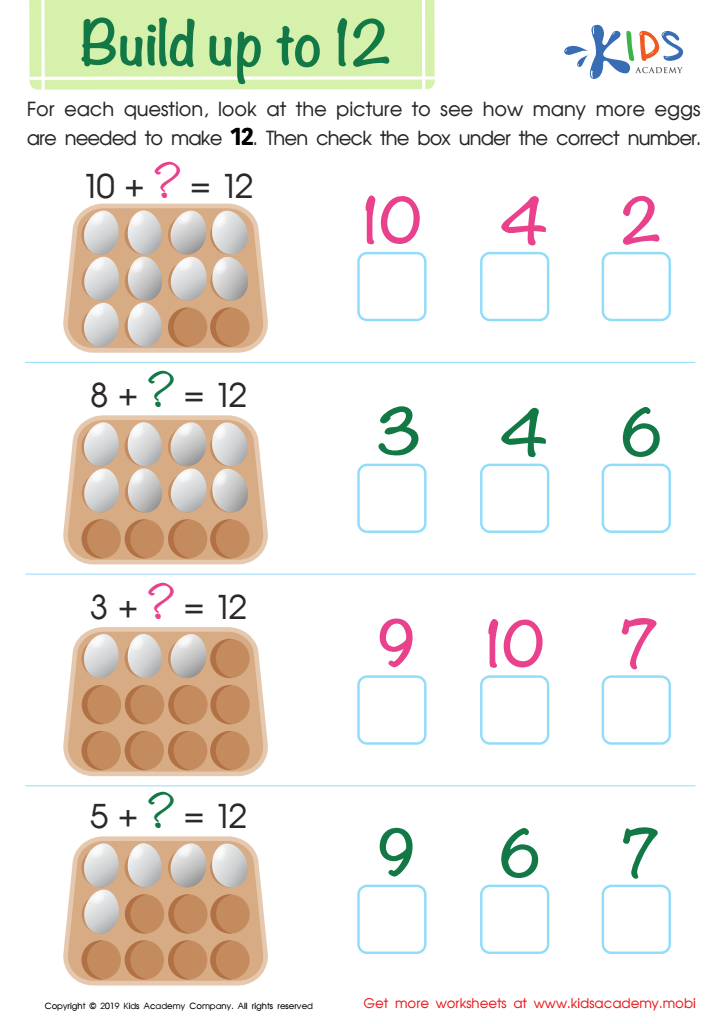
Build up to 12 Worksheet
Love eggs? Kids can identify them in the picture in this worksheet. We need to add numbers to make 12. Look at the picture and see how many eggs are needed. Check the correct number box. Breakfast or baking, eggs are essential!
 Assign to My Students
Build up to 12 Worksheet
Worksheet
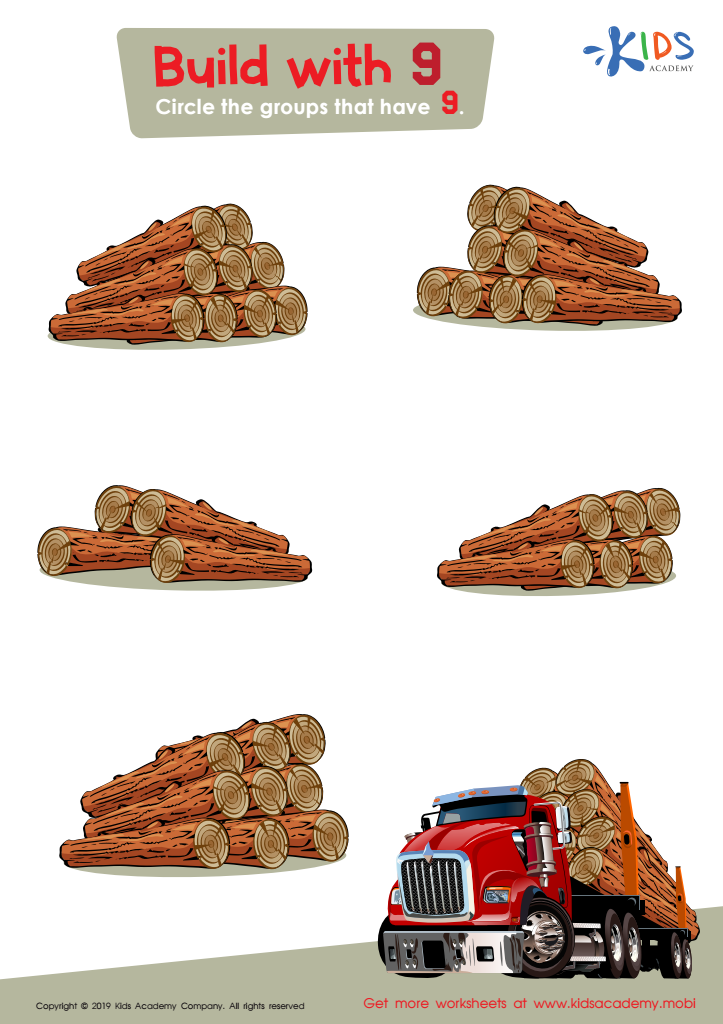
Build with 9 Worksheet
Your students' learning journey can be challenging, but ultimately rewarding. This worksheet helps them practice counting: count the logs in all the groups and circle those with 9 logs.
Build with 9 Worksheet
Worksheet
Join Kids Academy for Free
Who is primarily going to use this learning content?








Number formation is crucial for children aged 3-6 as it lays the foundational skills needed for mathematical understanding and overall literacy. During these formative years, young children are developing essential cognitive skills, and learning to form numbers correctly helps to foster a sense of order and clarity in their mathematical thinking. Proper number formation enhances fine motor skills, as children practice holding writing tools, controlling their movements, and developing hand-eye coordination.
Moreover, learning to form numbers accurately promotes confidence in young learners. When children feel competent in writing and recognizing numbers, they are more likely to engage actively in math-related activities, boosting their interest in learning. This early encouragement in number skills sets the stage for more complex mathematical concepts in later years, reducing anxiety and building a positive attitude towards mathematics.
Additionally, teachers and parents play a critical role in supporting number formation by offering appropriate materials and strategies, fostering an environment where practice is encouraged, yet pressure is minimized. With consistent practice, children can internalize formations, enabling them to recognize patterns and connections in mathematics. By prioritizing number formation, adults help ensure that children develop the skills they need to be successful learners in mathematics and beyond.








