Basic counting skills Addition & Subtraction Worksheets for Ages 3-6
3 filtered results
-
From - To
Enhance your child's foundational math abilities with our engaging Addition and Subtraction worksheets designed for ages 3-6. These interactive resources focus on basic counting skills, providing fun and stimulating activities to reinforce early numeracy. Each worksheet encourages children to practice addition and subtraction through colorful illustrations and hands-on exercises, making learning enjoyable and effective. Ideal for home or classroom use, our materials foster essential skills while promoting confidence in young learners. Watch as your child transforms numbers into friends and develops a positive mindset toward math. Start their mathematical journey today with our safe, easy-to-use worksheets!
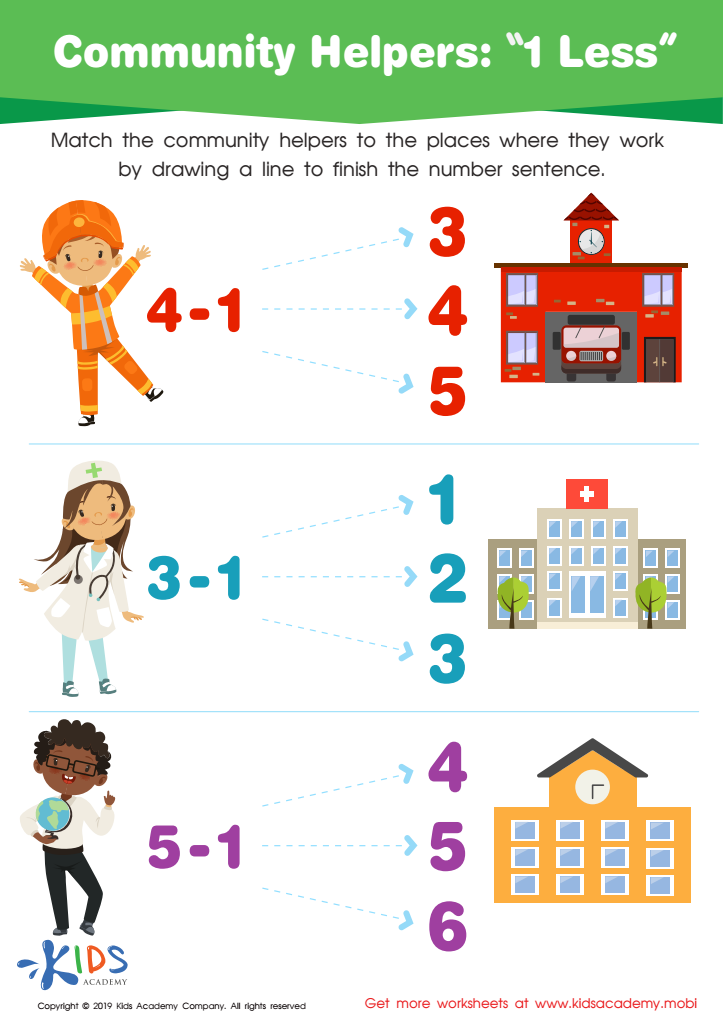
Community Helpers: 1 less Worksheet
 Assign to My Students








Basic counting skills, addition, and subtraction are foundational for a child's early cognitive development. Between ages 3-6, children's brains are highly receptive to learning new concepts, making this an ideal window for introducing mathematical skills. Developing counting skills enhances number sense, which is critical for children to understand quantity and relationships between numbers.
When children grasp addition and subtraction, they begin to understand how numbers work together to form new values, fostering critical thinking and problem-solving abilities. This early exposure supports future mathematical learning, paving the way for success in higher-level math and related fields.
Moreover, these skills also play an essential role in children's everyday lives; from sharing toys to counting steps, basic math fosters independence and supports social interactions among peers.
Parents and teachers serve as vital influences in nurturing these skills through engaging activities and playful learning experiences. Early attention to basic counting and calculations promotes confidence in math, reducing anxiety around the subject as children grow older. Investing in the development of these early math skills ultimately leads to lifelong learners who appreciate and engage with mathematics positively. This investment benefits not just individual children but broader society by empowering the next generation.








