
Spatial awareness Building Vocabulary Worksheets for Ages 3-6
3 filtered results
Difficulty Level
Grade
Age
-
From - To
Subject
Activity
Standards
Our "Spatial Awareness Building Vocabulary Worksheets for Ages 3-6" are designed to support young learners in developing crucial skills for understanding spatial concepts. Through engaging and age-appropriate activities, children are introduced to concepts like 'above,' 'below,' 'beside,' and more. These worksheets are perfect for early learners, encouraging vocabulary development and enhancing their ability to comprehend and navigate their environment. Our structured, fun approach helps children grasp these foundational terms, setting the stage for advanced learning in math, reading, and beyond. Equip your little ones with the tools to build confidence and enrich their cognitive abilities with our expertly crafted worksheets.
Favorites
With answer key
Interactive
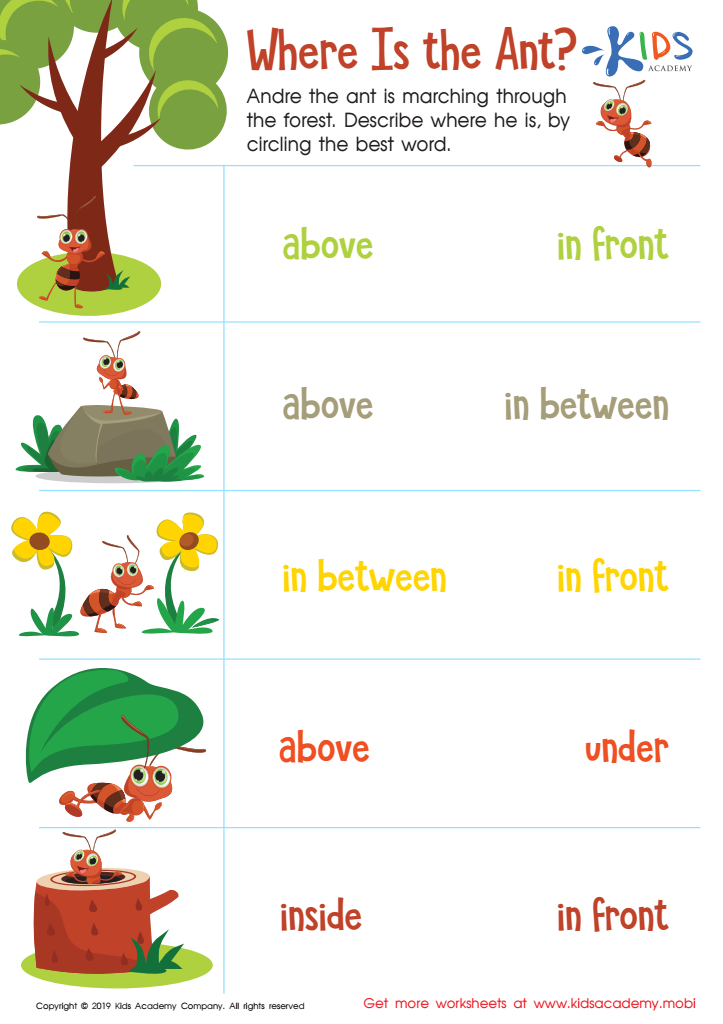
Where Is the Ant? Worksheet
Kids are captivated by ants. Andre is a busy ant, marching through the forest. Help your child circle the best word that best describes what he's doing in each picture. This colorful printout will show them the way.
 Assign to My Students
Where Is the Ant? Worksheet
Worksheet











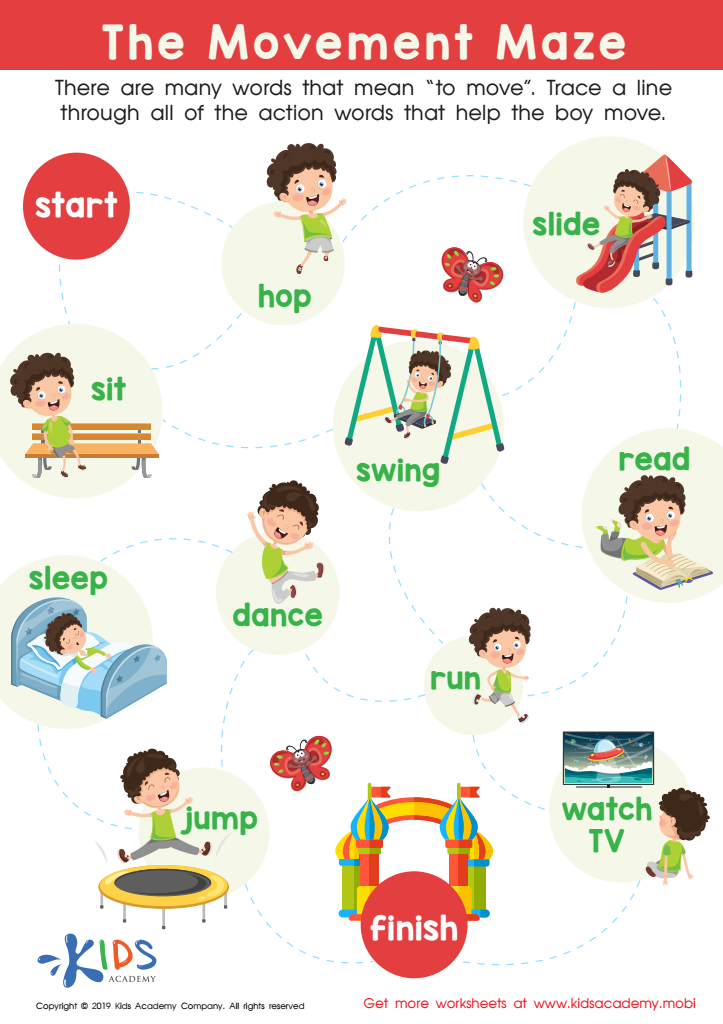
The Movement Maze Worksheet
Let your child have fun with this interactive PDF download. Kids will learn movement words with cute pictures, plus practice fine motor skills as they trace. A fun way to reinforce vocabulary. Jump, hop and sit – it's all here!
The Movement Maze Worksheet
Worksheet
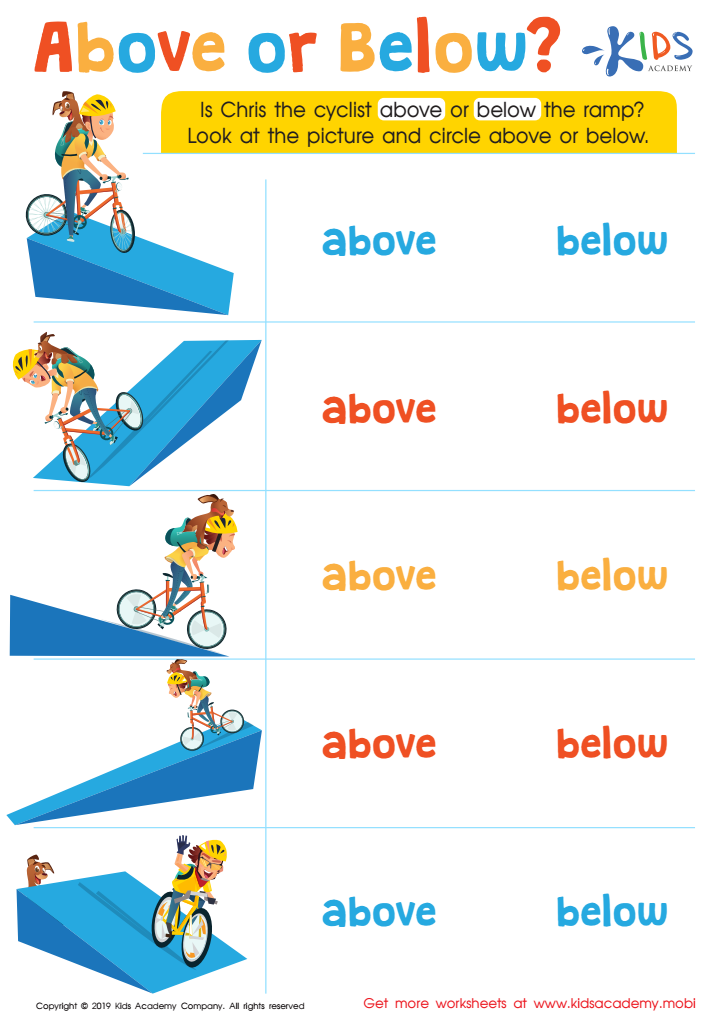
Above or Below? Worksheet
Do your kids cycle? Chris is a cyclist practicing on a ramp. Look at the pictures with them and decide if Chris is above or below the ramp. It's an important skill to help your kids become fluent speakers and writers - using the right words to describe something. Cycling is a fun sporting event.
Above or Below? Worksheet
Worksheet
Join Kids Academy for Free
Who is primarily going to use this learning content?


.jpg)





Spatial awareness and building vocabulary are crucial aspects of early childhood development that deserve attention from parents and teachers. Spatial awareness—the understanding of where one's body is in space and its relationship to other objects—plays a key role in developing motor skills, problem-solving abilities, and even mathematics. Children who can navigate their physical world skillfully are better equipped for tasks ranging from riding a bike to assembling puzzles.
Vocabulary building, meanwhile, is fundamental for effective communication and literacy. A robust vocabulary allows young children to express their thoughts, ask questions, and understand the world around them. It forms the foundation for reading comprehension, critical thinking, and academic success later in life. Engaging in conversations, singing songs, reading aloud, and describing daily activities can significantly enhance a child’s vocabulary.
For ages 3-6, integrating these skills can be as simple as exploring new environments, cueing physical play, and using descriptive language. For example, giving directions like “Put the block under the table,” fosters spatial understanding while also expanding language. Knowing terms like "under," "over," "next to," and "between" enhances both spatial and verbal acuity. Prioritizing these areas during early childhood promotes a rounded, well-prepared learner, setting the stage for lifelong success.








