Categorization skills World Around Us Worksheets for Ages 3-6
3 filtered results
-
From - To
Introduce your little learners to the fascinating world of categorization with our "World Around Us Worksheets" designed for ages 3-6. These engaging and interactive worksheets help young children develop essential categorization skills by exploring the environment around them. From grouping animals and plants to classifying everyday objects, these activities enhance critical thinking and boost vocabulary. Aligned with early childhood education standards, our worksheets provide a fun and effective way for kids to understand relationships and similarities among various items. Encourage your child's curiosity and cognitive growth, making learning a playful adventure with our thoughtfully crafted categorization worksheets!
 Assign to My Students
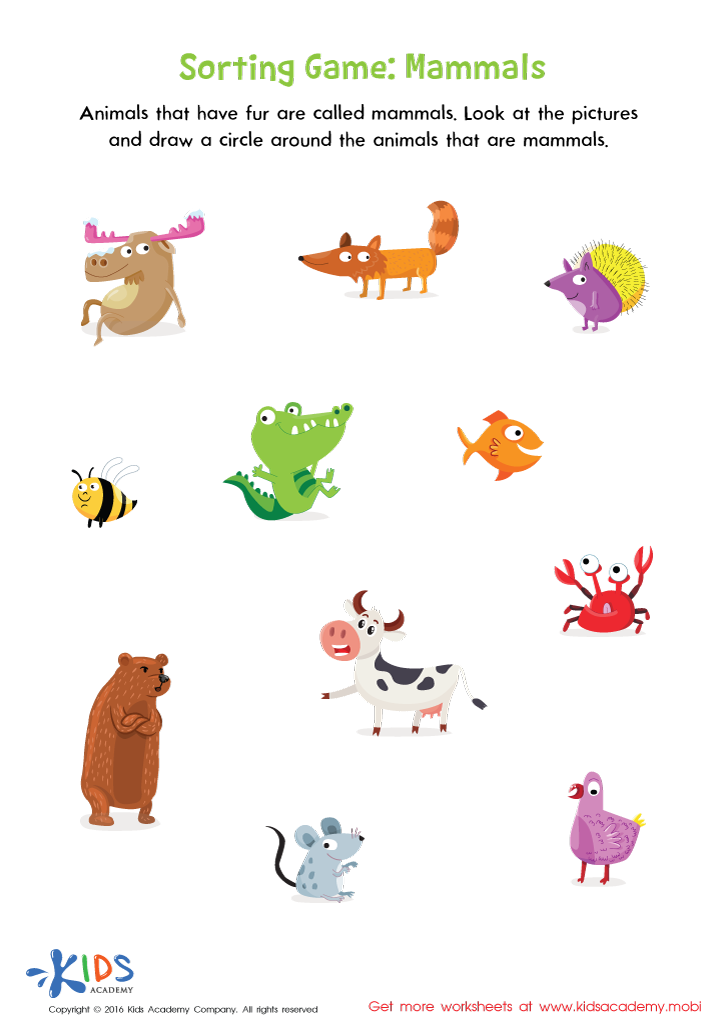
Mammals Sorting Worksheet

Identifying Living or Non–living Worksheet







Categorization skills, or the ability to group items based on shared characteristics, are crucial for children aged 3-6 as they lay the foundation for cognitive development and critical thinking. Parents and teachers should prioritize these skills because they significantly enrich a child's understanding of the world around them.
First, categorization helps children make sense of their environment. By grouping items, such as colors, shapes, or sizes, children learn to recognize patterns, which enhances their problem-solving abilities. For instance, categorizing fruits by color aids in language development by expanding their vocabulary and improving articulation.
Additionally, strong categorization skills support social learning. When children classify objects or ideas, they often engage in discussions with peers, promoting communication skills and collaborative learning. This interaction also fosters emotional intelligence as they learn empathy and respect for different perspectives.
Furthermore, categorization lays the groundwork for future academic success in subjects like math and science, where categorizing and organizing data is essential. By engaging with the world through categorization, children build confidence and curiosity, equipping them to navigate complex concepts as they grow. Investing time in developing these skills ensures a solid foundation for lifelong learning and adaptability in a rapidly changing world.