
Understanding suffixes Grammar Worksheets for Ages 3-6
3 filtered results
Difficulty Level
Grade
Age
-
From - To
Subject
Activity
Standards
Our "Understanding Suffixes Grammar Worksheets for Ages 3-6" make learning fun and engaging! Designed for young learners, these printable worksheets help children grasp the basics of adding suffixes to words. Activities are designed to enhance kids' reading, writing, and comprehension skills in a playful manner. With charming illustrations and simple exercises, children quickly learn how suffixes change meanings. Tailored for ages 3-6, these worksheets pave the way for early literacy success while keeping kids entertained and curious. Perfect for both classroom and at-home practice, our worksheets transform learning into a delightful adventure!
Favorites
With answer key
Interactive
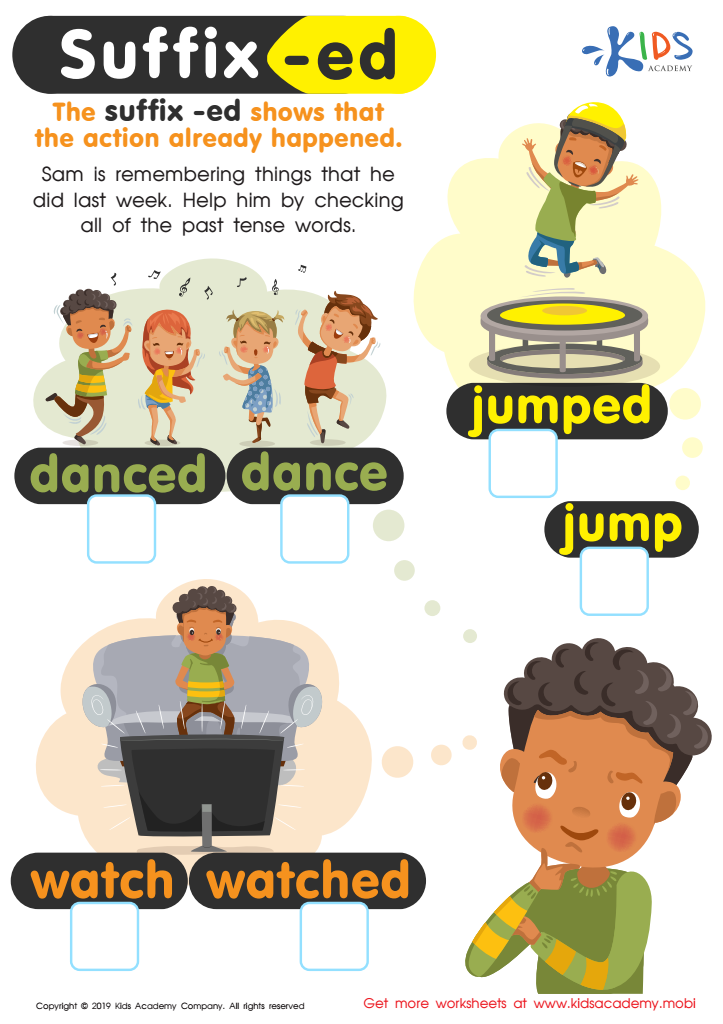
Suffix-ed Worksheet
Ask your kids if they know what suffixes are, and explain they are words added to the end of another word which changes the meaning. This worksheet focuses on the suffix -ed which shows something already happened. Help the kid in the picture find the past tense words.
 Assign to My Students
Suffix-ed Worksheet
Worksheet
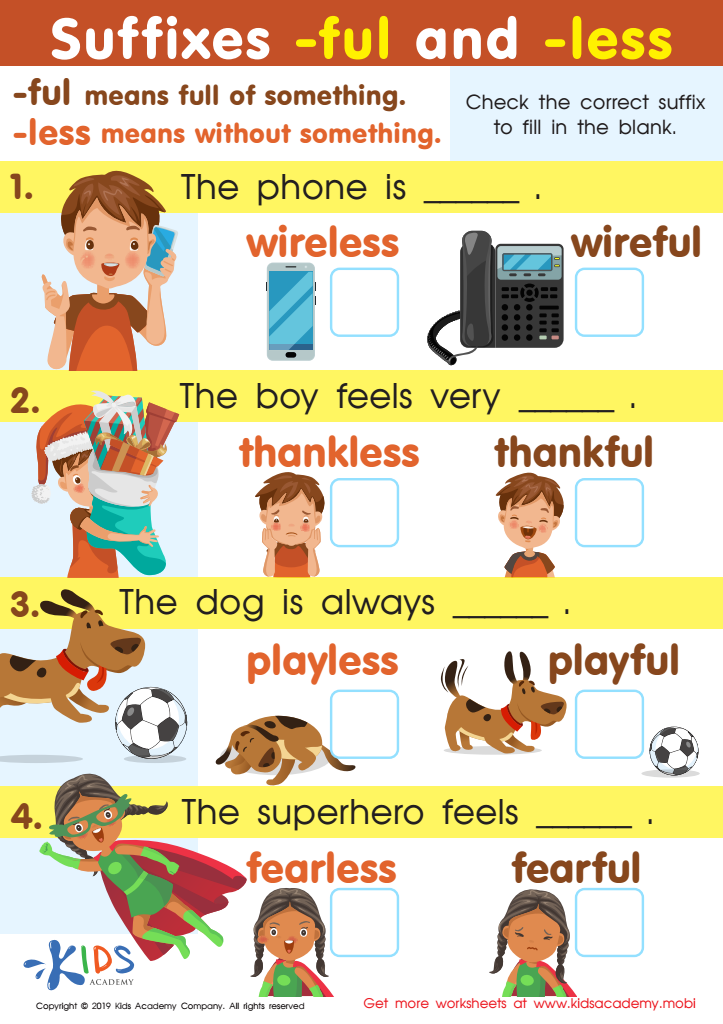
Suffixes –ful and –less Worksheet
Before you start this worksheet, make sure your kids know about suffixes. Explain that they're added to the end of words to change their meaning. In the worksheet, kids will learn about the suffixes –ful and –less. Look at the sentences in the picture with them, and help them to choose the right one for each blank.
Suffixes –ful and –less Worksheet
Worksheet
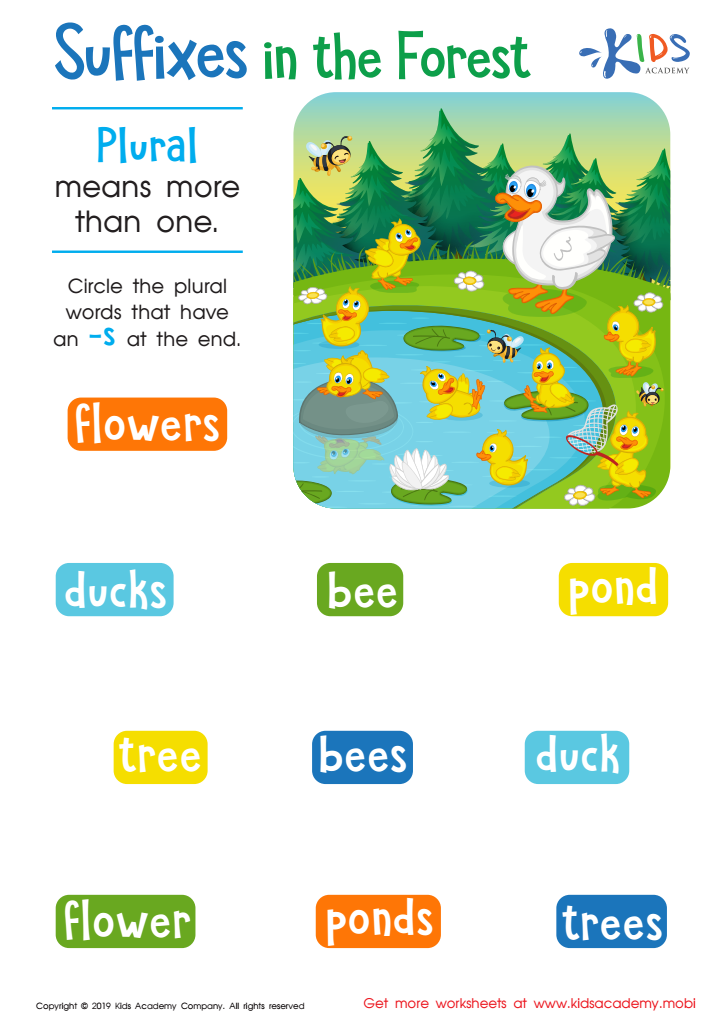
Suffixes in the Forest Worksheet
Suffixes are letters added to the end of words to form new words. These can be used to denote one who does something (e.g. reader) or more than one (e.g. adding -s). This worksheet helps kids practice pluralizing words they know by circling the plural words ending with -s.
Suffixes in the Forest Worksheet
Worksheet
Join Kids Academy for Free
Who is primarily going to use this learning content?




.jpg)


Understanding suffixes is crucial for young children as it lays the foundation for reading, writing, and general language development. At ages 3-6, children are in a prime stage to absorb new information. Learning about suffixes helps them make sense of the meaning and function of words, which enhances their vocabulary and linguistic skills.
For example, recognizing that adding "-ed" to the end of a verb can convey past tense (e.g., "talk" becomes "talked") helps children understand timelines and sequence in stories. Similarly, knowing that "-ing" signifies an ongoing action helps in comprehension and usage (e.g., "run" becomes "running"). Suffixes also aid in developing more complex words from basic ones, facilitating richer and more expressive communication.
From an educational perspective, grasping suffixes early on supports other literacy skills. It contributes to phonemic awareness, an essential reading skill where children learn to hear and manipulate sounds in words. This knowledge makes decoding new words easier and improves spelling abilities.
Parents and teachers should emphasize understanding suffixes because it ultimately contributes to a child's confidence and proficiency in communication. Engaging activities like word matching games, storytelling, and reading aloud can make learning suffixes fun and effective, setting a strong groundwork for future academic success.








