Analog Clock Understanding Worksheets for Ages 3-8
3 filtered results
-
From - To
Welcome to our "Analog Clock Understanding Worksheets for Ages 3-8"! These engaging printables are designed to introduce young learners to the world of telling time using analog clocks. Our worksheets feature a variety of fun activities, from coloring clocks to matching times, designed to enhance your child's understanding of hours and minutes. Each worksheet encourages hands-on learning through interactive and visual formats, making it easy for children to grasp this essential life skill. Perfect for home or classroom use, these resources support early literacy and numeracy development while keeping the learning experience enjoyable. Start your journey into time-telling today!
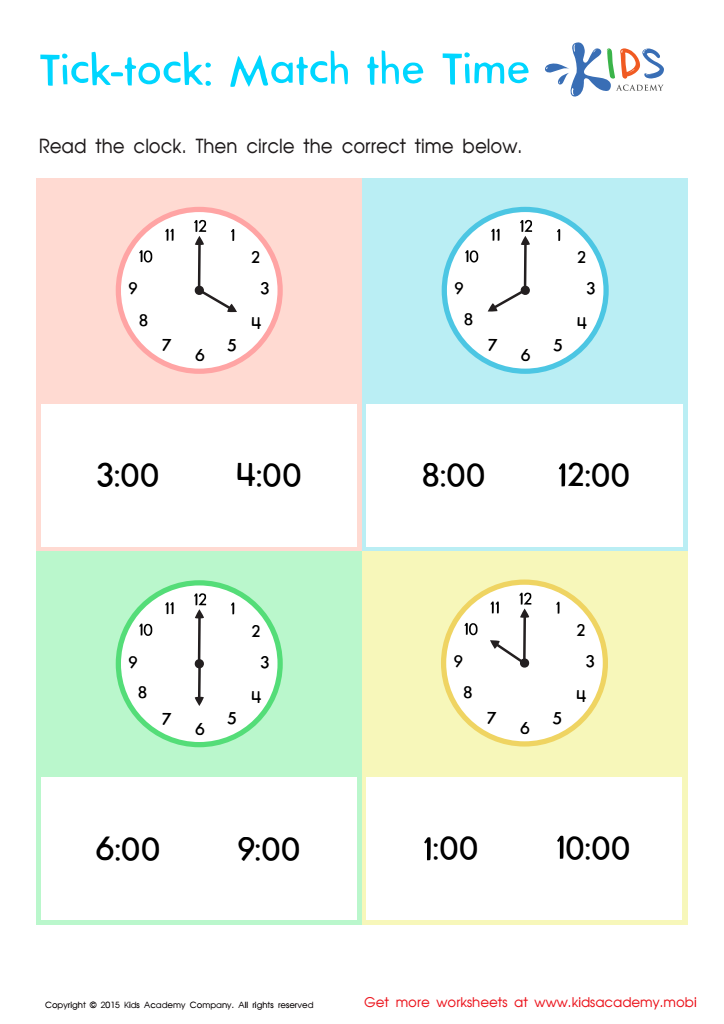
Telling The Time Worksheet: Part 4
 Assign to My Students
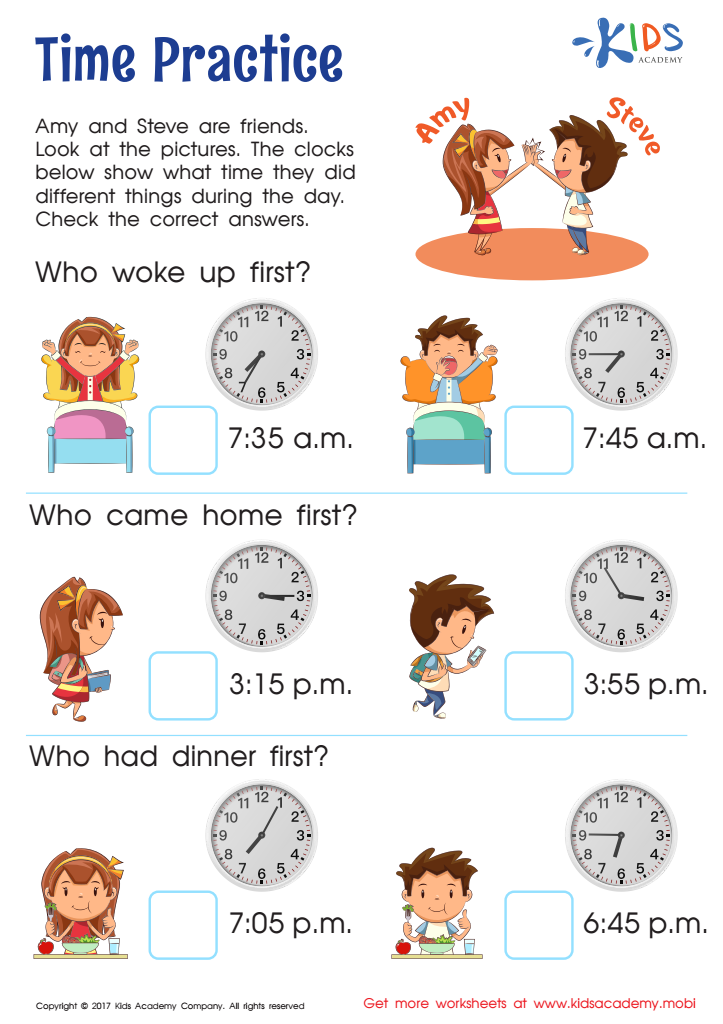
Time Practice Worksheet
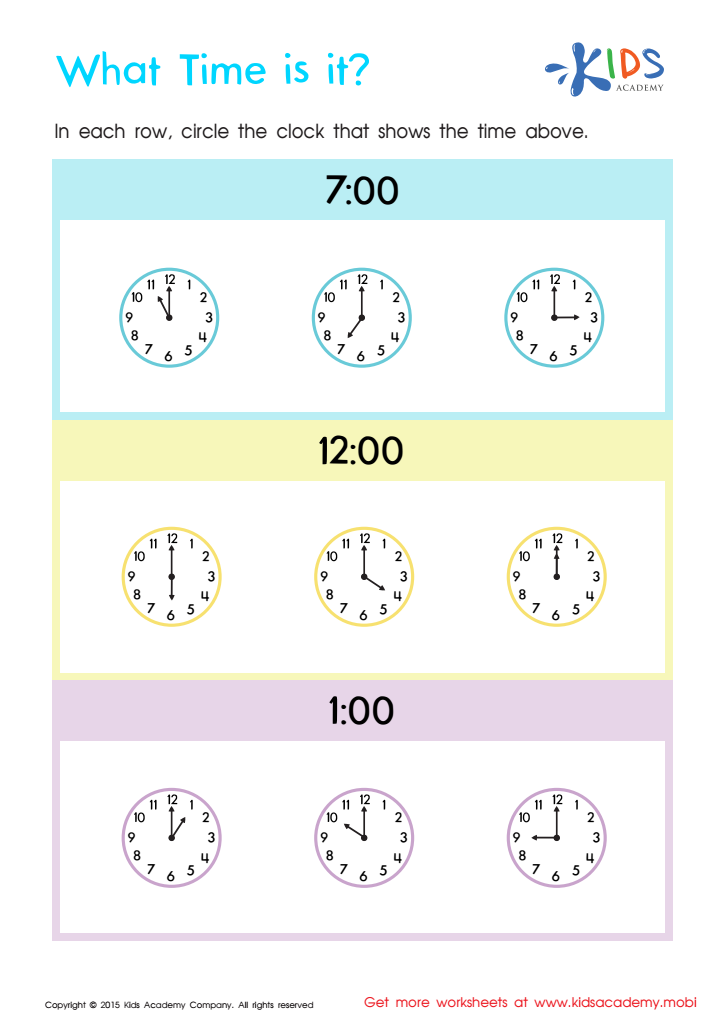
Telling The Time Worksheet: Part 3







Understanding analog clocks is essential for children aged 3-8 as it lays a foundational skill in time-telling that supports their daily routines and enhances their cognitive development. Unlike digital clocks, which provide a straightforward numerical representation, analog clocks encourage children to observe and interpret positions, helping sharpen their spatial awareness and critical thinking skills.
Learning to read an analog clock fosters a sense of responsibility and independence as children grasp the concept of time management, such as the duration of activities and the transition between tasks. Moreover, mastering this skill enables children to participate in conversations about time, enhancing their language and communication capabilities.
Furthermore, understanding time concepts—from hours to minutes—naturally integrates into broader math skills, promoting numerical fluency early on. It ties together addition and subtraction when calculating durations, thus reinforcing mathematical understanding in a practical context.
Additionally, since many clocks in classrooms, homes, and public spaces are still analog, helping children develop this competency ensures they can navigate their environment effectively. In summary, teaching children to read analog clocks cultivates essential life skills, bolsters mathematical abilities, and encourages independence and responsibility, making it an invaluable focus for parents and educators alike.








